
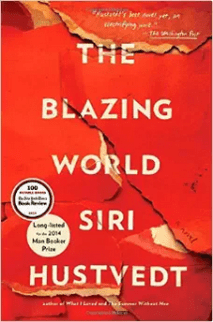
 Today is another review for the Literary Wives blogging club, in which we discuss the depiction of wives in fiction. If you have read the book, please participate by leaving comments on any of our blogs. Be sure to read the reviews and comments of the other wives!
Eva of Paperback Princess
Kate of Kate Rae Davis
Lynn of Smoke and Mirrors
Naomi of Consumed By Ink
TJ of My Book Strings
My Review
The Blazing World was one of my favorite books of 2015, so I won’t recap my review but instead provide you the link so that you can read my original review. Then I’ll go on with my comments for Literary Wives.
What does this book say about wives or the experience of being a wife?
Although Harriet is a widow at the beginning of the book, all her actions are centered around her experiences of being first a daughter and then a wife. She has been a good wife, but she has had no support from her art dealer husband for her art. She has sat quietly by and watched him claim credit for her ideas. Fiercely intelligent and original, she has become convinced that as an older woman, she is almost invisible. In fact, her entire focus on the project that she conceives and that drives the plot of the novel is fueled by anger at the paternalism of first her father and then her husband.
Unfortunately, she finds that the art world is paternalistic in just the same way, as she has trouble claiming her own art after conducting her experiment. This is a powerful novel about institutional sexism—particularly the difficulties women still have in being taken seriously in any realm except that of the household, but especially in the creative arts.

 What? Me Read?
I like that the author didn’t depict Harriet as being unhappy as a wife and mother. Even though she wasn’t getting the support from her husband she should have been getting for her work, she didn’t seem to focus on that fact until after his death. And she loved being a mother. There are so many books that show the wife and/or mother as being slowly suffocated by her role. But it’s not always so black and white.
Yes, that’s part of what makes it good. But her husband obviously didn’t think her career was important, just his.
And, unfortunately, many men and still like that.
I keep thinking Harriet was exhibiting the “love is blind” expression. And that it wasn’t until his death that she saw things clearly again.
I’m not sure what we know about that. But maybe, you’re right, she didn’t think about it until after he was gone. That doesn’t necessarily indicate she was happy. In fact, she was furious in retrospect.
Can you be happy and furious at the same time?
Here’s one question that popped into my mind when I thought about the book yesterday. Do you think Harriet was self-indulgent when it came to her anger? She has absolutely every right to be angry, but could we fault her for channeling that anger in a way that I thought had become almost self-destructive once she was planning to manipulate and use Rune to her advantage? (I’m not saying that that guy wasn’t aware he was being manipulated; he obviously did the same to Harriet.)
I don’t know.
I’ve enjoyed the discussion on your blogs about this novel; I wish I’d read it in time to participate as it sounds like a particularly good one for comparing responses!
It was certainly different, and we obviously had different opinions about it.