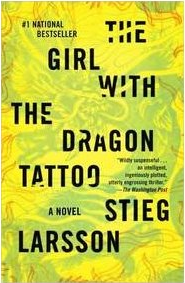
Day 32: The Girl with the Dragon Tattoo

Cover for The Girl with the Dragon TattooBest Book of Week 7!

Maybe everyone has read The Girl with the Dragon Tattoo by Stieg Larsson. But if you are one of the few who have not, you are missing an exciting thriller.

Editor and writer Mikael Blomkvist has just lost a libel case brought by a billionaire industrialist named Wennerström concerning Blomkvist’s allegations of corruption. Blomkvist has been sentenced to three months in prison. He had carefully checked his facts but then one of his witnesses recanted. In order to separate his magazine, Millenium, from this problem, he resigns.

After he gets out of jail, he is approached for a job by Henrik Vanger, the retired head of Vanger Corporation. Vanger wants Blomkvist to find out what happened to his great-niece Harriet, who disappeared off the family’s private island 36 years earlier during a day when the island was cut off from the mainland by an accident blocking the only bridge. He is afraid that some member of his family murdered her. He yearly receives a pressed flower on his niece’s birthday and believes the killer is expressing remorse through this means.

Although Blomkvist is initially reluctant, he eventually accepts the job and goes to live on the island. When he decides he needs a research assistant, Vanger’s lawyer connects him with Lisbeth Salander, a child-sized woman who dresses in a goth style and has a dragon tattoo.

Salander is a computer genius with a difficult past. When she was a teenager, she was institutionalized and is still under the care of a legal guardian, who controls her money and can have her institutionalized at any time. She is hostile and uncommunicative, and few people have bothered to try to get to know her. After her guardian has a stroke, he is replaced by Nils Bjurman, who uses his position to sexually abuse her.

Bjurman has seriously misjudged Salander, however, and she takes care of this problem in one of the most satisfying scenes of the novel.

As Blomkvist and Salander investigate Harriet Vanger’s disappearance, they begin to believe that they may be on the track of a serial killer. Ultimately, Blomkvist finds himself in grave danger.

With a complex, interesting plot, an engaging hero and formidable heroine, a slew of interesting characters, and a sense of Swedish politics and law, you will lap up this book and go looking for the next one. Larsson was an activist with strong feelings about violence against women, a theme in all of his books.

Day 31: Look at Me

Cover for Look at MeIn Look at Me, Jennifer Egan explores the meaning of identity in the modern world, where new identities can easily be created with a few clicks of a mouse. This academic beginning to my review should not dissuade you from reading this absorbing book.

Charlotte Swenson is a fashion model just recovering from surgery after a horrific car accident that smashed every bone in her face. The accident happened near her home town of Rockport, Illinios, which she has not visited in years. She is vague about what happened and what she was doing there: it is hard to tell at the beginning whether she can’t remember or doesn’t want to tell. When she returns to her home in New York, she finds that not even her closest friends recognize her new face. She has become invisible.

Before she leaves for New York, Charlotte meets Charlotte Hauser, the plain sixteen-year-old daughter of her best friend from high school, whom Charlotte has also not seen in years. The younger Charlotte has met a man on a river bank who looks like he has been in an accident.

In New York Charlotte Swenson is futilely trying to resurrect her career when she hears from a private detective who is looking for a mysterious man she met a few times named Z.

In the meantime, Charlotte Hauser has begun studying with her uncle Moose, whose life was changed when he had a revelation about light and history as a young man. Moose has been trying to find a student who can take up his ideas and thinks that Charlotte may be that person. He has struggled with mental problems and was forced to leave a prestigious job in academia to teach part time at a local community college.

Because she made a “timing error” in her first sexual explorations, Charlotte has been ostracized from her high school crowd and has decided to change schools to the rougher one across the river. She is also having an affair with the man she met along the river bank.

Charlotte Swenson has always looked for a way into the “mirrored room” of fame and fortune. Now, without her famous face, she is depressed and struggling to pay the rent until an internet intrepreneur comes to her with a tempting proposal.

Egan skillfully weaves these characters’ stories into an engrossing, thought-provoking novel. Some critics felt the novel suffered from the focus on the empty life of the glitterati that fascinates Charlotte, and truthfully, sometimes you sincerely dislike her. But you also like her pluck and self-truthfulness, and the focus is necessary to the novel’s themes.

Day 30: Never End

Cover of Never EndNever End by Åke Edwardson is an interesting police procedural. A young woman is raped in the park during a sweltering summer evening in Gothenburg. What concerns the police even more than the rape is the fact that it took place in the same alcove where a girl of the same age was murdered five years ago. Jeanette, the victim, was also choked with something, perhaps a dog leash, while the murdered girl was strangled with her own belt.

Chief Inspector Erik Winter leads the investigation, and Inspector Handler tries to help while dealing with his ex-wife’s death.

The characters were interesting and the solution was difficult to guess. I have read a couple of Erik Winter books so far, and I still find myself unable to get much of a sense of the personalities of Winter and the other detectives. Edwardson provides some personal information about his detectives: Winter is happily married with a young son, and he is grappling with the idea of how much time his work takes away from his family; he is also battling with nicotine withdrawal. But Edwardson really concentrates on the methods and findings of the investigation. Perhaps as you read through the series, you slowly develop an idea of what the recurring characters are like.

Day 29: The Winter Sea

Cover for The Winter SeaLet me start out by saying that this is not my kind of book. There are carefully researched and plausible historical novels that make you feel like you understand the time and place and that may or may not include a romance. Then there are romance novels that just happen to be placed in a historical time but otherwise read as if the writer did not bother looking up a single fact. And there are all ranges in between. Despite the notes from Susanna Kearsley about her research, I would locate The Winter Sea closer to the latter end of this range.

Carrie is a writer working on a novel about one of the Jacobite rebellions. She has been living in France where all the intrigue went on, but she isn’t getting into her novel. On a visit to her agent in Scotland, she is attracted to a ruined castle. When she hears that part of the rebellion was based there, she decides to move to the nearby village, and on a suggestion by her agent, make her main character a woman. She arbitrarily picks Sophia Paterson, her own ancestor.

She begins to imagine vivid scenes, which interleave the modern story. But when she checks the facts surrounding these scenes, she finds the details are actually correct. After awhile she decides the explanation must be that she carries her ancestor’s genetic memory in her DNA, an explanation so absurd that it dumbfounded me.

The modern author’s romance with her landlord’s son is interspersed with the story she is writing about Sophia’s romance with a young Jacobite. Although the story reflects some historical research, the focus is on the romance. The dialogue in the historical section is awful, as if the writer thought all she had to do to make it authentic was stick the word “did” in constantly. (“I did arrive from Edinburgh last month.”) I almost quit reading because I could barely stand to read the dialogue. I would rather have the writer use modern English than patently fake and unconvincing archaic English.

Had the author based the writer’s insights on some form of second sight–they are in Scotland after all–I would have found that explanation more acceptable than the pseudo-scientific claptrap. Avoid this one unless you absolutely don’t care about any historical or scientific authenticity.

Day 28: Dance with Death

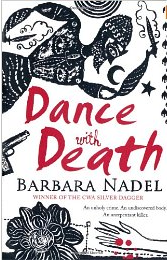
Barbara Nadel’s Turkish mystery novels are interesting because they usually involve one of the many minorities of Istanbul. Dance with Death takes place in the fascinating region of Cappodocia rather than in Istanbul, though. Inspector Çetin İkmen gets a call from his cousin asking him to come to Cappodocia. A body has been found in a cave, and his cousin believes it may be that of a girl with whom he was in love years ago. This girl, who was rambling around the Europe and then Turkey on vacation, simply disappeared, and he thought she had left him.

In the meantime, his colleague Mehmet Süleyman is still in Istanbul trying to catch an attacker of homosexuals.

Nadel’s Turkish mysteries are filled with detail about place and customs that I find irresistable. I almost always guess the killer fairly early, but sometimes this is my test of a mystery. If I still find it interesting even when I guess the solution, then it is worth reading. Dance with Death is full of the color of that mysterious region, and İkmen and Süleyman are sympathetic and interesting characters.

Except for one thing. A theme of men’s unfaithfulness runs through the books. Both Inspector İkmenand Süleyman have been unfaithful, even though they love their wives. I’m not sure if that is meant to indicate something cultural or not.

Day 27: Major Pettigrew’s Last Stand

Cover for Major Pettigrew's Last StandBest Book of Week 6!

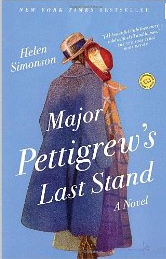
A touching love story, Major Pettigrew’s Last Stand is also a wry and witty jibe at small village life in England. Major Pettigrew is a proper widower who leads a life of quiet and habit, comfortable in his village and local golf club. Still suffering from the loss of his wife, he has just learned about his brother’s death and he is so shaken by this that he has a dizzy spell. Mrs. Ali, the widow of a Pakistani grocery store owner, has come to his house collecting for charity and helps him recover. The two begin a friendship based around discussions of books.

Besides missing his brother and wife, Major Pettigrew has other worries. He is concerned about his son, who seems only interested in money and prestige, and at times lacks gentility and honor, for which Major Pettigrew cares deeply. He is also concerned about his brother’s greedy wife and daughter, who do not seem likely to honor his father’s request that two valuable heirloom shotguns given to each of the sons be reunited when one of them dies.

Mrs. Ali is having her own battle with relatives. Her husband’s family wants her to give over her store to her religious fundamentalist nephew while she takes her expected widow’s place as a family servant.

Major Pettigrew must navigate the murky waters of village and family disapproval of his relationship because of racism and class snobbery and decide how much he wants to keep his quiet life. Mrs. Ali must in turn decide how much duty she owes to her family.

This novel is charming and delightful, one of my favorite books of 2011. Major Pettigrew’s dry and clever comments amused me throughout. The novel is beautifully written. I have been eagerly waiting to see what Ms. Simonson does next.

Day 26: Love, Poverty, and War

Cover for Love, Poverty, and WarEssays are not really my genre since I was terrorized by Ralph Waldo Emerson and Henry David Thoreau in my teens, but I’ll give this a try.

Love, Poverty, and War is a collection of articles written by Christopher Hitchens between 1998 and 2005. It is a mixed bag containing book reviews, biographical opinion pieces, travelogues, and political polemics. I have read that he has said or written something to irritate everyone. I found him scarily intelligent and well-informed, although he has also been accused of picking his facts and disregarding those that don’t agree with his beliefs. He has a strong opinion about everything, it seems.

Hitchens’s book reviews are difficult for me to assess because I had not read a single one of the books (although I had read the authors) except Brave New World, which I read about 1970. I thought it was curious that most of the literature he reviews was written before the 1960s. Those reviews are included in the section called “Love,” so I suppose they are some of his favorite classic authors, but his selections made me wonder how he picked the essays to include in this book (if he did). I loved his review of a book by some academic that compared Bob Dylan’s songs to religious poetry by counting how many words the pieces had in common. His comments on this methodology are hilarious.

His portrait of Churchill was startling and shocking to me, as it was almost entirely negative. But then I started wondering about why it is included in the section called “Love” along with essays about Kipling, Kingsley Amis, and Orwell. I decided that he is fascinated by people of contradictions, although certainly he does not appreciate hypocrites.

I regret to say that I am not familiar enough with the details of events he discusses under “War.” For example, he repeatedly brings up the U.S. bombing of a Sudanese chemical plant, which I don’t recollect at all. He has been criticized for a shift from leftist to rightist politics because of his opinions about the U.S. handling (or lack thereof) of Salman Rushdie’s situation when he was under fatwa and then his reaction to 9/11 and the attacks following. I noticed that between essays he certainly shifted his position on the Sudanese bombing, maintaining at first that the factory produced aspirin and later that there were strong indications that it was used to produce WMD.

I didn’t see this as a political shift as much as the result of his knowledge of the situations in Iraq and Afghanistan and an honest abhorrence of some of the left-wing apologists after 9/11. Unfortunately, it seems that some of his optimism about the interventions in Iraq and Afghanistan was a bit premature.

Hitchens is sharp and witty. I laughed out loud frequently even if I didn’t agree with him. However, if you are not very familiar with the events he discusses, he is sometimes hard to follow. And since these are essays, he does not cite his sources. Sometimes he states things as facts that make me wonder where he got his information.

Day 25: Shiloh

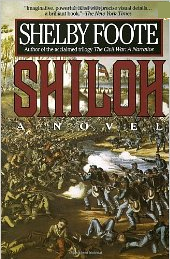
Cover to ShilohIn Shiloh, the historian and novelist Shelby Foote has written an interesting fictional account that describes the battle from the points of view of several different narrators, some on the Union side and some on the Confederate. Each narrator has his own chapter. In these brief narratives you get a sense of the character while being able to trace the larger movements of the battle.

Foote manages to work into the narratives the major events, such as the death of General Johnston; the surviving Confederate leadership’s failure to follow Forrest’s recommendation of attacking again at night, which probably would have ended in victory for the Confederates; the 10,000 Union “shirkers” who hid along the riverbank after they became dispirited from having to pull back time after time; and the river crossing by Buell’s troops, which turned the tables in the Union’s favor.

Lieutenant Palmer Metcalfe is marching with the Confederate army under Johnston as it prepares for a surprise attack on the Union troops. He thinks back with satisfaction to the complicated plan he helped draft, as he is a staff officer under Johnson. The noisy troops may have lost the element of surprise, but Johnston insists upon attacking.

Captain Walter Fountain is a Union soldier writing a letter to his wife Martha during a Tennessee evening when the Confederate troops burst out of the woods and charge the Union army.

Private Luther Dade is wounded in battle and is sent to a triage area to wait for a doctor. After hours pass and no doctor shows up, Dade begins to show signs of infection. He stumbles around across a large swathe of the battle area and finds himself witnessing the death of the Confederate commander Johnston.

So the novel proceeds in short chapters that culminate with a return to Lieutenant Metcalfe as he reviews the results of the battle. The characters are briefly drawn but have distinct personalities. Through following the peregrinations of the various characters and with the assistance of the maps in the book, you can get a good understanding of the complex battle and why the initially successful attack ultimately failed.

Day 24: Great House

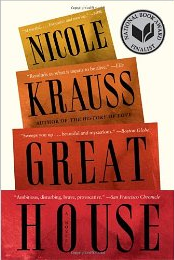
The tale this collection tells is so complex that my book club members asked me to send them an email explaining the sequence of events, once I had figured it out. Great House by Nicole Krauss is written as a series of interleaved stories without regard to sequence, almost as if she wrote the stories in order as a novel and then cut it up into pieces and rearranged it. The effect is interesting, but it is difficult for readers to understand where they are in time as they go from one story to another.

A labyrinthine tangle of people’s stories is written around the migration of a desk from one person to another. Nadia, a writer, tells the story of how she accepted the loan of furniture from Daniel, a Chilean poet, who was soon after murdered by Pinochet’s regime. Years later, a woman comes to her claiming to be Daniel’s daughter and asking for the desk, so Nadia gives it to her.

Arthur, the husband of Lotte, the writer who gave Daniel the desk, finds a secret while he is going through his dying wife’s things. This secret may be the clue to where Lotte got the desk.

Nadia goes looking for the desk to ask for it back because she finds she cannot write without it. She eventually finds herself in Israel. Other characters encounter the desk, are affected by the search, or meet Nadia or each other. We find out that the woman who claimed the desk was not the daughter of Daniel after all, but the daughter of someone who has an even better claim to it, as his family lost it in the holocaust.

Most of the members of my book club were perplexed, and many of them did not like any of the characters. I had a more neutral reaction. The desk eventually comes to represent all of the things that were lost in the holocaust. The stories as a whole are demanding and interesting, and Krauss purposefully leaves you with unanswered questions.

Day 23: The Dead Lie Down

Cover for The Dead Lie DownBest Book of Week 5!

Sophie Hannah is another writer of dark mysteries who I discovered during the past year. The Dead Lie Down was the first of her books that I read, not the first in the series. Be careful if you buy her books as some of them have two titles, depending upon whether you buy the British or the American version. I have bought two copies of the same book by mistake.

Ruth did something bad in the past but was punished far out of proportion to her crime. She is still trying to recover some confidence and self-esteem when she meets Aidan, a picture framer. The night they get engaged, they make a pact to tell each other everything and forgive each other their secrets, with no questions asked. But Ruth is shocked when Aidan confesses he strangled a woman named Mary Trelease years ago. She is even more confused when she realizes that she has met Mary Trelease and she is alive.

Ruth takes her case to Sergeant Charlie Zailer, a recently disgraced police officer, who dismisses it. At the same time, Aidan confesses to Charlie’s fiancé, DC Simon Waterhouse. After further consideration, both of them decide to investigate further, because they feel a sense of dread.

The Dead Lie Down is a compelling novel with a tangled plot. Sophie Hannah follows a convention in her novels of alternating the narrative between a usually victimized character (in this case Ruth) and the police officers. She indicates this alternation by changing the form of the dates that head each chapter. This confused me at first because for every other chapter she was using the European form of putting the day before the month, and I thought the chapters that took place in early March were actually flashbacks to January and February. Just something to keep in mind when you are reading Hannah.

I have found that Hannah’s novels are deliciously dark and always difficult to figure out, even though by now I know the pattern that someone is being deeply deceived. The trick is to figure out who and how. Her police officers are seriously flawed and have a difficult relationship. A bit of narrative that I have had difficulty following is the story of their romance, which is, however, just incidental to the novels. In other respects the books are stand-alone and do not have to be read in order.

Sophie Hannah is another find for those who like edgy, complex mysteries with a touch of the gothic thriller.