Day 42: The Invention of Hugo Cabret

Cover for The Invention of Hugo CabretI got interested in reading the Invention of Hugo Cabret by Brian Selznick after I saw the marvelous movie Hugo, which is based upon it. The book has been called a masterpiece, and it really is. A combination of graphic novel and children’s book, about two thirds of it is told in beautiful charcoal drawings that drive the narrative forward.

Hugo is a mechanically gifted boy living secretly in the Paris train station. He keeps the clocks in the train station running in the hopes that no one will discover the absence of his uncle, who is supposed to do the work. He supports himself by stealing food from the cafés in the train station. He doesn’t go to school.

In his spare time he works on an automaton that his father brought home from the museum where he worked shortly before he died. The automaton can write a message, and Hugo believes that if he makes it work, he will receive a message from his father. To get parts for the automaton, he steals toy parts from a stern old toy maker. But one day he is caught.

I did not actually try to use the drawings as a series of flip books but understand that you can, to create black and white movies. And that is a suggestive way of hinting at one beauty of this novel. In the beginning you think you are reading a more or less traditional children’s story but then it shifts to tell a story about the history of the movies. The book is inventive–a graphic novel, a children’s story, a flip book, almost a movie, and a real delight.

Day 41: Death Comes to Pemberley

Cover for Death Comes to PemberleyDeath Comes to Pemberley is an unusual attempt by P.D. James, a mystery with Elizabeth and Mr. Darcy and their family and friends as characters. P.D. James is, of course, the queen of the mystery novel, but I had to admit to some disappointment with this effort.

On the night before the Darcy’s annual ball, the Darcys, his sister Georgina, the Binghams, Colonel Fitzwilliam, and a suitor of Georgina’s have just finished dinner when a coach careers into the yard containing Lydia Wickham, who says that someone is trying to murder her husband. As you will remember from Pride and Prejudice, Lydia would have been ruined by Wickham had not Darcy paid him to marry her, so the family has been at outs.

The men all go off to find Wickham bending over the body of his friend Major Denny. Although the evidence seems to suggest that Wickham has murdered Denny, he insists that after an argument he left the coach containing the three of them, on their way to crash the Darcy’s ball, and didn’t know what happened to Denny.

Although James is a little more successful at capturing the style and time of an Austen novel than other modern writers who have used the Darcys as characters, she spends no time on character development at all, leaving this to the readers’ knowledge of Pride and Prejudice. Yet, at the same time, she unnecessarily, considering the novel is supposed to take place six years later, has characters rehash the events of the original. Although I cannot recall the details, I also have a note that the novel was repetitive.

I have generally avoided reading the plethora of new books riffing on the reinterest in Austen, but I was looking forward to this one because James is usually so good. Although not at all a bad book, I feel that this was not one of her better efforts.

Day 40: The Damage Done

Cover for The Damage DoneIn The Damage Done by Hilary Davidson, Lily Moore comes home to New York from Spain when the police call her to tell her that her sister Claudia was found dead in the bathtub on the anniversary of their mother’s suicide. In an effort to support Claudia, but unable to deal with her lifestyle of drug addiction, Lily has been paying the rent on her own apartment so that her sister would have a place to live. Lily hasn’t seen her sister for three months, since she came home to visit a supposedly drug-free Claudia only to find her strung out. Since then, Claudia has not returned any of her calls.

When Lily goes to the morgue to identify the body, she realizes that the dead woman bears only a superficial resemblance to her sister, which makes the circumstances of her death–the supposed suicide on the date of their mother’s suicide–doubly suspicious. Lily realizes that Claudia has been missing for months, and that the other woman has stolen Claudia’s identity. She is determined to find her sister even as the police decide that Claudia is a suspect in the unknown woman’s death.

Davidson has written a capable, fast-moving mystery that keeps your attention. The characters are interesting, and readers will like Lily and her affectionate gay friend Jesse. I guessed one part of the puzzle fairly early in the book, but the solution was more complicated than I thought. The writing could have used another edit, but I don’t think editors actually edit books anymore. Overall, though, the book was enjoyable and fun to read.

Day 39: Away Off Shore: Nantucket Island and Its People, 1602-1890

Cover for Away Off ShoreIn Away Off Shore, Nathaniel Philbrick explores the history of Nantucket Island, from the first boat of British people leaving the restrictions of the mainland to the final death throes of the whaling industry.

This book could probably be called a microhistory because it is the history of one small island. I had a feeling when reading it that it might be one of Philbrick’s earlier books, and sure enough it was written in 1994, well before his other books. It was apparently reprinted on the shirttails of his more recent, very successful histories.

Philbrick explains how different Nantucket was from mainland New England even from its beginnings. It was occupied by Wampanoag Indians when the Pilgrims arrived to find the rest of the coast almost empty of Native Americans. These people were first treated well by the new settlers, who even purchased their land from one of the two groups (the wrong one, however), but this relationship slowly changed. The Indians were eventually enslaved to some of the other islanders by incurring debts they could not pay, for which an exorbitant amount of work was demanded in return. The islanders’ isolation from the mainland, their strong Quaker roots, and their eventual success in the whaling industry as the first men to go after sperm whales singled them out from other New Englanders.

Philbrick relates the history of the island largely by focusing on a few colorful individuals and families, and principally on two antagonistic factions. Although that strategy makes the book interesting, I’m not sure it provides a true reflection of the island through time.

I felt that the book makes assumptions about the readers’ knowledge of Nantucket, as if it was written for the inhabitants or at least those who are frequent visitors. He often makes comments like “the house was located where the post office is now.”

This last comment is a minor criticism, but it relates to a more major one, which is the lack of good maps and pictures. The book has two reproductions of old maps, but they are so small and fuzzy as to be unreadable. I am a  map person, so when Philbrick is describing where things are, I want to see them on the map. That was almost always impossible. In addition, most histories of this type contain reproductions of paintings or old photographs so that we can see what some of the people or the old town looked like, but this book has none. Indeed, Philbrick actually compares photographs of two men, but the photos do not appear in the book. It would have been nice if the book contained pictures of some of the people and places.

Philbrick is known as an expert on Nantucket, and the book certainly shows meticulous research. It is very interesting, but also frustrating at times.

Day 38: The Winter Palace

Cover for The Winter PalaceBest Book of Week 8!

The Winter Palace by Eva Stachniak is an excellent, absorbing historical novel that captures the rise of Catherine the Great.

Barbara (Varvara) Nikoleyeva is the daughter of a Polish bookbinder who takes his family to St. Petersburg hoping for opportunity. It is the years of the reign of Empress Elizabeth, the daugher of Peter the Great, who has wrested the empire from her nephew, the rightful heir, Ivan, and placed him in prison. Years ago, Varvara’s father had bound a badly damaged book owned by Elizabeth, and Varvara’s mother, an artistocrat who has married beneath her, urges him to draw himself to the Empress’s attention. The family’s move is a success until both Varvara’s parents die, and as a young woman she begs a place at court from Elizabeth.

The court is full of secret passages and peepholes. Nothing is private, and many people are paid to listen, poke through others’ belongings, and inform. Varvara finds herself employed as a spy, or nose, for the Chancellor Bestuchev. She does not wish for this position but finds it a way to keep favor, as in the volatile atmosphere of the court, one needs to keep in with the right people. Even the position of princes and princesses can be precarious, and Varvara has no social status.

Varvara is new to court when the Empress imports Sophia Anhalt-Zerst to consider her as a possible bride for her heir, the childish Peter Fyodorovich. Varvara’s sympathies are caught immediately as she watches Sophia navigate the treacherous shoals of the temperamental Empress, Sophia’s own selfish and conniving mother, and the foolish Peter. Despite her mother’s plotting, which almost gets her thrown out of the country, Sophia converts to Russian orthodoxy, taking the name of Catherine, and eventually marries Peter.

Varbara becomes close to Catherine and supports her even as she is ignored and then cruelly treated by her husband and loses her status with the Empress and the court when, because of Peter’s impotence, she fails to conceive.

The life of the Russian court is vividly depicted in this enthralling novel, where Catherine’s rise to power is paralleled by the building of the magnificent Winter Palace.

Day 37: The Notting Hill Mystery

Cover for Notting Hill MysteryI have always understood that the first mystery novel was The Moonstone by Wilkie Collins, but last year I read an article that said the first mystery novel was actually The Notting Hill Mystery by Charles Felix (pen name for Charles Warren Adams), which was published serially  in 1862 before being published in a book. Even more interestingly, this article made a good case for the actual author being Benjamin Disraeli, the prime minister of England (that is, for Charles Felix being a pen name for a pen name). Well, of course I had to read it.

Two wealthy sisters have a sympathetic connection that makes them each get ill when the other is ill. The stronger sister is stolen away by gypsies at the age of five.

Years later, the other sister marries a wealthy man, and she and her husband fall under the spell of a mesmerist, the sinister Baron R. He has an assistant who develops a mysterious sympathy with the wife. Baron R. figures out the two are sisters and marries his assistant.

Soon, the Baroness is dead, having apparently swallowed a bottle of acid while sleepwalking in her husband’s laboratory. It looks like an accident until the insurance investigator, Ralph Henderson, learns that Baron R. took out several life insurance policies on his wife. As he investigates, he finds there may actually have been three murders.

If you have read many 19th century mysteries, you’ll know they tend to be overcomplicated, and this one is no exception. Also in common with other early mysteries, it has a strong flavor of the gothic.

The story is narrated entirely as depositions, which makes it seem more removed from the reader. Although Wilkie Collins used a similar device in The Moonstone, his character’s depositions teem with personality, and he is much more skillful at revealing prejudices and flaws.

In addition, the mystery is not very mysterious. Within 40 pages, it was perfectly clear where things were headed. However, as a new representative of a genre, I’m certain the story was blood-curdling to Victorian readers, whose only other exposure might have been to short stories by Edgar Allan Poe featuring detective C. August Dupin. It certainly compares at least equally or even favorably with some of the “Golden Age” mysteries I have read (for example, by John Dickson Carr) that concentrate more on timetables than on character development and motives.

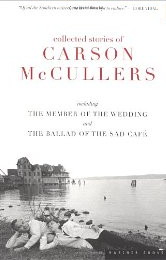
Day 36: Collected Stories of Carson McCullers

Cover of Collected Stories of Carson McCullersI sometimes feel frustrated with modern short works because I want them to tell more. Unlike short stories from earlier times, they don’t close any loops but simply capture a moment. This statement explains why I prefer the novel form and may not be very avant garde in my tastes.

Collected Stories of Carson McCullers contains a large number of short stories–some set in New York and some in the south–and two longer works, “The Ballad of the Sad Café” and “A Member of the Wedding,” only the last of which I had read before.

McCullers captures mostly sad moments, many of them autobiographical from what I understand from the introduction. Three of the stories are about her marriage to an alcoholic, although in one it is the wife who drinks.

Although McCullers is known as a “Southern Gothic” writer, the only piece in this collection that truly fits that description is “The Ballad of the Sad Café.” This story illustrates her ideas about love–that people love other people who are unattainable and that even the most unlikely people can be the recipients of adoration or even obsession. Several of the other stories are also about this theme.

“A Member of the Wedding” explores the unhappy adolescent, also one of McCullers’s themes. Frankie, a 12-year-old girl, becomes fixed on the idea that when her brother marries his fianceé they will take her with them on their honeymoon. She is obsessed with this idea and won’t allow herself to admit that they probably won’t. Her obsession is ultimately rooted in the degree to which she hates her town and herself.

Readers familiar with McCullers do not expect cheerful tales, but they are beautifully written and evocative.

Day 35: The End of the Wasp Season

Cover of End of the Wasp Season I have long been a fan of Denise Mina’s gritty mysteries, set in Glasgow. The End of the Wasp Season begins with two seemingly unrelated deaths: in Strathclyde, a crooked ex-millionaire banker named Lars Anderson commits suicide, and a young woman, Sarah Errol, is brutally murdered in a Glasgow suburb. Sarah was home temporarily taking care of her mother’s estate, and the wealthy suburban neighborhood is terrified by the seemingly random attack by hoodlums.

We know from the beginning that Sarah Errol was killed by two boys, but we don’t know exactly what happened or why.

As Detective Inspector Alex Morrow investigates, she runs into an old friend, the murdered woman’s housekeeper. Later Morrow’s friend Kay is accused of stealing from the dead woman’s estate. Kay’s teenaged boys are then arrested for the murder. Alex is convinced that her friend and the boys are innocent and tries to prevent a travesty.

DCI Morrow finds that one of the boys who broke into the home was the son of Lars Anderson, and that he mistakenly believed Sarah was his father’s mistress. As DCI Morrow investigates, she finds out about the boy’s horrible home life. Eventually we are lead to believe that the boys broke into Sarah’s house to scare her, and that the Anderson’s son stood there in horror and watched his companion go berserk. But the evidence is confusing.

I have been impressed by Mina’s work since I read the Garnethill series, her first three books. Her books feature strong women from working class backgrounds and criminal families who are trying to make their way on the right side of the law. Alex herself has a stepbrother who is a crime kingpin, from whom she has been trying to keep her distance.

Day 34: Your Presence Is Requested at Suvanto

Cover to Your Presence is Requested at SuvantoYour Presence Is Requested at Suvanto by Maile Chapman is an unusual and disturbing novel about the events at a hospital in Finland at the turn of the century. Sunny Taylor is an American who begins a new job as a nurse for a ward of mostly American women. These women, the wives of men in the timber industry, come regularly for treatment even though most of them are probably not really ill. The atmosphere of the ward is more one of pampering than of being treated for serious illness.

While telling of seemingly innocuous everyday incidents, the book develops a feeling of darkness and uneasiness, increased by the bleak setting of the isolated hospital.

A new doctor, Peter Weber, takes over the hospital with a plan to change the ward to a maternity ward for local women. An older, troublesome woman named Julia Dey is in his sights. Sunny begins to understand that Dr. Weber wants to teach the Finnish doctors a new uterine stitch for birth problems by having them practice on the older women who are receiving hysterectomies.

Something happens, and although Sunny thinks she remembers the day of the events, she somehow doubts her memory of what happened or who might have been involved.

The novel is an attempt at a sort of Victorian Gothic. It is certainly atmospheric, but some readers may find it rather slow-going, as it takes awhile for anything definite to happen.

Day 33: The Great Game: On Secret Service in High Asia

cover for The Great GameThe Great Game by Peter Hopkirk details the history of the 19th century shadow war for supremacy in Central Asia–that is, the spying, territory-grabbing, and general skullduggery accompanying the land grab of the Central Asian states and countries by Tsarist Russia and Victorian Great Britain. A great deal of the activity was centered around Afghanistan, which provides a lot of background about why the situation is so messed up today.

Investigations (exploring and snooping) were first begun in the area because of the British occupation of India. The greatest fear of the British occupiers was that the Russians would come swooping down on them through the Khyber Pass to take away what they had gained in India. So they sent small groups of men into the forbidding, wild regions to investigate the terrain, establish outposts, and try to make pacts with local war lords, khans, and other rulers.

This history is written by a Brit, so the Russians are the tacit bad guys. However, it would seem that often the Russians were more reliable partners to these states and countries than the British, who consistently let down their allies by doing nothing when the Russians invaded their territories. For their part, the Russians seemed often to be more brutal, but not always.

The book contains the enthralling stories of many young officers and civilians who took on dangerous missions into unknown, very wild territory with little or no backup from the British government, some of them simply to explore the areas but others to actively spy. Often these young men received no thanks from the British government for their efforts.

Note that a different edition of this same book is called The Great Game: The Struggle for Empire in Central Asia. I believe these are both the same book but that On Secret Service has been updated, taking into consideration recent events. I am not exactly sure which one I read because my edition was a special one from the Folio Society (just called The Great Game), but was published around the same time as the more recent book.