Day 52: Winter’s Bone

Cover for Winter's BoneI became interested in reading Winter’s Bone by Daniel Woodrell after seeing the powerful, gritty movie. If anything, the book is grittier and more compelling.

Winter’s Bone is a grim, yet touching, sparsely written tale of a young girl’s attempt to save her home. Ree Dolly is a high school student who has been supporting her mentally ill mother and two younger brothers in an area of the Ozarks that except for some modern-day conveniences doesn’t seem like it could be much different from it was a hundred years ago or more. One day the sheriff arrives to tell her that her father put their house and property up as collateral for his bail, and that if he doesn’t make his court date in a week, the family will lose their home. To Ree, this would mean a loss of all hope.

Ree sets out to find her father, whom she hasn’t seen in several months. Although almost everyone she visits is related to her in some way, most of the men are meth cookers, and her quest among the Ozark hollows is fraught with danger. Some of the women are even scarier than the men. Ree begins to feel that there is some greater mystery–that others know where her father is and aren’t telling. Initially resistant to her efforts, her terrifying Uncle Teardrop finally decides out of family loyalty to help her.

Woodrell’s prose is both lyrical and spare. You are rooting for Ree, her honest, uncorrupted spirit in stark contrast to the endemic criminality of the community.

Day 51: With Fire and Sword

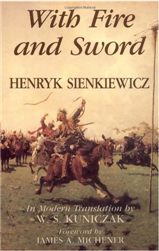
Cover for With Fire and SwordBest Book of Week 11!

Two years ago I read an exciting trilogy of Polish novels written in the 19th Century by Henryk Sienkiewicz, a Nobel prize winner for lifetime achievement in writing epic literature. The books were wildly popular for about 50 years, and Polish friends of mine tell me that they were their childhood reading. My review of the trilogy was published on Nancy Pearl’s blog (the librarian who has her own action figure), and I wrote to her awhile back asking if I could republish it here. She did not respond, so without further ado, I am going to write another review of the first book, With Fire and Sword. I will of course crib from my original review. The three books are stand-alone but with recurring characters, so you can read just one without missing important plot points.

It is 1647, and the Polish-Lithuanian Commonwealth is having some trouble—there are rumblings of rebellion among the Cossacks, who are a major force in the Polish army. Yan Skshetuski is a young Polish officer in the hussars of the Ukrainian Prince Yeremi Vishnovyetski. Prince Yeremi sends him on a mission as an emissary to Bohdan Hmyelnitzki, the leader of the Cossack rebellion. Yan has just become engaged to the beautiful Helen, but duty calls, so he makes his way through down the river to where the Cossacks are gathering.

Yan has been sent too late, though, for the rebellion has already started when he arrives, and he is made a prisoner. He escapes with difficulty and makes his way through the war-torn landscape, all the time worrying about Helen.

The political situation in Poland is very unstable, so no one comes to Prince Yeremi’s aid as he is attacked by hoards of Cossacks from the southeast. Even though Helen has been kidnapped by the wild Cossack Bohun, Yan cannot take time to look for her because he is embroiled in another mission for the Prince. So, his friends, the fat buffoon Pan Zagloba, the lovelorn knight and master swordsman Michal Volodyovski, and the gentle Lithuanian giant Longinus Podbipyenta decide to help Yan by rescuing Helen themselves.

This novel is all adventure and romance, and it is truly exciting. Along the way, you learn something about 17th century Polish history.

If you are interested in reading the book, you may have  a hard time finding it (although I see it is available in a print-on-demand basis). It is also available in several translations, about which there is some debate. The original translation by Curtin is said to be truer to the book, but I took a look at it, and it is also fairly badly written. The translation that I read by Kuniczak takes some liberties with the structure of the novel, but is eminently readable, if you can find it. The cover picture at the beginning of the article is from the edition that I read.

Day 50: Blacklands

Cover for BlacklandsBest Book of Week 10!

Belinda Bauer was another of my discoveries last year as a new writer of dark, psychologically complex novels. Blacklands is not so much a mystery as a thriller.

Twelve-year-old Steven Lamb’s uncle Billy was murdered as a child by a serial killer, and his grandmother has never gotten over it. Steven’s Nan spends all day looking out the window for her son, whose body was never found. Everyone thinks Billy was murdered by pedophile Arnold Avery, who is serving a life sentence.

Steven decides he will find his uncle’s body and that will fix his family, so he has spent all of his spare time for three years digging up the moor near his house where Avery’s victims were found. Finally he realizes the task is hopeless.

Steven feels that he is so average that he has no talents, so he is pleased when his teacher tells him he writes a good letter. He decides that maybe if he writes to the murderer, Avery will tell him where he buried Uncle Billy.

When Avery realizes that the person who has been writing to him is a boy, he decides that the situation is too delicious and he must escape from prison. Of course, he is successful.

The barren moors of Exmoor are so vividly described that they are almost a character in this chilling, suspenseful novel. At times I wasn’t totally convinced by the depiction of the thinking of the serial killer, but for the most part I was absolutely riveted.

Day 49: The Other Family

Cover for The Other FamilyI have enjoyed reading Joanna Trollope’s books about contemporary life for years. In The Other Family, she explores the effects upon two families of a man’s death.

At the death of Richie Rossiter, a musician who used to be famous, his partner Chrissie is horrified to find that he has left his piano and a substantial part of his assets to his first family–Margaret, his first wife, and his son Scott.

The book follows the reactions of both families. This disposition awakens in Chrissie a sense of further insecurity, one that has always existed, since he refused a divorce and never married her. In fact, although she wears a wedding ring, it is one she bought herself. She is hostile toward Margaret and Scott and doesn’t even want them to attend the funeral. She has also been left to pay taxes that she would not otherwise have been liable for, so her family will have to make do with less money.

Margaret, on the other hand, feels better in realizing that she has not been forgotten. She has continued to live close to the humble roots that she and Richie rose from, and has founded an established business. She is a more mature woman than Chrissie, and she has been ambitious and successful, but feels she needs a change in her life.

Two of Chrissie’s daughters are not well-developed characters, but Amy, Chrissie’s youngest daughter, becomes fascinated by her half-brother Scott and tentatively reaches out to him.

As always, Trollope does a good job of portraying the complexities and messy relationships of modern life.

Day 48: The Cruelest Journey: Six Hundred Miles to Timbuktu

Cover for The Cruelest JourneyMore than two hundred years ago, the Scottish explorer Mungo Park set off on a journey to try to discover where the Niger River ends up. At the time, it was not known whether the Niger comes out in the Mediterranean, joins with the Nile, or does something else. (It does–curves back out into the Atlantic.) Park made it as far as Timbuktu, but after he left, he was never seen again. Later he was reported to have been murdered.

In The Cruelest Journey: Six Hundred Miles to Timbuktu, Kira Salak relates her attempt to re-create Park’s journey by kayaking alone up the Niger River from Old Segou in Mali to Timbuktu. Although modern readers might believe that there are much fewer dangers in this journey than the one taken by Mungo Park, it is still one of the most desolate regions in Africa. She states that she is the first person and only Caucasian woman to travel alone in the region after one was murdered in the 30s.

Taking only what she can carry in her little kayak, Salak is forced to come ashore for food and shelter, sometimes when she would prefer not to. She encounters friendly people, hostile people, and people who are threatening, including some men who chase after her down the river to demand money. Although the river seems to be mostly slow moving, she runs into stormy weather and worries about being attacked by hippos. She has to keep paddling despite injuring her arm on the first day, and later she has an attack of dysentary after eating spoiled food fed to her by some villagers.

Although she is certainly alone for much of the time, she periodically meets up with a larger craft containing a National Geographic photographer and his crew. They have a deal that he is not to interfere in her trip, but simply to take pictures. I feel it was unfortunate that none of the photos were included in the book except on the cover. Instead an address is given to the National Geographic web site.

The book is well written and interesting, although it contains a lot more of her musings and fewer descriptions of what she saw than I would have preferred. She also appears to have made this journey without much preparation, including understanding the customs of the people she will be visiting, as she finds when she attempts to buy the freedom of some slaves.

As she approaches Timbuktu, she is struck by how much more the villagers seem to be changed by tourism than earlier on the river, increasingly hostile or begging for money as she passes by. Considering that she knew in advance that Timbuktu is no longer the legendary city it used to be, I was surprised by how disappointed she is when she reaches it. It is hard to decide which she is more disappointed about, that there is no sign of the legendary city built by the gold and salt trades or that she can’t stay in a nice hotel as she planned because the town is packed with tourists (or maybe that the town IS packed with tourists).

Although perhaps it was part of her sense of adventure to be relatively unprepared, I felt that more research before she made the trip would have been in order. I couldn’t help feeling at times that her reactions to a few events or sights were uninformed. (As one Amazon reviewer points out, she mistakes a pile of rubble for the National Museum in Bamako.) Nevertheless, it is an interesting story. I couldn’t help feeling that Salak combines in herself both courage and foolhardiness.

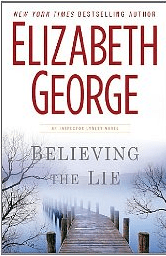
Day 47: Believing the Lie

Cover for Believing the LieI have been a fan of Elizabeth George’s Detective Inspector Lynley and Detective Sergeant Havers series ever since I read A Great Deliverance, the first one. However, it seems to have gone astray ever since George killed off Lynley’s wife three or four books ago, and I came close to not picking up this one. With Believing the Lie, however, George is slowly returning to form. (Just as a side note, those of you who think you know the series from Masterpiece Mystery are sadly mistaken. I was thrilled to hear they were doing the series but really upset at how they combined books, changed endings to ones that were less effective, and so on.)

Lynley is asked by Assistant Commissioner (and slimy politician) David Hilliard to do him a favor and investigate whether a wealthy industrialist’s nephew died in an accident or was murdered. Of course, a lot is going on with the Fairclough family below the surface.

Since the investigation is unofficial, Lynley takes along his friends Simon and Deborah St. James, who are recurring characters in the series. Simon St. James is a forensic scientist of some note and Deborah is a world-class photographer. Although the nephew’s death has been ruled an accidental drowning, Simon finds some evidence to suggest otherwise.

In investigating Fairclough’s son Nicholas, Deborah becomes involved with his beautiful Argentinian wife, with whom she feels a sympathetic connection, while Lynley and Simon investigate the rest of the family. As family secrets are revealed, things begin to fall apart.

Meanwhile back at home, Havers gets more involved with her neighbor’s family. She has long cared about the little girl next door, Hadiyyah, and her handsome father Taymullah Azhar. Now Azhar’s estranged partner, Angela Upman, has returned to the family. Barbara wants to dislike her because of the pain she has caused her family, but Angela is nice and helps her improve her professional appearance, as she has been ordered to do by her new boss. However, Barbara thinks that something is going on.

I think what makes George’s books outstanding are her writing skills and her ability to create convincing characters. I have said before that I have dropped many series mystery novels, principally because I get tired of the secondary characters, who keep doing the same things over and over. George does a nice job of developing even the minor characters and making them interesting, instead of just using them as plot devices.

That being said, George seems determined to thrust Lynley into a series of romantic disasters. Maybe she should be following a dictum I have heard attributed to P. D. James that it’s not a good idea to mix the romance and detective genres. In the first book, Lynley was madly in love with Deborah as she was marrying Simon. In the second book, he suddenly realized he loved his old friend Helen. Then he spent several books chasing Helen, whom we all loved, and was happily married for one or two books until she was murdered. Since the last book he has been stupidly pursuing an affair with his alcoholic boss. As I said before, I think killing Helen was a big mistake, and judging from some of the comments on Amazon, others agree.

One more caveat to this book. Deborah is starting to have the secondary character problem I described above. She is so obsessed by her conception problems that she thinks she understands Bernard’s wife based upon finding one copy of a brochure in the house. Because she thinks she knows what’s going on, she ignores all evidence that things may not be as she thinks. This misunderstanding has tragic consequences. Deborah has been obsessing over her inability to have a child since the third or fourth book in a long series. I wish George would have her adopt a child and get it over with.

Day 46: The Winter Thief

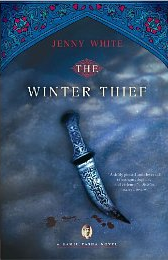
Cover for The Winter ThiefThe Winter Thief is the latest of Jenny White’s mysteries set in late 19th Century Istanbul about the investigations of the honest and hard-working Special Prosecutor Kamil Pasha.

It is a freezing cold, wintery holiday in Istanbul when Vera Arti visits an Armenian publisher to try to convince him to publish The Communist Manifesto in Armenian. Disappointed in her attempts, she doesn’t notice when someone follows her home. When her husband Gabriel returns abruptly to their apartment and tells her they must leave immediately, she argues that she must pack her things. He leaves her to get a carriage for them, but while he is gone, she is taken by the Sultan’s new secret police.

In another part of the city there has been a bank robbery and next door a massive explosion at a café followed by a fire where many people are injured or killed. Kamil Pasha is helping out at the scene when he finds evidence that his brother-in-law Huseiyn might be one of the victims.

Gabriel Arti’s mission is to open a socialist commune in Armenia, and to do that he arranged to purchase a shipment of illegal guns and robbed the bank. His fears for his wife lead him to seek the help of an enigmatic but powerful acquaintance of Kamil Pasha’s who helped him arrange the gun shipment. At the man’s suggestion, Gabriel departs for Trabzon and the commune, leaving the other man to try to find his wife.

Although the Ottoman empire has traditionally been one that tolerates people of different religions and race, tensions are rising. Vahid, a vicious, sadistic, conniving commander of the Sultan’s new secret police has a plot to gain more power by making the Sultan believe that the Armenians are a threat to the empire and then providing himself an opportunity to end the threat. Vahid believes that Huseiyn might have been having an affair with the woman he intended to marry, who died in the fire. In his efforts to find Huseiyn and wreak his vengeance, he runs up against Kamil Pasha and his sister, who is frantically trying to find her husband. The next thing he knows, Kamil Pasha has been framed for the murder of a young Armenian girl.

As we follow the adventures of all those people, as well as Gabriel, the members of the commune, and others, the book begins to feel too disorganized and diffuse. My interest flagged a little. However, the threads of the story all come back together when the Sultan dispatches Kamil Pasha to the wilds of Armenia with a small troop of soldiers to find out whether the new settlement is a band of Armenian revolutionaries or a harmless socialist commune.

Day 45: The Possessed: Adventures with Russian Books and the People Who Read Them

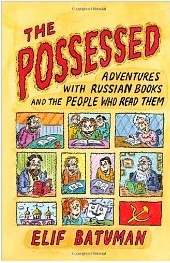
Cover for The PossessedMaybe not many of you would be interested in a book like The Possessed: Adventures with Russian Books and the People Who Read Them by Elif Batuman, but as a previous student of Russian and also a previous literature graduate student, I found it very funny.

Batuman has written a book about her years as a graduate student of Russian language and literature that skewers many things, but particularly academic conferences with their absurd presentation topics and academic thinking, with the oblique reasoning process that sometimes accompanies it. For example, on the way to a conference on Tolstoy’s estate, Batuman loses her luggage and is forced to dress in flip-flops, sweatpants, and a flannel shirt. Some of the scholars attending the conference assume she is a Tolstoyan and that she has taken a vow to walk around in sandals and a peasant shirt for days. When she calls a Russian clerk to find out about her luggage, the clerk replies, “Are you familiar with our Russian phrase resignation of the soul?”

While relating her adventures in studying, travelling in Russia, and living in Turkey, where she went because her grant was too small for her to afford a stay in Russia, Batuman muses on ideas from literature and compares the lives of the people she meets with the adventures of characters in Tolstoy, Dostoevsky, and Chekhov. Her observations are colored with her own peculiar view of life, which poses that “the riddle of human behavior and the nature of love appear bound up with Russian.” In Turkey, when she is challenged by scholars to study Turkish literature, particularly because of her Turkish heritage, she concludes that no one reads it, even the Turks.

Batuman expanded articles she wrote for Harper’s and The New Yorker into this book, which is named after one of Doestoevsky’s more enigmatic novels. Although her musings are occasionally a trifle too erudite for me to follow (and perhaps my memories of Russian literature too rusty), I found the book amusing and couldn’t put it down.

Day 44: The Dogs of Riga

Cover for The Dogs of RigaHenning Mankell was my introduction to Swedish crime fiction. I usually enjoy his mysteries, but have not really liked his “more serious” novels. The Dogs of Riga is another of his mysteries featuring Inspector Kurt Wallender.

In a novel set earlier in time than his previous mysteries, Wallender travels to Latvia in the days before the dissolution of the Soviet Union to discover why Major Liepa, a Latvian police inspector who has been working on a case with him, is murdered as soon as he returns home. Wallender is bewildered by the politics and workings of the deeply depressed country. He soon figures out that the person arrested for the murder is innocent.

Wallender responds to the pleas for help by Liepa’s widow, Baipa Liepa, to continue his investigation further than the Latvian officials want him to. He encounters widespread governmental corruption and the realities of living in this grim regime. Readers of Mankell’s books have heard of Baipa Liepa, because she is the woman he loves in books that take place in a later timeframe.

Wallender is his usual depressed self, eating bad food and getting little sleep. The setting of urban Riga, though, is much more dark than Mankell’s usual setting of rural Sweden.

I enjoyed the book, although I thought that Wallender seemed strikingly naive at times. Mankell’s writing is sometimes a little awkward, although it is usually spare and transparent.

Day 43: A Discovery of Witches

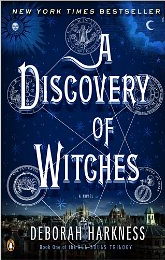
Cover for A Discovery of WitchesBest Book of Week 9!

A Discovery of Witches by Deborah Harkness is like Twilight for adults. A couple of years ago I decided to try the wildly popular Twilight series and found the first book terribly juvenile. But recently, I picked up A Discovery of Witches, also extremely popular and with similar themes. I just finished reading it and had a lot of fun.

Diana Bishop is a Yale science historian visiting at Oxford to study alchemy. She is also a witch, from a long line of witches. But ever since her parents were murdered in Africa when she was seven, she has refused to learn about and tries not to use witchcraft.

She is working in the Bodleian Library when among the manuscripts she calls up is one called Ashmole 782. As soon as she touches it, she can tell it is powerfully enchanted. To keep true to her vow not to use witchcraft, she refers to it as she would any other manuscript and then sends it back.

Not long after, she meets a mysterious vampire named Matthew Clairmont, a well-known but reclusive genetic scientist. He is interested in the book but disturbingly warns her to beware of other witches. As she has been brought up to fear vampires, she is appalled at his warning and tries to avoid him. But she soon figures out he is actually trying to protect her from the other vampires, witches, and daemons who have suddenly appeared in the library, despite the dictum that the three species are not supposed to draw attention to themselves from humans. Matthew explains that they all want Ashmole 782.

Soon Diana and Matthew have formed a strong bond of attraction, but because Diana has neglected her education in her heritage, she is unaware that relationships between the species are strictly forbidden.

This is a lively and engrossing book, sometimes light and comic but other times fraught with romance, danger, action, and suspense. You care about Diana and Matthew and are interested to see where their story is leading. The book also introduces other fascinating characters, such as Diana’s aunts, Matthew’s family, and Diana’s aunt’s house. Yes, it is a character. Matthew–overly protective, quick to anger, not always under control–makes a much more convincing vampire than does the sulky, languishing Edward from Twilight, and Diana is a lot smarter and more interesting than Bella. This book is the first of a series of three, and I’ll be looking forward to the second book.