
 This period’s Best Book is Salt Creek by Lucy Treloar!
Day 1200: Magpie Murders
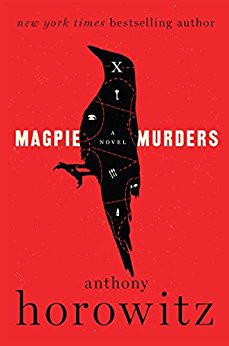 My husband and I love Midsomer Murders. The program has not been broadcast in Austin for years, so we began collecting the DVDs. After our move, we were happy to find that the Portland PBS station periodically airs the older series, which we’ve been watching. So, I was delighted to learn that Anthony Horowitz, the author of Magpie Murders, had written some of the screenplays. How could I go wrong?
Alan Conway, the author of the successful Atticus Pünd mystery series, has sent his latest manuscript, Magpie Murders, to his publisher. After a brief introduction by his editor, Susan Ryland, we’re plunged directly into his Christie-esque whodunnit.
But the novel comes to an abrupt end before it is finished. The last few chapters are missing. Before Susan can contact Conway, she learns he is dead from an accidental fall off the tower in his home.
The publishing house hasn’t been doing that well recently, so Susan begins looking for the final chapters. They have been erased from Conway’s computer, and the manuscript is not with his others. Susan’s boss’s copy is missing the same pages.
Susan begins to suspect that Conway’s death was not an accident. As she investigates, she finds that Conway borrowed characters, settings, and ideas from his real life and liked puzzles and anagrams. Susan thinks that the key to Conway’s death may lie in his manuscript.
I enjoyed Magpie Murders and thought that its novel within a novel structure was clever, but I also didn’t think that the Pünd novel was all that important to the plot. That is, it was important, but it wasn’t necessary to include the entire novel. Of course, this structure gives you two entertaining mysteries for the price of one, but I thought that there were too many characters in the Pünd novel, and it was confusing. Also, too much was told in narrative rather than in action and dialogue.
I did not solve the Pünd mystery, but I did somehow sense who the murderer was in the “actual” mystery despite not knowing the motive. When the motive was revealed, it seemed weak to me.
This seems like a severe review, but I actually enjoyed the novel very much. So, I guess I am carping at small things. The action moves forward nicely, the interior mystery has a pleasant old-fashioned feel, and the “real” mystery has an engaging heroine.
Related Posts
Day 1199: Salt Creek
Best of Five!
Ten years after she left Australia in 1862, Hester Finch recollects the seven years her family spent in the Coorong, at Salt Creek, southeast of Adelaide. Her father brought the family there after all of his other business ventures had failed.
Originally from genteel stock, Mrs. Finch is appalled by the rusticity of the station, as are her children. Mrs. Finch, who moved to Australia for the sake of her husband, is depressed and apathetic, so Hester, the oldest girl, must take her place doing the housework and educating the younger children. Mr. Finch considers himself a godly man who must do his duty by bringing the natives to Christianity, so they take in a mixed race boy named Tully.
Life is difficult, and it slowly gets worse. Although Hester falls in love with Charles, a young artist doing a survey of the area with his father, she decides that she will never allow her fate to be determined by another.
As Hester tries to figure out a way to leave Salt Creek without abandoning her younger brothers and sisters, events occur that make the family understand the kind of man their father is.
Some readers may need patience for the beginning of this novel, as it is mostly setting the stage for events to come. I found the plaintive tone of the novel at first a little depressing. However, just before the halfway point, events get going, and the novel becomes absolutely gripping.
Although Treloar states that the novel is based very loosely on her family’s beginnings, the characters in the novel are completely fictional except for four of them. Those characters make up a subplot that involves an actual murder.
I felt the novel lacked descriptions that would give ideas of the appearance of the place (references are made to its beauty, but I was unable to form a mental picture), but the daily existence of the characters is fully realized. This is at times a harrowing read for my Walter Scott Prize project, but it is certainly worth it.
Related Posts
Day 1198: Consequences
 If you expect E. M. Delafield’s Consequences to be like her witty Diary of a Provincial Lady, you will be surprised. Although it addresses themes that Diary touched on much more lightly, it is serious, sad, and even bitter.
Alex Clare grows up in the typical environment of a Victorian child of wealthy parents. She and her brothers and sisters are raised by Nanny and only see their parents at specific times. Alex is an aggressive child with her siblings, but her desire is to have someone care about her. Since Nanny dislikes her and Cedric and Barbara band against her, she tries to please her mother.
But a childish game causes a near tragedy. Alex’s part in it is misinterpreted, and she feels too guilty to defend herself, so her parents send her away to a convent school in Belgium.
Here, Alex begins a lifelong pattern of fastening upon someone for whom she will do anything. In school, it is Queenie, for whom she breaks rules to give treats and try to hang around her. These kinds of crushes are forbidden, and Alex is constantly in trouble for breaking rules, while Queenie blithely accepts forbidden treats and gets away with it. Alex does not learn to develop standards of behavior. She just yearns for love and understanding without having the ability to evoke it from others.
This childhood does not prepare her for young womanhood, where the only expectation is that she will marry well. She does not enjoy all the parties and events she must attend and is unable to hide her discontent.
Alex is not an attractive character. She is needy, unprincipled, and depressive. But her small transgressions are magnified by her family until she feels friendless and isolated.
Consequences is Delafield’s indictment of this kind of upbringing and the expectations for women of her class and time. It is also a character study of a woman who feels lost wherever she is. It is quite the feminist statement, published in 1919. The reviews included in the appendix of the Persephone edition show that its message was not well understood or accepted by the (presumably) male literary world of its time.
Related Posts
Day 1197: Literary Wives! The Headmaster’s Wife
 Today is another review for the Literary Wives blogging club, in which we discuss the depiction of wives in fiction. If you have read the book, please participate by leaving comments on any of our blogs. Be sure to read the reviews and comments of the other wives!
Eva of Paperback Princess
Kate of Kate Rae Davis
Lynn of Smoke and Mirrors
Naomi of Consumed By Ink
TJ of My Book Strings
My Review
In trying to rate The Headmaster’s Wife, I again became frustrated with Goodreads’ inflexible five-star system. The novel was more ambitious and better written than many run-of-the-mill novels I’ve given three stars to, but it wasn’t good enough to get four stars, which I give to books I like a lot but don’t think are wonderful. There was just something lacking in it, and 3 1/2 stars would have been perfect.
Arthur Winthrop, the headmaster of a private prep school, is found wandering naked in the park. He tells the police his story about having an affair with a student forty years younger than him, an event ending in a crime.
But halfway through the book, we find it is not about what we think it is. Arthur turns out to be an unreliable narrator. At this point, the focus changes to Betsy, the girl in the headmaster’s story, sort of. There’s not much more about the plot that I can say without major spoilers.
The prep school world is one that I’m not familiar with, but everything about this novel could have taken place in the 1950’s instead of the current times. I found the world of the book scarily insulated from the events of the real world.
Overall, I found this novel unsatisfying. The first half of it I found distasteful, especially in these Me Too days. But the novel, as I said before, isn’t really about what it seems. The second narrative is unsatisfying because we only actually see Betsy in her relationship to the males in her life—her boyfriends, her son, her lovers. It’s as if she has no actual life. Which, of course, leads us into our Literary Wives discussion.
What does this book say about wives or the experience of being a wife?
First, I didn’t believe in Betsy as a character except in Arthur’s narrative. In her own section, we have no sense of her day-to-day life. She doesn’t seem to exist. Maybe that was the intention of the author, but maybe he is just really bad at depicting women. While Arthur shuffles papers and attends board meetings, she does literally nothing except have one conversation with an acquaintance.
At the beginning of Arthur and Betsy’s relationship, when Arthur sees she is cooling off, he plays a nasty trick to get rid of a rival. Betsy is fully aware of it. Yet, we are to believe that she went ahead and married Arthur, presumably to have a place at Lancaster forever. I didn’t believe it.
Then, we see Betsy, as I mentioned before, only in relationship to the males in her life and mostly in reference to sex. That is, when she looks back at her own life, it’s one sex scene after another, except for her memories of her son, and even those are somewhat eroticized. Even her desire to become good at tennis involves an affair with her tennis instructor. All I can say is, guess what guys? Sex isn’t the only thing women think about.
The central theme of the novel is supposed to be about grief, but characters in this novel don’t deal with their grief or even really face it. I feel that Greene meant for this novel to be meaningful, but it doesn’t really make it.
Related Posts
Day 1196: Lamentation
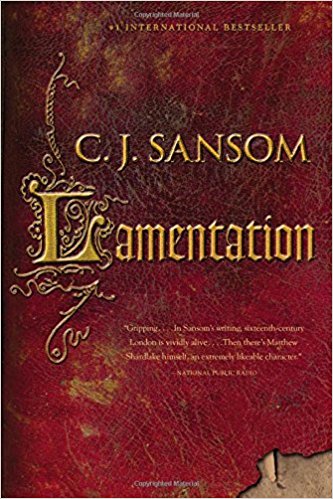 Although at the end of the last Matthew Shardlake novel, Matthew vowed to change his life, it is not substantially different in 1546, the beginning of the last novel in the series. He has vowed not to become involved in any more political cases, yet he takes one more for Queen Catherine, formerly Catherine Parr.
The religious situation in England is more fraught than it has been. As King Henry is the head of the church, he believes that all must follow his beliefs. Yet he vacillates between a more conservative view of the church and the reformist view, with resultant trials for heresy on both sides. Right now, the conservatives, headed by Bishop Gardiner, seem to be in ascendance, and having a reformist queen would be very inconvenient for them. Queen Catherine’s followers are fairly sure that if the conservatives prevail, she’ll be brutally discarded.
Unfortunately, Catherine has written a document, Lamentation of a Sinner, and not destroyed it as she was advised. Although it is not heretical, it distinctly shows her reformist views. More seriously, Henry would view her having written it secretly as disloyalty. Unfortunately, the document has been stolen from a locked coffer for which only the Queen has the key. Matthew agrees to try to recover the manuscript.
At the beginning of his investigation, Matthew encounters the murder of a printer, Greening. This man belongs to a group of religious radicals, and he is found clutching a page of the Queen’s manuscript in his hand. The investigation is further confused when Matthew learns that Greening was printing another book, an account by Anne Askew of her treatment before she was burned for heresy.
I think that this last novel is the best of the series. Despite its bulk, it is fast moving and atmospherically charged, reflecting everyone’s fears at the time. No one in Sansom’s books, it is true, seems to have any sense of humor, and perhaps that is partially what has bothered me about the series. In any case, by the end of the novel, Matthew has certainly set foot on a different path.
Related Posts
Best of Five!
 The Best Book for this period is The Priory by Dorothy Whipple!
Day 1195: The Long Song
 Several years ago, I greatly enjoyed Andrea Levy’s Small Island. So, I was happy when I saw that The Long Song was in both my Walter Scott Prize and Man Booker Prize projects.
July is fathered upon her slave mother, Miss Kitty, by the overseer on Amity, a Jamaican sugar plantation. It is early in the 19th century, so July is a slave, too.
July and Miss Kitty are field slaves, but when July is nine years old, the master’s sister, Caroline Mortimer, takes a fancy to her. She takes July away from Miss Kitty to train her as a house slave and calls her Marguerite. The novel is written as July’s memoir, as she recalls the final days of slavery on the island and its transition to freedom.
At first the tone of this novel bothered me. It seemed too sprightly and playful for subject matter that is sometimes appalling. It really tears into its white characters, too, who are portrayed at best as hypocrites but more often much worse. Eventually, though, its sly sense of humor got to me, and I laughed out loud. Still, I did not feel as involved by this novel as I did with Small Island.
Related Posts
Day 1194: House. Tree. Person.
 I scented gaslighting very early on in Catriona McPherson’s newest cozy creepster, House. Tree. Person. That did not spoil my enjoyment.
Ali McGovern has a trauma in her past and hints of a nervous breakdown. Her family is in a precarious financial position, too, because her husband, Marco, used her successful salon to prop up his failing restaurant. So, they lost both. When Marco falsifies her credentials to get her a job at Howell Hall, a mental hospital, she goes along with it, thinking she won’t get the job. But she does.
She comes home after her first day at work to a different problem. Her fifteen-year-old son, Angelo, is implicated somehow in the discovery of a body on the grounds of an old abbey across the street from the McGovern’s flat. The police think he knows something about it. Marco seems to know what is going on, but neither Marco nor Angelo will tell her.
At work she meets a cheerful and supportive staff, but her boss, Dr. Ferris, finds fault with her slightest action. In a catatonic patient, Sylvia, Ali thinks she sees signs of consciousness. She also believes that something is going on with Julie, a teenage patient who claims she’s being held there against her will.
Catriona McPherson has become one of my favorite writers for suspenseful and spooky but light reading. Her characters are engaging, and she creates a strong sense of place in small-town Scotland. House. Tree. Person. is another page-turner from her.
Related Posts
Day 1193: Pompeii
 I was just as short way into Pompeii when I realized I had read it before, probably when it first came out. Leave it to Robert Harris to make a page turner out of a story that everyone knows the end to.
The novel begins a mere two days before the horrendous eruption of Vesuvius. Marcus Attilius Primus is the newly arrived aquarius for the area—the engineer who is responsible for maintaining and operating the aqueduct that provides water to the towns along the bay. His predecessor mysteriously disappeared two weeks before. Soon after the beginning of the novel, Attilius discovers that the aqueduct has stopped running. He mounts an expedition to Vesuvius to try to find the break.
On the course of his urgent journey to repair the aqueduct, Attilius runs afoul of Numerius Popidus Ampliatus, a powerful citizen of Pompeii. He is also attracted to the man’s daughter, Corelia. When in his work on the aqueduct, Attilius figures out what is happening on the mountain, he has to avoid assassins sent by Ampliatus as he endeavors to rescue Corelia.
The novel also follows Pliny, who as admiral takes the fleet across the bay in an attempt to make observations and rescue people.
Harris has done his homework, and his descriptions of the eruption are terrifying. He must have had the time frame right, but my only quibble is that Attilius has to cover so much ground before he gets to Corelia, I can hardly imagine she would still be alive when he got there. This is another well written, suspenseful novel by Harris.
 What? Me Read?