Day 724: & Sons

Cover for & Sons& Sons is a novel about fathers and sons, but it is really most about sons and the effect on them of their father’s actions. It is also about the fate of a lifelong friendship.

The friendship seems to be the catalyst for events. Charles Topping has died, and his funeral is packed with people waiting to see his best friend, the reclusive novelist A. N. Dyer, give the eulogy. Dyer is noted for several excellent books, but Ampersand has become a classic about prep school life.

At the funeral, though, it becomes clear that Andrew Dyer himself isn’t quite all there. During the eulogy, he becomes upset about the whereabouts of his young son Andy and has to be removed from the podium.

The story is told by a narrator who is not at all trustworthy, Charles Toppings’ son Philip. When Andrew Dyer meets him at the funeral and finds he has split from his wife, he kindly invites him to stay.

This suits Philip, who grows more malevolent as we get to know him. He is on hand a few weeks later when the Dyers reunite at their father’s request to discuss something important. He can be there to eavesdrop and look through old papers, but generally he cannot possibly be privy to all the details of the story he tells.

Andrew Dyer has been estranged from his ex-wife and two sons since the family learned about the existence of his third son, Andy. Andy is now seventeen. Andrew has tried to avoid neglecting him, as he did his two other sons, and do a better job of bringing him up. But Andrew knows he is nearing the end and is afraid Andy will be alone. He fears Andy is just as messed up as the other sons, only in a different way. Andrew has formed another preoccupation about Andy that shows how divorced he is from reality.

Andrew’s oldest son Richard is an ex-drug addict who has stabilized his life with great difficulty. He is now a drug counselor and has a wife and two teen children. The other son Jamie is a documentary filmmaker whose films for years have dwelt on the darkest of subjects. Philip Topping has a grudge against both of them for the teasing he received as a child.

The novel is told using letters between Andrew and Charlie, passages from Ampersand, and other artifacts from Andrew’s life, as well as Philip’s testimony. We find Andrew feverishly manufacturing an “original draft” of Ampersand because he burned up the original manuscript in disgust at what he did to his old friend Charles in fiction. Now he needs one to leave with his papers.

I waited to write my review for a few days after I finished the book, and I’m still not sure how much I enjoyed the novel. It is well written and absorbing, and it provides a lot to think about.

Related Posts

The Art of Fielding

The Sense of an Ending

The Child in Time

Day 723: Greenbanks

Cover for GreenbanksBest Book of the Week!
This novel begins with a large family Christmas dinner at Greenbanks, the home of Robert and Louise Ashton. It is around 1910. Louise is in her late middle age, a quiet, kind woman who delights in her housekeeping skills and her garden. Her husband, a serial philanderer, has proved a source of pain and humiliation, but she has tried to live it down.

Although the Ashtons are grandparents, three of their grown children live at home. Jim works at the family business, allowing his father to devote little time to it. Charles also purportedly works there, but he prefers to spend time fiddling with inventions, tinkling the piano, and entertaining his adoring mother. Laura is just about to engage herself to Cecil Bradfield. Rachel, the five-year-old daughter of Letty and Ambrose, is Louise’s favorite grandchild.

Robert soon dies in embarrassing circumstances. But even though the novel follows the fortunes of the family over roughly 15 years, it concentrates on the relationship between Louise and Rachel. Rachel, with a self-absorbed mother and an officious father, loves spending as much time as possible at Greenbanks with her grandmother.

The novel has overtones that are feminist for the time, as Rachel finds she has a gift for scholarship. Her father’s rigid and old-fashioned ideas about the place of an education in the lives of young women cost her a scholarship at Oxford, but she manages to continue her education despite him.

Inside cover
The cover at the top is really plain, but for some reason Amazon shows this picture, which is actually the inside of the cover!

One source of disagreement in the family is Louise’s choice of companion. Louise always felt sorry for Kate Barlow when she was a child and tried to include her in family activities. When Kate was a young woman, it was rumored she became pregnant by a married man and had his child, then was thrown off by her parents. Louise meets her in town one day and begins a correspondence with the reluctant woman. After Charles leaves for South Africa and her other two children marry, she invites Kate to become her companion. But Kate never really accepts Louise’s kindness.

The story of the Ashtons is told in spare, matter-of-fact prose that makes no attempt to influence the reader. Many of the characters are flawed and some are unlikable, but there are no heroes and villains here, just a set of ordinary middle-class people. It’s difficult, then, to explain why I so much enjoyed reading this novel. Whipple is a master of style and shows us her characters in the fullness of their lives.

Related Posts

Someone at a Distance

A View of the Harbour

Mrs. Palfrey at the Claremont

Day 722: The Narrow Road to the Deep North

Cover for The Narrow Road to the Deep NorthDon’t expect good cheer and humor from The Narrow Road to the Deep North. It is the often harrowing novel based on the experiences of Richard Flanagan’s father as a POW during World War II, one of the hundreds of thousands of Australian soldiers forced to build a railroad through Burma with not much more than their bare hands. A much-sanitized version of this story was the basis for The Bridge on the River Kwai.

Dorrigo Evans is the main character of the novel, a surgeon who ends up being in charge of the prisoners simply by virtue of not having died. We meet him first as an older man, one of Australia’s greatest war heroes, feeling no self-worth, unhappily married, and unfaithful to his wife. The novel moves back and forth in time between the days when he is waiting to be shipped overseas at the beginning of the war until his death years later. In the summer before he went to war, we learn, he fell madly in love and had an affair with his uncle’s young wife Amy.

I think it is interesting that the New York Times reviewer thought this affair was a huge flaw in the novel while the Washington Post reviewer thought it was beautiful. I agree with neither of them (although I lean more toward the Times reviewer’s opinion) but think the Times reviewer was off base in blaming the affair for keeping Dorrigo from pulling his life together after the war. It wasn’t the affair at all but the memory of the decisions Evans was forced to make during the war. At one point, he must decide whether to try to save Darky Gardiner an undeserved beating or try to save another man’s leg. Both die, and the later revelation of Darky’s true identity makes this more painful. At another point Dorrigo is made to decide which of his starving, disease-ridden men must march 100 miles north of the camp. He picks the men with boots, reasoning they might have a chance of making it alive.

Occasionally, we see the thoughts of the men’s captors, the Japanese officers or Korean guards. In all his life after, only for a moment does the Japanese Major Nakamura have the slightest doubt of his behavior during the war. To him, the Australian soldiers had shamed themselves by surrendering and were being given a chance to redeem themselves by serving the Emperor. We occasionally also get glimpses of the brutality of mind that characterizes the Japanese military.

Whether you like this book or not, it is not one you will soon forget. This novel won the Booker Prize last year. Although I preferred several of the other short- and long-listed books for the prize, I still found it compelling reading.

Related Posts

Unbroken: A World War II Story of Survival, Resilience, and Redemption

Life After Life

A God in Ruins

Day 721: Death in Brittany

Cover for Death in BrittanyI selected this book just because of its setting, and it certainly makes an effort to impart the scenery and atmosphere of Brittany.

Commissaire Georges Dupin is originally Parisian, but he is enjoying his relocation to Brittany. He is sitting in a cafe with his morning coffee when he is summoned to Pont-Aven, where the 90-year-old owner of the Central Hotel was stabbed to death in the bar. It was Pierre-Louis Pennec’s habit to spend the evening there, sometimes with other people, sometimes alone. The death happened after the restaurant was closed.

No one at the hotel reports anything unusual. Pennec’s life revolved around the hotel, which had been in the family for generations. His grandmother had helped build Pont-Aven’s reputation as an artists’ haven by supporting artists, the most famous of whom was Gaugain. Copies of their paintings hang throughout the restaurant. The only unusual thing Dupin and his team can discover is that Pennec was told that week that he would not live long.

Under suspicion are Pennec’s son and daughter-in-law, but they seem to have no motive. Also under suspicion is Pennec’s estranged half-brother.

The night after the murder someone breaks into the restaurant. But to all appearances, nothing was taken or has changed.

link to NetgalleyI was reading an advance copy and was at first put off by the writing, which was not stellar, particularly overuse of the word “very.” But these problems may be resolved in the published version. One thing Bannelec attempts is to illustrate the beauties of Brittany. Most of this material was interesting, and I appreciated the effort, even though sometimes the novel reads like a travel guide. But I have criticized other novels for not providing a sense of the location, and this one certainly attempts to do so.

The characters aren’t particularly distinctive. I kept confusing two of Dupin’s inspectors and several of the suspects. So, overall, I would rate this novel as just average.

Related Posts

Murder in Pigalle

Murder on the Eiffel Tower

The Bones of Paris

Day 720: Galway Bay

Cover for Galway BayGalway Bay is fiction based on the stories of Mary Pat Kelly’s great-great grandmother about leaving Ireland in the first half of the 19th century to come to America. The novel covers a lot of ground—the iniquities of Ireland’s Anglo-Irish landlords, the Great Famine, early Chicago, the American Civil War, the Fenian Brotherhood—and ends with the Chicago World’s Fair.

Honora Keeley is a young girl living in a fishing village on Galway Bay when she meets Michael Kelly and they fall in love at first sight. They want to marry, but they have to convince Honora’s family, because Michael owns nothing but his horse. However, he earns enough to marry by winning a horse race in Galway.

Honora’s sister Maire, who was married the day Honora met Michael, is soon a widow after her husband dies in a fishing accident. On Honora’s wedding night, Maire saves Honora from the landlord’s droit du seigneur by volunteering in her stead. I’ll say something about this later.

Michael is no fisherman. Honora and Michael have a tough enough time of it farming but are making out okay when the potato blight hits. The behavior of the landlords and the British government during this time is shameful, and Kelly depicts it vividly. After several years of the blight and other misfortunes, Honora finally is able to convince Michael to leave for America, to Chicago, where his outlawed brother Patrick is said to reside.

Although this novel has a fairly good story, there is something about the narrative style that bothered me. It is told in first person, but in a modern style that is not convincing. Many things happen, but I didn’t ever feel as if I understood much about the characters’ personalities. Especially early on, when we are getting to know the main characters, often opportunities for revealing dialogue turn into storytelling episodes, where we hear another Irish legend. Everyone has one or two identifying characteristics, but they don’t feel like real people. I think the novel may have been more successful in the third person.

Finally, I was highly skeptical of whether droit du seigneur would have occurred in the 19th century, as it is usually associated with Medieval times. I’m sure this event is based on family legend, but I think Kelly could have treated this one with a little skepticism, especially as the lord’s behavior is abetted by a priest. I attempted some research on the topic and was surprised to find a lot of discussion about whether it was ever actually practiced at all. But with one exception, the references were to Medieval mainland Europe, not the British Isles. That exception was a Facebook page about Ireland, but I was unable to find the actual reference on the page to see if it cited any sources. I have read several history books about Ireland and took a graduate course in Irish history, and I have never heard anything about this, although the other abuses are well known. (I have since found one source for this alleged practice, Arthur Young, the author of a book called Tour of Ireland in 1780, who stated it was commonly practiced in rural Ireland. He is listed in Wikipedia as an agriculturalist who traveled to observe agricultural practices. Still, with this little information, we have no idea if his statement is based on rumor or fact, and this report is 50 years or so before the time of this novel.)

Related Topics

The Sea House

Troubles

Giants in the Earth

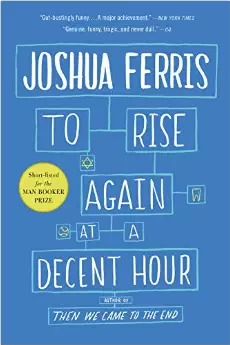
Day 719: To Rise Again at a Decent Hour

Cover for To Rise Again at a Decent HourThe descriptions I’ve read of this book in reviews and on the cover don’t really do a good job of conveying what it is like, and I’m afraid mine won’t be any better. Still, I’ll give it a try.

Paul O’Rourke is a rather neurotic New Yorker, a middle-aged dentist who loves the Red Sox. He wants to belong to something so badly that his desire has messed up his two most significant relationships. Each time, he has fallen madly for his girlfriend’s family—the first a close-knit Catholic family whom he offended by announcing he was an atheist, the second a close-knit Jewish family he tried to impress by his research into the Holocaust.

Paul feels he needs to engage more with life but instead engages less. He records and watches baseball games and eats take-out and does little else except worry about how little his patients floss. At least, that’s all he’s done since he and Connie, his office manager, broke up.

Although Paul texts, he does not use other Internet technology, so he is surprised when someone puts up a web site for his dental practice. He immediately contacts the designers of the site and asks them to take it down. Soon, someone is posting odd messages about a group called Ulm on the site and has also started a Facebook page and Twitter feed in his name.

Rather than simply working through a lawyer, Paul engages with this other “Paul” in long philosophical arguments by text. Soon Paul’s other self is trying to get him to visit his “homeland” in the Negev desert.

This novel creates a distinct personality in Paul as well as a fair amount of humor. I enjoyed it even though I thought many of the discussions were gratuitous and the plot a bit whacky.

Related Posts

Straight Man

Wife 22

Await Your Reply

Day 718: A God in Ruins

Cover for A God in RuinsBest Book of the Week!
In my opinion, Kate Atkinson’s Life After Life was absolutely the best book I read in 2013. It is the story of Ursula Todd, who dies and comes back to life until she accomplishes her goals. A God in Ruins is about her beloved brother Teddy. Atkinson describes it as a companion piece rather than a sequel.

Like Life After Life, Teddy’s story dwells on the effects on his life of World War II, during which Teddy is an RAF bomber pilot. Although the novel covers his entire life in a nonsequential, rambling order, clearly the events of the war are a major focus to which he keeps returning.

During the war he makes himself a promise that if he lives through it, he will always be kind. And he is, to his sisters, his matter-of-fact scientist wife, and his unlikable daughter Viola. When his daughter fails spectacularly at child-rearing, his home is a harbor for his two grandchildren.

Although Teddy does not have Ursula’s ability to shape her own future, during the war he flies so many missions without being killed that his comrades deem him invincible. And in later life his daughter comes to fear he will live forever.

I can’t explain why A God in Ruins is such a wonderful follow-up to Life After Life without giving too much away. Its focus is on the bombing campaign against Germany, and it explores the ethical issues of that campaign, which killed many German civilians. It also shows the waste of the  young men sent to pursue it, sometimes in conditions almost guaranteeing they won’t return. And the terror of these young men.

Atkinson is deft in her depiction of believable characters and is also a beautiful, inventive writer. It’s quite possible that A God in Ruins may be my favorite book of 2015.

Related Posts

Life After Life

Started Early, Took My Dog

The Greatcoat

Day 717: Wildfire at Midnight

Cover for Wildfire at MidnightGianetta Drury is more sophisticated than the usual Mary Stewart heroine. She is a model and the ex-wife of a writer. It is 1953 and London is filling up for Queen Elizabeth’s Coronation when Gianetta’s boss suggests she take a holiday and get some rest. At the suggestion of her parents, she travels to a hotel on the Isle of Skye. (It is because of this book that I formed a life-long desire to see the Isle of Skye, as yet unmet.)

Gianetta has only been at the hotel a few hours when she makes two horrifying discoveries. One is that her ex-husband Nicholas is staying at the hotel. The other is that a local girl was recently murdered on one of the mountains, her body found across a bonfire like a sacrifice. She is said to have been meeting a man from the hotel.

All of the men currently staying at the hotel were there at the time of the murder except for movie star Marcia Maling’s chauffeur. Mr. and Mrs. Hartley Corrigan are vacationing with Alastair Braine, an old friend of Gianetta’s, here for the fishing. Colonel Cowdray-Simpson, also a fisherman, would seem to be too old to be a suspect. The famous mountaineer Rodney Beagle is there, climbing during the day and listening nightly to the radio broadcasts about Edmund Hillary’s expedition on Everest. And there is also a bouncy travel writer named Hubert Hay, who is researching his next book, Sauntering Through Skye. The handsome Roderick Grant is also a climber, and he quickly shows a liking for Gianetta. And then there’s Nicholas. Unfortunately, none of the men have an alibi for the murder.

Very soon two other visitors to the hotel have vanished, two women who went climbing on Garsven, the same mountain where the girl was found. They were seen from afar climbing with a third person, yet everyone else has returned to the hotel. To her horror, Gianetta is also aware of some information that seems to implicate Nicholas. She begins struggling with understanding where her loyalties lie.

Wildfire at Midnight is atmospheric and suspenseful. Stewart was a wonderful writer, known for her evocative descriptions of exotic locales and for her engaging characters. I come back to her books for light reading again and again.

Related Posts

This Rough Magic

Nine Coaches Waiting

Touch Not the Cat


Day 716: The Siege of Krishnapur

Cover for The Siege of KrishnapurThe Siege of Krishnapur, the second in J.G. Farrell’s trilogy about the British Empire, is a novel of ideas, full of the mordant humor and irony that characterizes the first book, Troubles. Farrell based his novel on the true-life 1857 siege of Lucknow, during which British residents held out for five months against attacks from Indian sepoys.

As author Pankaj Mishra explains in the introduction, this siege and similar incidents generated at the time a popular romantic genre of fiction, wherein two young English people meet in India just before the rebellion and bravely withstand privation to prevail in the end. In The Siege of Krishnapur, Farrell is among other things satirizing this genre.

George Fleury arrives in Calcutta with his sister Miriam just before news of the first sepoy rebellions. Like Farrell’s protagonist of Troubles, Fleury is an unformed young man, and worse, he tends to the pedantic. He is inclined to the romantic and likes to lecture about the supremacy of feelings and ideas over the new plethora of objects and inventions resulting from the current Industrial Revolution.

In Calcutta, Fleury and Miriam meet another brother and sister, Harry and Louise Dunstable, offspring of one of Krishnapur’s doctors. Harry is a young lieutenant, and Louise is thought to be the prettiest (English) girl in India. Fleury is taken by her, but she spends her time flirting with the young soldiers.

Once the young people reach Krishnapur, it is not long before the rumors of trouble turn into reality. The Collector, who is in charge of the district, has been paying attention, though. The others have been ridiculing him for surrounding the Residency with trenches and sending his wife home to England.

The Collector can’t quite comprehend why the natives would want to attack the British, who in his mind are bringing them the wonderful benefits of civilization. He himself attended the Great Exhibition and has filled his house with some of the marvels exhibited there, including electroplated busts of some of the great poets. (Shakespeare’s head turns out later to make a great cannonball; Keats’ does not.)

Once the British are under attack, there are thrilling yet funny descriptions of the fighting, bravely and innovatively conducted by Harry and the other soldiers, who have limited resources, and incompetently assisted by Fleury. Fleury is continually arming himself with some bulky and impractical weapon. Inside the Residency, the British begin by maintaining strict social levels and having tea parties. Once Fleury and Harry have rescued Lucy, a suicidal fallen woman, from her bungalow outside the compound, the other ladies are horrified at having to share quarters with her, even though they are sleeping on billiard tables.

Many vibrant characters inhabit this novel. The Padre is an Anglican clergyman who endlessly tries to convert his flock’s thoughts into more pious channels, haranging them even in the midst of battle. Dr. Dunstable is so incensed by the more modern treatments of his rival, Dr. McNab, that he challenges him to verbal debates and eventually gets himself killed trying to prove Dr. McNab is wrong about the cause and treatment of cholera. Even when Dr. Dunstable’s death proves Dr. McNab is right, the supposedly rational and enlightened British still somehow believe he is wrong. The Magistrate is so interested in phrenology that he shocks everyone by feeling the back of Lucy’s head to determine its amativeness and is slapped for it.

As conditions in the Residency deteriorate, the true nature of the British rulers of India emerges, petty, jingoistic, and chauvinistic, caring little for the natives, who do not appear much in the novel except as servants or attackers. In one revealing speech, an opium grower rejoices at how much money has been made by forcing the Indians to grow opium and then using it to addict the Chinese. In fact, it was just at this time that the 8th Earl of Elgin stopped to hear about the rebellion in northern India while he was on his way to China to force the Chinese emperor to admit British opium dealers.

The novel tells a great story, while still being full of wit and philosophy.

Related Posts

Troubles

Sea of Poppies

River of Smoke