Day 770: Captain in Calico

Cover for Captain in CalicoThe foreword to Captain in Calico, written by George MacDonald Fraser’s daughter, says that it is closely based on the careers of the pirates Captain Jack Rackham and Anne Bonny (Bonney). I would suggest it is more loosely based. With the little I know about the subject, I spotted inaccuracies, and the novel has a completely fabricated ending.

Calico Jack Rackham arrives in the Bahamas full of hope. Although he fell into piracy against his will, he’s kept at it for the past few years, and he and his shipmates have captured a ship full of Spanish silver. But he has heard about a pardon being available, and he hopes to take his pardon so he can marry the girl he left behind, Kate Sampson.

Governor Woodes Rogers isn’t content to simply give his pardon. Jack must betray his shipmates and be captured along with the silver before he gets a pardon. What the governor knows and Jack does not is that his betrayal will be for nothing. Kate Sampson is engaged to be married, to the governor himself.

So, Jack betrays his crew, loses his fortune, and gets his pardon, but he does not get Kate. Afterwards, drunk and angry, he ends up in a duel and is wounded. A voluptuous married woman named Anne Bonney takes him home to heal him and promptly seduces him.

Soon Anne is trying to talk him back into piracy. She has heard the governor is shipping treasure, and she knows the name of the ship. She wants Jack to raise a crew, steal a boat, and stop the ship on the high seas. Jack thinks it’s a risky business, but she talks him into it. In turn, he persuades his friend Major Penner, with whom he had signed on as a privateer, to join him.

George MacDonald Fraser’s novels are marked by more realism and less romanticism than most historical novels, especially from his time. His protagonists are often unsavory types. In this case, Jack starts out by betraying his friends, but I presume we are supposed to be sympathetic with him. I wasn’t. In Fraser’s Flashman novels, in contrast, we are amused by Flashman’s lack of scruples but find his morals abhorrent. Next, Fraser’s novels are usually marked by impeccable research, but this one differs in several respects from the other reading I’ve done on Anne Bonny. For one thing, she ran away to marry Bonny, a poor sailor. In this novel, she was basically sold to Bonney, a rich plantation owner.

link to NetgalleyFinally, this novel falls into a genre that leaves a bad taste in my mouth, wherein a man’s troubles are the fault of a seductive, unprincipled woman. I really don’t like these novels. No matter which sex is leading the other astray, it’s presumed the victims can’t think for themselves. Since a large proportion of the women in American prisons are there for abetting their partners in crime (a statistic I read a while back, so I can’t back it up with a citation), this does seem to happen to women, but in literature it is much more frequently the men who are betrayed. Why do you think that is? (That’s a rhetorical question, but you can answer it if you like.)

So, not one of Fraser’s best, as he frankly admitted. Still, Fraser is a good writer who always manages to keep your attention.

Related Posts

The Candlemass Road

Flashman

Treasure Island

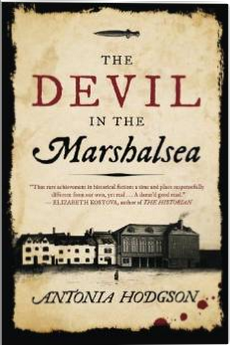
Day 692: The Devil in the Marshalsea

Cover for The Devil in the MarshalseaTom Hawkins has been leading a dissolute life ever since his ordination ceremony was sabotaged by his stepbrother’s reports of his behavior at school. In a desperate attempt to save himself from debtor’s prison, he goes out gambling with his disapproving friend Charles and manages to win enough money to save himself. But on the way home, he is attacked and robbed of everything. Soon, he is on his way to the Marshalsea.

In 1727, the Marshalsea is not the place Dickens described in Little DorritAlthough Dickens’ prison was a place of lost hope, in the early 18th century, the Marshalsea is a hell-hole run by a venal and vicious governor, Mr. Acton. Hawkins is astounded to find that it costs more to live in the Marshalsea than it does outside, and if you can’t pay your lodging you will be banished to the horrors of the Common Side, from which bodies are brought out daily. Hawkins has no money at all except what he gets for pawning his mother’s cross and a bit of money from Charles.

To support himself, Hawkins takes on the job of investigating the death of another debtor, Captain Roberts. Although Roberts’ death was deemed a suicide, it was almost certainly a murder, and his ghost is reported as roaming the prison.

Hawkins has taken Roberts’ room, so his roommate is Samuel Fleet, whom all of the prison inhabitants fear. Fleet claims to have been asleep when Roberts’ body was dragged from the room that night. But Hawkins soon observes that Fleet never sleeps.

This novel is terrific. It is thoroughly researched and richly imagined so that both the setting and characters come to life. Hodgson explains at the back of the book that many of the characters are based on actual historical figures. This is Hodgson’s first book, and I’ll be looking for more.

Related Posts

Jack Maggs

Great Expectations

The Solitary House

Day 656: The Mysteries of Udolpho

Cover for The Mysteries of UdolphoI valiantly strove to finish The Mysteries of Udolpho, but with about 80% of it read (frustratingly hard to tell with a collection on Kindle), I just couldn’t take it anymore. Although the book is a classic gothic novel, it is extremely long and slow moving, and my mild curiosity about the secrets of the castle could not overcome my feeling that the novel was never-ending.

Radcliffe was known for writing novels that were more realistic than those that had come before in the gothic genre. That is, the events, however unlikely, might actually happen. Heroines are kidnapped, not squashed to death by a giant foot.

Emily St. Aubert’s troubles begin with her father’s death, but not before the two of them take a leisurely several-hundred-page trip through Provence. There she and her father meet the handsome Valancourt, alas only a younger son.

After her father dies, Emily finds she is left destitute except for her estate and goes to live with her fashionable and shallow aunt Madame Cheron. Madame Cheron eventually marries an Italian lout, Count Montoni. Once Emily and her aunt are in his power, he expends all his energy first in trying to force Emily to marry one of his dupes and then in trying to get both women to hand over all their property in France.

About halfway through the nearly 800-page book, Montoni takes them to his castle, Udolpho, in the Italian alps. Here I was expecting things to heat up, and they do a little, with a disappearing previous owner, secret passageways, unnamed but horrible sights, and odd lights on the battlements. On the other hand, Emily spends most of her time looking at the scenery—described in excruciating detail and admired while she is in peril of her life—and painting watercolors. Oh, also writing poems at the drop of a hat that we get to read.

To modern audiences, Emily seems a bit insipid, but her role is to demonstrate the feminine virtues under duress. So, instead of investigating where the secret passage from her bedroom goes or looking at the contents of the heavy chest or trying to escape, she faints and runs away. She does, however, do what she thinks is right most of the time.

So far, although the most famous, The Mysteries of Udolpho is not my favorite of the “horrid mysteries” mentioned in Northanger Abbey that I reported I was reading in a collection. (This novel wasn’t mentioned but is included in the Horrid Novels collection for completeness.)

Related Posts

The Castle of Wolfenbach

Northanger Abbey

Dracula

Day 624: Men Against the Sea

Cover for Men Against the SeaMen Against the Sea is the sequel to Mutiny on the Bounty, and it accomplishes an interesting feat. While Mutiny on the Bounty depicts Captain Bligh as an enraged and irrational task-master, Men Against the Sea shows him as a consummate navigator and an able leader.

The novel takes up where the mutineers put the more loyal men adrift in a small boat. They have very little food and water and only a small tool box and a few weapons. Nineteen men are crowded into the 23-foot-long open launch.

Although the men make their way at first to one of the nearby Friendly Islands (present-day Tonga), they come close to being killed there by hostile natives. In fact, one of their number is murdered while they make their escape. They realize they will have to travel 3600 miles to the nearest European-occupied territory, in the Dutch East Indies (Indonesia).

Narrated by Thomas Ledward, the ship’s surgeon, the novel tells the story of this incredible journey. The men fend off hostile natives, battle storms, and survive on scanty rations and little fresh water, lead on by Captain Bligh.

This novel is well written and engrossing, although it lacks the suspense of the trial in Mutiny on the Bounty. I am looking forward to the final book in the series.


Day 616: The Rathbones

Cover for The RathbonesBest Book of the Week!
The Rathbones is a strange and wonderful novel, part gothic mystery, part magical realism, about a whaling family in the 18th and 19th centuries. Mercy Rathbone is a girl, the last of a mysterious family. She lives in a massive house only partially built that used to house dozens of people. Now only her aloof mother lives there with her and her cousin Mordecai—who stays in the attic and acts as her tutor—and a few servants.

Mercy has vague memories of a brother that her mother and cousin tell her never existed. She has not seen her father for more than ten years, although packages from him occasionally arrive. She is curious about the family portraits in a gallery, all with the names removed. She knows the names of her mother and father but has no idea who her grandparents were, or how they related to Moses, the patriarch of the family.

One night Mercy is attracted by the sound of a boy singing and ventures into a part of the house where she is not allowed, the widow’s walk where  her mother goes every night. There she witnesses her mother being embraced by a strange man, and that man chases her through the house. She finds refuge with Mordecai, and the two decide to go to sea to find her father. They flee in a little dory, pursued by the strange man.

So begins a wonderous adventure, where they encounter an island occupied only by old ladies; an island of rich, eccentric cousins with a massive collection of furniture and art; an island of birds occupied by a woman who only speaks bird language. At each stop Mercy learns more about the odd and sometimes grotesque history of her family, many of whom have a magical affinity for the sea.

I do not usually enjoy magical realism, but with this novel I loved never knowing where the story would go. It is an odd one, certainly, and probably not for everyone, but it is imaginative and unusual.

Day 614: The Bridge of San Luis Rey

Cover for The Bridge of San Luis ReyThe Bridge of San Luis Rey is a moral fable that explores whether there is a purpose in life beyond that of a person’s own will. This theme is not one that interests me, nor do I usually enjoy fables, but I did enjoy Wilder’s rich characterizations in this short novel.

The novel begins in 1714 in Peru, when the bridge of San Luis Rey collapses, killing five people. A monk, Brother Juniper, believes that this event may be his opportunity for scientific proof of the will of God. So, for six years he collects information about the lives of each victim.

What follows is a chapter about each of the lives of the victims, in all their humanness and contradictions. The Marquesa de Montemayor is an ugly, rich old woman who is despised by many for her eccentricity. She obsessively loves her daughter, who has moved to Spain to get away from her, and she writes her rambling but marvelous letters that only her son-in-law reads. With her dies her young maid Pepita.

Esteban is a twin whose brother Manuel recently died. Esteban and Manuel were inseparable until Manuel fell in love with the actress Perichole, who used him to write her love letters. Ever since Manuel’s death, Esteban has been inconsolable.

Uncle Pio was a wanderer who eventually settled down to mentor Perichole, whom he raised from a young barroom singer to become a great actress. But Perichole begins to have ambitions beyond the theatre and eventually throws off Uncle Pio. Uncle Pio has devoted himself only to her, though, and promises to educate her son Jaime.

This novel is beautifully written and touching in its acceptance of the foibles of humanity.


Day 608: The Convenient Marriage

Cover for The Convenient MarriageThe Winwood sisters are in turmoil. Miss Winwood has gained a spectacular suitor in the Earl of Rule, who has finally decided to marry. He is wealthy, and his generous settlement will save the family from ruin. The only problem is that Miss Winwood is in love with Edward Heron, a mere army lieutenant and a second son with no fortune.

Young Horatia Winwood, not yet out of the schoolroom, thinks she has the solution. Rule wants to marry a Winwood, and it should not matter to him which one. So, she goes to his house and proposes herself as an alternative. She forthrightly points out her unfortunate eyebrows and her stammer and hopes that Rule won’t mind them. Rule is enchanted.

So, Horry gets married without realizing she has made a love match. Since Rule is afraid he may be too old for her, he treats her with a little too much care. She has told him she won’t interfere with him, so she says nothing when she learns about his mistress, Caroline Massey.

Rule has broken with Massey, though, who is jealous and angry. Crosby Drelincourt, Rule’s foppish heir, is eager to make trouble, as is Rule’s enemy, Robert Lethbridge.

Horry soon finds herself very popular. But her efforts to make Rule jealous and the plots of Rule’s enemies land her in trouble, and her scapegrace brother Pelham’s schemes to get her out of it only make things worse.

In Horry, Heyer has created another engaging and feisty heroine. Heyer is an expert on the Regency period, as well as the master of warm and funny romantic escapades, and The Convenient Marriage is one of her best.

Day 587: Harvest

Cover for HarvestBest Book of the Week!
Harvest seems to be concerned with exploring the dark side of human nature. Set in an unspecified time in the past, it focuses on unusual events in a small, remote village.

The villagers are celebrating the harvest. They are so busy drinking and eating that they forget to appoint their harvest queen. Groggily awakening the next morning, they spot two fires. One is green wood burning in the distance, a signal that some new family is establishing itself. The other is the master’s resented dovecote and the stables. Someone has set fire to the dovecote, and the fire has spread.

The novel’s narrator, Walter, noticed three young men return the night before with a load of hallucinogenic mushrooms and a dried puffball. He knows there is no use for the puffball except to spread a fire. Still, he decides to say nothing.

After the fire is out, Walter notices how the men he believes guilty behave over-helpfully to Master Kent and insist that the newcomers must have set it. So, the master and some of the villagers go off to see them.

Walter has injured his hand in the fire, so he stays home. But he soon hears how the villagers caved in the roof of the hovel so that it injured the young woman inside and how the master sentenced her two companions to a week in the stocks.

For some reason I felt dread from the onset of this novel, and this feeling was not wrong. Although the villagers have already started trouble by not confessing their actions, much worse is to come. For kind Master Kent has lost his property through an entailment to his wife’s cousin, a ruthless and cruel young man who is only interested in enclosing the common land and putting it to sheep. Now that he is master, it is up to him to mete out justice when the next incident happens.

Although Walt’s main fault is inaction, he soon finds himself being treated like a stranger again, for he came to the village long ago as a servant to Master Kent. Soon the village he loved is unrecognizable.

This novel is masterfully written, about how greed and ignorance can destroy a community. It is a dark and twisty tale.

Day 569: The Castle of Wolfenbach

Cover for The Castle of WolfenbachThe Castle of Wolfenbach is one of several “horrid” novels referred to in Jane Austen’s Northanger Abbey. All of these novels, as I reported awhile back, are packaged together in a book for Kindle, so I thought I’d try them out.

This novel begins in the wilds of Switzerland on a stormy night when a mysterious young lady asks for shelter for herself and her servant at a small cottage. The inhabitants of the cottage take the fugitives to the nearby Castle of Wolfenbach for more comfortable accommodations. This castle is not being occupied by its owner but is maintained by two servants, and the castle’s upper floors are reputed to be haunted.

The young lady, Matilda Weimar, is not afraid of ghosts, however. She sleeps upstairs, and although she hears noises and sees lights across from her bedroom window, she goes the next day to explore that part of the castle. There she finds in residence an older lady and her female servant. The castle servant Joseph knows they are there, but his talkative wife does not.

Matilda explains why she is a fugitive. She has never known her parents, but was raised by her uncle. Lately, her uncle has begun showing her attentions that make her uncomfortable. What made her flee was that she overheard the housekeeper advising him to sneak into Matilda’s bedroom at night and claim her for his own.

The older lady, the Countess of Wolfenbach, offers to tell part of her story to Matilda, but Matilda asks her to wait until the next day. However, that night there is a disturbance, and Matilda visits the “haunted” area of the castle the next day to find the countess’s attendant murdered and the countess gone. When Matilda was leaving the countess the day before, however, the countess offered to send a letter to her sister in Paris asking for refuge for Matilda. Soon Matilda is on her way to the Marchioness of Melfort in Paris.

Matilda and her friends have many more adventures, in which Matilda unfailingly demonstrates her purity and honor. The evil Herr Weimar chases after her and tries to remove her from her friends, telling her that he is not actually her uncle but found her by the roadside. A young count falls in love with her, but her scruples about her unknown lineage do not permit her to accept his proposal of marriage. Temporarily, she retires to a convent.

The plot of the novel is quite convoluted and involves several kidnappings, pirates, murders, deathbed confessions, scandalous rumors, defamation of character, and other food for melodrama. Characters are mostly either good or evil, although all the evil people repent. Dialogue is elaborate and ceremonial.

This novel is not terribly scary to modern sensibilities, nor does Parsons do a very good job of creating suspense. But The Castle of Wolfenbach, which was written in 1793, is an early effort in what is essentially a genre of potboilers. Although Matilda is so good and does a lot of fainting, she at least shows some occasional evidence of spunk. Even as scary as its contemporary audiences found it, there is little doubt of a happy ending.

WolfenbachI was disappointed not to find a spooky cover available for this novel, although the one for the collection I am reading isn’t bad, so I attach a picture of this scary castle. It came up on a search for the cover, but I actually have no idea at all where it came from.


Day 538: Treasure Island

Cover for Treasure IslandIf I had to guess which of Robert Louis Stevenson’s books is the most popular, I’d pick Treasure Island. My own favorite is Kidnapped, though, and I probably wouldn’t have reread Treasure Island except that it came free with a reading app for my iPad. Still, it’s a pretty good adventure story.

The plot is familiar to everyone. Jim Hawkins and his parents run the Admiral Benbow Inn in an isolated location near the English seashore. A shifty old sailor comes to stay. He seems to be on the watch for someone, and asks Jim to alert him to strangers. Soon more shifty sailors arrive looking for him. The Hawkins’ guest is drinking himself to death, though, and he dies soon after Jim’s father does. In his sea chest is a treasure map.

Jim has gone for help to the Squire Trelawny and Dr. Livesey. Soon they prepare a ship to go collect the treasure, taking Jim with them. A crucial misstep occurs when the Squire hires the crew without waiting for the captain (something that seemed not only improper but stupid to me). He hires as the cook a one-legged man named Long John Silver. Silver and a good part of the crew turn out to be pirates who know about the map and want the treasure.

I was struck by a few cases when the protagonists behave nonsensically, the biggest being abandoning the ship when they find out a mutiny is afoot. Almost all the sailors are ashore at that point. It seemed like they should just sail away to another part of the island.

Still, the novel is written really well, and Stevenson is good at building suspense. I’m sure that successive generations of young people are thrilled to discover this adventure story.