Day 1204: The 1977 Club! The Women’s Room

Cover for The Women's RoomThere’s nothing subtle about The Women’s Room. It’s a book I reread for the 1977 Club, and I was curious about whether it would affect me the way it did the first time, years ago.

It is the story of Mira and her awakening consciousness of the role of gender in our society. In its time, the novel was an important feminist work that profoundly affected the thinking of many women and perhaps some men. I remember vividly watching the movie on TV with a male coworker. He was astounded at the examples of sexism but even more astounded because I kept saying “That’s happened to me,” pretty much for every example.

French uses the vehicle of the novel to tell the stories of many women. First, it focuses on Mira’s suburbanite girlfriends when she is a young wife and mother in the 1950’s. Without fail, they are all treated poorly by their husbands. She prides herself on being the perfect wife and mother even though she finds life unfulfilling, but that doesn’t save her from a divorce when she is in her late 30’s.

The bulk of the novel focuses on the women she befriends as a graduate student at Harvard. These women are awakening to paternalism in our society. Still, they, too, are all betrayed in some way by their husbands or boyfriends.

I’m struggling now to express my many thoughts with some kind of coherency. One is about the crudeness of it all. First, I was struck by some of the things the men said to their wives in the early portions of the novel and by how the wives accepted this kind of stuff without being outraged. I’m talking about terrible name calling and reducing everything to sex. These women were more my mother’s age than mine, so I have no way of telling whether these scenes were exaggerated.

But overall, I feel that French makes a lot of generalizations and stereotypes men as badly as the men stereotype the women in her novel. I was always confused in the 70’s by some men who seemed to equate feminism with man-hating, but rereading this novel, I can see where that idea comes from.

Finally, it is just plain crude. I understand that women were taking pride in being able to discuss sex and use words that were only allowed to men before, but the language really grated on me. Moreover, there is free use of ethnic slurs. Maybe we’re supposed to know that they are used ironically, but there’s no overt indication that this is the case.

1977 club logoI think The Women’s Room is important as a historical document but not as literature. There are, for example, many places where the story is interrupted by little polemics by a narrator who is unnamed until the end of the novel (although it’s not too difficult to figure out who she is). I found these interruptions, where the narrator has to overtly draw conclusions about the events, irritating and unsubtle, as if French thinks her readers are too stupid to come to the right conclusions. Same with many of the discussions between her characters, although that’s a better way to handle the subjects.

Although my memory of my first reading of this book, when I was in my 20’s, was that I was struck by how much of it mirrored some of my experience, I do remember that French wrote another book, which I also read. And I remember thinking, oh, more of the same stuff, and putting it aside.

Related Posts

The Kreutzer Sonata Variations

The Invention of Wings

Sweet Tooth

Day 1202: The Mystery of Mrs. Blencarrow

Cover for The Mystery of Mrs. BlencarrowFlighty Kitty Bircham has flown to Gretna Green to elope with her swain when she discovers in the marriage record a juicy bit of gossip. The respectable and dignified widow from her village, Mrs. Joan Blencarrow, has married someone secretly. Indeed, she has been married for three years!

Kitty is so excited about her discovery that she fails to notice the name of Mrs. Blencarrow’s husband. Instead of running off with her own new husband to London as planned, Kitty goes straight home, figuring this juicy bit of news will win her forgiveness from her mother.

Soon the neighborhood is agog. Is the rumor true or not? Mrs. Blencarrow even has a visit from her own uncles trying to find out, but she only tells the vicar the truth.

I was somewhat dissatisfied with this Victorian era sensation novella, which is a character study rather than a mystery. Part of the truth comes out fairly quickly, but it isn’t hard to guess the other part. And we get a very unfinished story. Why did the couple marry? That’s not at all clear. Are we to believe it was from passion? That’s hard to believe considering her later reaction. What is clear is that Mrs. Blencarrow thinks she will be in disgrace if the truth comes out. But that doesn’t answer the question of why they married in the first place.

Mrs. Blencarrow is an interesting person, and this is a very short work, so a qualified approval.

Related Posts

Passages in the Life of Mrs. Margaret Maitland, of Sunnyside

The Rector and the Doctor’s Family

The Perpetual Curate 

Day 1198: Consequences

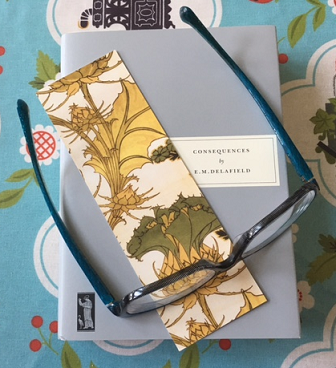
Cover of ConsequencesIf you expect E. M. Delafield’s Consequences to be like her witty Diary of a Provincial Lady, you will be surprised. Although it addresses themes that Diary touched on much more lightly, it is serious, sad, and even bitter.

Alex Clare grows up in the typical environment of a Victorian child of wealthy parents. She and her brothers and sisters are raised by Nanny and only see their parents at specific times. Alex is an aggressive child with her siblings, but her desire is to have someone care about her. Since Nanny dislikes her and Cedric and Barbara band against her, she tries to please her mother.

But a childish game causes a near tragedy. Alex’s part in it is misinterpreted, and she feels too guilty to defend herself, so her parents send her away to a convent school in Belgium.

Here, Alex begins a lifelong pattern of fastening upon someone for whom she will do anything. In school, it is Queenie, for whom she breaks rules to give treats and try to hang around her. These kinds of crushes are forbidden, and Alex is constantly in trouble for breaking rules, while Queenie blithely accepts forbidden treats and gets away with it. Alex does not learn to develop standards of behavior. She just yearns for love and understanding without having the ability to evoke it from others.

This childhood does not prepare her for young womanhood, where the only expectation is that she will marry well. She does not enjoy all the parties and events she must attend and is unable to hide her discontent.

Alex is not an attractive character. She is needy, unprincipled, and depressive. But her small transgressions are magnified by her family until she feels friendless and isolated.

Consequences is Delafield’s indictment of this kind of upbringing and the expectations for women of her class and time. It is also a character study of a woman who feels lost wherever she is. It is quite the feminist statement, published in 1919. The reviews included in the appendix of the Persephone edition show that its message was not well understood or accepted by the (presumably) male literary world of its time.

Related Posts

The Diary of a Provincial Lady

The Home-Maker

A Lady and Her Husband

Day 1192: The Priory

Cover for The PrioryBest of Five!
Saunby is an old estate that belongs to Major Marwood. It was once a priory, and the ruins are still there. The major is a poor landlord and manager who cares only for cricket. Although he has hundreds of pounds of unpaid bills and the house is falling to bits, he spends a huge amount of money every year in hosting two weeks of cricket matches.

The major is most unhappy about how the house is being run. His sister, Victoria, who is supposed to be in charge of the house, pays attention to nothing but her art, producing one atrocious painting after another. His two daughters, Christine and Penelope, are happy in their isolation up in the nursery, making odd-looking dresses and ridiculing the neighbors. The servants do what they want. Everyone in the household is completely self-absorbed.

So, the major decides it is time he remarried, principally to get someone to take care of the house and keep expenses in check.  He has his eyes upon Anthea Sumpton, a woman no longer young who he is sure will be sensible.

Unfortunately, Anthea is in love with him and doesn’t understand he is making a marriage of convenience. Soon, she will have a rude awakening.

Everyone in this novel is due for a rude awakening, however, as the focus of the novel moves to Christine and what happens when she falls in love with Nicholas Ashwell. He is one of her father’s cricket players who has been raised to be as selfish as her family is.

This novel is also somewhat an Upstairs/Downstairs novel at first, when the new maid, Bessy, falls in love with Thompson, who helps with the cricket. He returns her feelings but doesn’t reckon with the rejected Bertha.

This novel is the best kind, the type in which characters develop and you change your mind about them. Beginning in the late 1930’s, it is also winding its way slowly toward the war. I found the novel beautifully written, involving, and ultimately touching, as a dysfunctional family learns to become slightly more functional. I have enjoyed all of Whipple’s novels, but I think I liked this one best, so far.

Related Posts

They Knew Mr. Knight

Someone At a Distance

Greenbanks

Day 1185: Landscape in Sunlight

Cover for Landscape in SunlightMrs. Custance, the vicar’s wife, is planning the annual church fête, but she is also wondering what will happen to her daughter. Cassie is currently tutoring Leonard Templar, but Mrs. Custance knows she is contemplating taking a caravan with her bouncing friend Joan and perhaps working at Joan’s school. Mrs. Custance once hoped that Cassie would marry George Brigham, Cassie’s childhood friend, but after the war George got engaged to an Italian countess. The engagement was short-lived, but Mrs. Custance has never forgiven George. George’s father, Sir James, also complains that George is an unsatisfactory son.

George has done nothing worse than go into partnership with a tradesman. Any income in the house belongs to him, but it’s not keeping the house from going to bits under the care of two lazy old servants.

In the meantime, Eustace Templar is trying to think of a way to get the Midges out of Prospect Cottage, his rental home. Eustace thinks it is the perfect home for his brother-in-law, Colonel Ashford, if only the Midges could be persuaded to move.

Landscape in Sunlight is another enjoyable domestic comedy by Elizabeth Fair. It follows the village people through their everyday lives, with just a touch of romance.

Related Posts

Bramton Wick

The Mingham Air

The Native Heath


Day 1176: The Native Heath

Cover for The Native HeathJulia Dunstan is delighted to have inherited her uncle’s Belmont House in Goatstock. Belmont House was the place of her fondest memories of childhood, when she and her cousin Dora would visit there. Dora, too, she is meeting for the first time in years, since Julia’s widowhood and return from life in the colonies. As Julia is given to impulsive and kind acts, she invites Dora to live with her at Belmont House, Dora having had such a hard life.

In Goatstock, the neighbors are all agog to set eyes upon Julia. And eccentric neighbors there are aplenty. Mrs. Minnis dresses like a juvenile and borrows from the neighbors; if returned, the objects are broken. Mrs. Prentice is so embarrassed at being caught looking into the house from the street that she fails to call. The vicar and Miss Pope are being preyed upon by Miss Briggs, who sees Alaric Pope as a future husband. Lady Fincy is the expert on food and gives lectures about eating nettles.

Of young people, there are only three. Julia has brought along her nephew, Robert, just qualified as an engineer. Marian Prentice is engaged to a missionary in Africa, and her best friend, Harriet Finch, would like to see her stay in England. Harriet plots to throw Robert and Marian together before she realizes she quite likes Robert herself.

As for Julia, her kind heart soon has her feeling responsible for several people. But she eagerly renews her friendship with her cousin, Francis Heswald. He always did like her, she thinks, but maybe he likes Dora a little more.

I’ve found all of Elizabeth Fair’s books delightful, and this one is no exception. They have been compared to the work of Angela Thirkell, minus the sentiment. I don’t actually think of Thirkell’s novels as sentimental, however, so I’m not sure what that comment means. With Fair’s flair for eccentric characters and their lightness, her books remind me more of some of those of Elizabeth Cadell.

Related Posts

Bramton Wick

A Winter Away

The Mingham Air

Day 1171: Seaview House

Cover for Seaview HouseAlthough Mr. Heritage has been friends with sisters Rose Barlow and Edith Newby for years, he is jealous of the attention of his godson, Edward Wray. So, he is not at all happy when he notices that Edward is attracted to Rose’s daughter Lucy.

Lucy has been friends with Nevil Fowler since they were children and has a dim expectation that they will eventually marry. That’s why it takes her a while to figure out that she has feelings for Edward. In the meantime, Mr. Heritage’s machinations have put matrimony in Nevil’s mind, and Lucy’s best friend, Philippa, has intimated that she is closer to Edward than she actually is.

Seaview House is another charming domestic comedy from Elizabeth Fair. I only recently discovered her novels, being republished by Furrowed Middlebrow, and wish there were more than six of them to read.

Related Posts

A Winter Away

Bramton Wick

The Mingham Air

Day 1166: The Mingham Air

Cover for The Mingham AirA broken engagement followed by a bout of pneumonia brings Hester Clifford to Mingham and her godmother, Cecily Hutton, for recovery. She is inclined to think the Huttons need some organizing. Cecily is a woman of two moods, the creative and the motherly, of which the creative is the predominant. So, her household is poorly run. Her husband, Bennet, has been an invalid for so long that invalidism has become more of a habit than a necessity. Maggie works hard on a nearby farm, but Cecily is constantly scolding her for her dress and general messy appearance. Derek can’t decide what to do with his life, so keeps changing jobs.

The Huttons used to be friendly with Thomas Seamark, but since his wife’s death four years ago, he has become a bit of a recluse. Hester thinks it’s about time the friendship was renewed, and her efforts are successful. This renewed acquaintance leads Cecily to the conclusion that Hester would make a perfect wife for Thomas. She becomes so convinced of this that she doesn’t even notice she is putting obstacles in the way of his pursuit of her daughter, Maggie.

Like Fair’s other novels, The Mingham Air is full of colorful village characters, like Mrs. Hyde-Ridley who competes with her closest friend to entertain her while spending the least possible money, and Mrs. Merlin, the rector’s wife, who co-ops the parish féte for a display of country dancing. I enjoy these light novels, which contain just the slightest edge.

Related Posts

A Winter Away

Bramton Wick

Money to Burn

Day 1163: The Shuttle

Cover for The ShuttleAt first, I wasn’t sure I would like The Shuttle, despite my enjoyment of Frances Hodgson Burnett’s other novels. That is because it begins with an extended metaphor, rather cumbersome, about the shuttle of fate weaving together east and west. I wasn’t altogether sure which east and west she was talking about and had wild thoughts about China. But we weren’t leaving the Occident. By west she meant America, more precisely the United States. By east, England. But this introduction lasts only a couple of pages, and then we get into the action.

The novel begins with Rosalie Vanderpoel, the gentle, naive daughter of a New York millionaire. It is the early days of the migration of young, titled Englishmen to New York looking to marry money, and the relatively innocent New Yorkers don’t understand that most of these men are fortune hunters. Rosalie becomes engaged to Sir Nigel Anstruthers. Although Reuben Vanderpoel, Rosalie’s father, does not like Nigel, only nine-year-old Bettina sees him for the vicious bully that he is.

But Nigel hasn’t done his homework. He doesn’t realize that American girls don’t come with dowries nor that Rosalie won’t expect to hand her money over to her husband for handling, as an Englishwoman might. Once he realizes his mistake, he blames it on Rosalie.

Rosalie goes to live in dilapidated Stornham Court, where she is mistreated and bullied by her husband and his mother. Thinking that no man would take money from a woman, Rosalie doesn’t offer any, and it takes a while before she realizes that’s what he wants. But he doesn’t want money for the estate, just to support his vicious habits. He cuts her off from her family to make her miserable and keep control.

Rosalie isn’t the heroine of the novel, however. That honor belongs to Bettina, or Betty, who vows at the age of nine to go sometime and rescue Rosalie. And so she does, 15 years later.

This novel isn’t one of great surprises. When Betty finds Rosalie and her son alone and works to buck them up and get them ready to leave, the tension builds from the expectation of a showdown with Nigel. When Nigel finally arrives, he uses all his cleverness to foil Betty. We know who will win—we just don’t know how.

I don’t think Burnett’s adult novels were considered sensation fiction, but this one certainly deals with those kinds of topics and is very melodramatic. Still, it was a fun book to read. Betty is clever and determined. You know she will win at love and defeat Sir Nigel.

Related Posts

The Making of a Marchioness

That Lass o’Lowrie’s

Diana Tempest

Day 1156: Bramton Wick

Cover for Bramton WickI so enjoyed A Winter Away that I looked for more novels by Elizabeth Fair immediately. I found that they are being reprinted in a nice edition by Furrowed Middlebrow. Bramton Wick is Fair’s first novel, set in a village in post-World War II England. It is a gentle domestic novel with a bit of an edge.

Although the novel features several eccentric denizens of the village, it centers around Laura and Gillian Cole. Mrs. Cole and her family used to be the owners of Endbury, one of the large homes in the area, until Mr. Cole died and they had to sell. Mrs. Cole, although she dislikes the current owner of Endbury, Lady Masters, has begun to notice that Lady Masters’ son Toby has a liking for Laura.

Neighbors Miss Selbourne and her friend “Tiger” Garrett raise dogs in a cheerfully disordered household. Miss Selbourne has noticed, though, that whenever there is something unpleasant to be done, Tiger gets ill.

The neighborhood isn’t short of elderly women, for the Miss Cleeves are also nearby. The Miss Cleeves are penniless and dependent upon their landlord, Miles Corton, for help. Miss Cleeve is profoundly deaf, one sister is a religious fanatic, and the other sister sprinkles her malicious gossip with untruths.

Gillian, Mrs. Cole’s other daughter who is a war widow, has decided to take under her wing the wealthy new resident of the village. Mr. Greenley is from new money. He dresses like a parody of an English country gentleman and has not been welcomed to the village. Gillian thinks he just needs a little help fitting in.

This novel is gently comic, reminding me of Angela Thirkell without quite so much sharpness and snobbery. As Laura tries to figure out what she wants from life, we are greatly entertained by the antics of her neighbors.

Related Posts

A Winter Away

Wild Strawberries

Money to Burn