Day 784: The Heart Goes Last

Cover for The Heart Goes LastStan and Charmaine are living in their car. They used to live a comfortable middle-class life, but the downturn was worst in the Northeast and both of them lost their jobs and then their home. There has been a breakdown in society. The streets are dangerous and normal services are defunct.

Charmaine has been earning a bit as a waitress in a bar, and Stan has been looking for work. He is even forced to go to his shady brother Colin for help when it has always been the other way around. Colin offers him a job, but Stan decides to wait a while, knowing that the job is likely to be illegal.

On the TV at the bar, Charmain sees an ad for the Positron Project, which offers employment and housing. When Stan and Charmain attend an introductory session, they’re not told very much except that if they return, they will not be allowed to leave. They must be ready to commit to the project.

Stan and Charmaine decide to give up their freedom for stability, even though Colin warns them not to go there. When they commit to the project, they find that the whole community is built around a prison. To create enough work around the prison, the staff must alternate one month inside the prison as inmates, one month out, sharing their house with another couple that is in when they are out.

This situation doesn’t seem to disturb them, and they continue on for a year. Then Charmaine becomes romantically involved with their male alternate, who calls himself Max. This relationship eventually leads to discoveries about the true nature of the project.

link to NetgalleyThe Heart Goes Last allows Atwood full rein of her acerbic sense of humor and biting satire. It is reminiscent of the darker excesses of the Maddaddam trilogy but without any very sympathetic characters. Instead, it gets progressively more absurd as it continues. Its references to the current political climate are obvious. Although I found this novel entertaining, I did not enjoy it as much as I have some of Atwood’s other novels.

Note: Caroline of Rosemary and Reading Glasses has written this fascinating post comparing this novel to Milton’s Paradise Lost.

Related Posts

The Handmaid’s Tale

Oryx and Crake

The Stone Mattress


Day 782: Literary Wives! The Silent Wife

Cover for The Silent WifeToday is another review for the Literary Wives blogging club in which we discuss the depiction of wives in modern fiction. Be sure to read the reviews and comments of the other wives! If you have read the book, please participate by leaving comments on any of our blogs.

Emily of The Bookshelf of Emily J.
Lynn of Smoke and Mirrors
Naomi of Consumed By Ink

* * *

Although The Silent Wife is billed as a psychological thriller, if that is actually its intent instead of marketing hype, it fails. I see it as more of an in-depth exploration of a dysfunctional relationship and particularly of the character of one unusual woman.

Jodie’s husband Todd of 20 years has just been through a depression, but he seems to be improving. On the surface, their marriage is fine. She is a highly educated woman who enjoys making a perfect home and working part-time with her therapy clients. Todd’s remodeling business keeps him out of the house a lot, and he enjoys drinking after work with his buddies, but she doesn’t seem to mind this and is always glad to see him come home. Although he is a serial womanizer, she has long learned to live with this fact and ignores it.

This information is the first odd note in the novel, because we have learned that Jodie’s father was also a womanizer, and Jodie was a witness to the havoc it created. We wonder immediately how she can accept this situation in her own marriage.

What Jodie doesn’t know is that Todd has embarked on a more serious affair. He is sleeping with the 20-something daughter of his boyhood friend Dean. Although he doesn’t remember proposing to her, suddenly he has a fiancée and a baby on the way, and Natasha is pushing him to tell Jodie.

When Jodie learns about the affair, it is through the furious Dean. Todd hasn’t mentioned a thing, so she doesn’t take it seriously. Even when he tells her he’s moving out, on the morning of the event, she still thinks he’ll come back.

Although I didn’t find this novel to be a thriller, we know from the first sentences that a crime is involved, and the novel is an effective psychological portrait of a woman who can ignore anything she doesn’t want to see. Combined with a man who avoids anything confrontational, this is an explosive mixture. While Todd allows himself to be pushed into one untenable position after another, Jodie continues to disregard what is happening.

The novel is effective and it kept my interest, but it indulges a little too often and too long in its deep discussions of psychology. Perhaps this is supposed to be a reflection of how Jodie thinks, although it’s not always presented that way, but these passages could have been more succinct and effective. Added to that, the novel is only moderately well written. Still, the plot keeps you engaged.

What does this book say about wives or about the experience of being a wife? In what way does the woman define “wife”—or in what way is she defined by “wife”?

Literary Wives logoI think that this novel is too particular to this couple to make any broad statements about being a wife. But Jodie has definitely created her own image of her relationship to Todd. She has prided herself on making the perfect, calm, immaculate home, on providing beautifully cooked, delicious meals, on leading her own life and letting Todd lead his. But this life does not seem to consist of any sharing on an emotional level. In fact, it survives by keeping secrets.

Her reaction to Todd’s cheating seems inexplicable at first, considering her parents went through the same thing. Instead of it being a deal-breaker, she decides not to let it bother her. She puts it away from her. This is the character trait that I found fascinating. Her father’s unfaithfulness made her mother unhappy. So, she decides not to let it make her unhappy. She continues not to even acknowledge the truth of other things that might make her unhappy, and she pursues this course through one unpalatable event after another. But then, we find she has plenty of practice in hiding things from herself.

Related Posts

The Child Garden

This Is Your Life, Harriet Chance!

Mercy Snow

Day 780: A Place We Knew Well

Cover for A Place We Knew WellI was a kid during the Cuban Missile Crisis, and I don’t remember it as having much effect on our lives. I do remember the ridiculous duck-and-cover exercises and the display of model fall-out shelters, but I only remember one family that had one. I grew up in Michigan, not Florida, though, where things were apparently different.

Wes Avery realizes that something is up early on Friday, October 19, 1962. He is a former air force gunner, who took part in bombing raids over Japan during World War II. When the nearby McCoy Air Force Base begins a build-up, he notices right away.

The rest of his family is absorbed in other activities so at first doesn’t notice his concern. His wife Sarah is depressed and traumatized over a hysterectomy that was performed on her without her consent a couple of years before, after a miscarriage (sadly, all too common at that time). Her doctor is treating her with far too many pills. Charlotte, their daughter, has been picked for the Homecoming court. She is worried that she will be the only girl without a date until Wes’s employee and best friend Steve suggests that another employee, Emilio, a Cuban refugee from a good family, take her.

Emilio and Charlotte are happy about this solution, but Sarah tries to talk Charlotte into waiting, knowing that other boys whom Sarah considers more suitable will ask her. Wes has to field arguments from Sarah, who obviously thinks he tries too much to please everyone. Added to all this tension, as everyone’s awareness of the situation with Cuba grows, is a family member’s reappearance, which makes West feel disloyal to Sarah.

link to NetgalleyThis novel is effective at building tension and sympathy for Wes in the situation in which he finds himself. Despite what has happened to Sarah, it is not as good at evoking sympathy for her. Although her preoccupations turn out to have a deeper basis, if only in her own mind, they seem trivial compared to the possible immanence of war and the difficulties Wes finds himself in. I think we should feel more deeply for Sarah, but for some reason, we don’t, perhaps because her concern over Charlotte’s first date and her apparent snobbery seems so ridiculous. (Of course, there is a reason for that.)

However, overall I think this novel does a great job of evoking time and place. I think the closing chapter, a letter written in present time, is a little too didactic, though, and serves as an anticlimax even though we want to know what happened to the characters.

Related Posts

The House We Grew Up In

Amy and Isabelle

Once Upon a River

Day 778: This Is Your Life, Harriet Chance!

Cover for This Is Your Life, Harriet ChanceA few years ago, I read Jonathan Evison’s West of Here. This Is Your Life, Harriet Chance! is nothing like it. It’s a somewhat whimsically told story of the whole of one woman’s difficult life.

Harriet Chance is a widow nearing 80 whose husband died a few months before from Alzheimer’s. She gets a call from a cruise company telling her that her husband booked a cruise to Alaska for two. At first, she has no intention of going, but then she decides to take her best friend, Mildred.

Her friends and family are a little concerned, because she claims she is being haunted by her husband, Bernard. Harriet is a little worried that they want her to enter the retirement community where Mildred lives. She loves her home and doesn’t want to leave. Besides, Bernard is haunting her.

When Mildred’s son arrives to pick Harriet up for the cruise, she learns that Mildred isn’t coming after all. Instead, Dwight gives her a letter to open on the ship. Harriet isn’t going to like what it says.

link to NetgalleyTold in a way that is supposed to remind us of the old TV show, “This Is Your Life,” the novel skips backward and forward to scenes from Harriet’s ordinary-seeming but painful life. This narrative technique is anchored by the story of the cruise, which is told linearly.

I found this novel touching, although in some ways the narrative style creates distance from the story. It’s a serious story told as if it’s a comedy, with bumbling, repentant Bernard as a chorus in ghost form.

Related Posts

West of Here

A Heartbreaking Work of Staggering Genius

Sweet Caress

Day 773: We Need New Names

Cover for We Need New NamesI wanted to like We Need New Names more than I did. It is about an interesting topic and is vividly written, sometimes with striking images. But like some of the commenters on Goodreads, I agree that it seems to be trying to deal with too many issues at once. Somehow, I did not get as involved as I expected.

Darling is a tween girl running with her friends from Paradise, a slum of tin shacks in Zimbabwe. They spend their time playing games and stealing guavas from a richer neighborhood called Budapest. Darling’s father has been away in South Africa for years, trying to find work, but they haven’t heard from him or received any money. While Darling’s mother is traveling to sell things, Darling stays with her grandmother, Mother of Bones.

Eventually we learn that Darling’s family used to live a middle class life in a brick house, but the government knocked down their neighborhood. So, they came to live in Paradise.

Bulawayo’s tale is focused enough until, after a vote against the corrupt government results in retaliation, things become too dangerous and she is sent to live with her aunt in Detroit. Perhaps the last third of the novel reflects Darling’s confusion as a teenager, but it packs in scenes of typical teenage years conflated with growing awareness of issues back home, the disconnected feelings of immigrants, the war in Afghanistan, some sneers at the U.S., and her own homesickness. At some times it feels as if Bulawayo thinks America should be responsible for the welfare of all nations, which it can’t possibly do.

Related Posts

Unaccustomed Earth

Once Upon a River

Under the Lemon Trees


Day 767: Still Alice

Cover for Still AliceBest Book of the Week!
Still Alice is the sometimes harrowing but always compassionate story of a woman diagnosed with early onset Alzheimer’s. Alice Howland regards her life as nearly perfect. At 50 years old, she is a tenured cognitive psychology professor at Harvard who speaks regularly at conferences. Her husband is an important research scientist also at Harvard. She has three adult children. Her only regret is a feeling of loss of the closeness she once had with her husband John. She feels his lab is more important than she is.

Alice begins noticing small little lapses. She occasionally forgets a word or loses something. She puts this down to natural aging until one day when she is on her way home from a run and suddenly gets lost. She is only confused for a few minutes but is disturbed by the incident. After she forgets to go to one of her conferences, she visits a doctor and eventually gets her diagnosis.

What makes this novel unusual is that we see Alice’s deterioration from her own point of view. She understands what is happening to her until she doesn’t. In her case, the progress of the disease is terrifyingly swift. She is diagnosed in the fall, but by the spring she is receiving the only poor teaching evaluations she has ever gotten from her students. We see her loss of pride as her ability to lead her life erodes.

As an older woman, I found some of the tests she undergoes alarming, particularly one where she’s shown a picture of an object and can’t think of its name. I knew what object they were describing, and I also couldn’t think of the name for about a minute. It was a hammock. When we are older, we all have incidents like this, but I think they raise the dread of this disease sometimes. Luckily, I don’t have the gene associated with Alzheimers (although that doesn’t guarantee that I won’t get it), and I haven’t ever had any major episodes like Genova describes.

Genova’s novel makes a strong point about the lack of support for Alzheimer’s patients. She shows how Alice, because she loses language first, is unable to explain that she can still understand what’s going on, at least at times, but people behave as if she cannot.

This novel is excellent. Once you sit down with it, you won’t want to get back up until you finish it.

Related Posts

We Are Not Ourselves

Family Furnishings

Thinking, Fast and Slow

Day 764: Sweet Caress

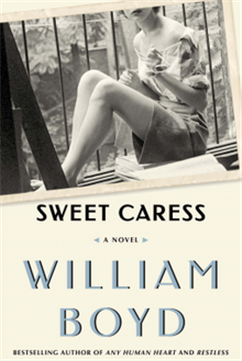
Cover for Sweet CaressAlthough I have by no means read everything by William Boyd, Sweet Caress reminds me most of his Any Human Heart, perhaps because it’s the story of one person’s life. This novel is about Amory Clay, a photographer born in 1908. Boyd creates the impression that Amory is a real person (so much so that I googled her twice) by interjecting photos of her life into the novel.

Amory leads an unusual life almost from the start of the novel. Although her father suffers from depression and other problems as a result of World War I, she is so content with her home life that she is upset when her parents send her away to school. Her parents are not well off, but Amory learns later that a legacy from an aunt is dedicated to her education.

Her mother wants her to attend university, but she decides early that she doesn’t want to go. Her favorite uncle, Greville, gave her a camera on her 10th birthday, and she wants to be a professional photographer.

Then a violent incident brings her home. Her father arrives at school unexpectedly to take her to tea. But his intention is to commit suicide, and he doesn’t want to go alone. Amory survives the drive into the lake and even saves her father, who is committed to an institution for a long time.

Soon after, Amory becomes Uncle Greville’s assistant. He is a society photographer, and although Amory does not enjoy this type of work, she must start somewhere. But she takes a risk with an unusual betrothal photo, and its reception ruins her chances. Soon Amory is off to capture the decadent night life of Berlin.

Amory leads an extraordinary life that contains many sorrows and triumphs. She is a war correspondent for both World War II and the Vietnam War, she is attacked by fascists rioting in London, she travels with lesbians to Mexico, she encounters a Charles Manson-like figure in 1960’s California. She almost unwittingly marries a lord and has a family. These are just some of the events of her life, its story punctuated with paragraphs from the “present time” of 1978, when Amory is an old woman.

link to NetgalleyI found this novel involving, although not as much as I did Any Human Heart. For one thing, I wasn’t always convinced I was hearing a woman’s voice, and in no way was this because of Amory’s adventurous life. Also, Amory’s voice is a reserved one, with certain exceptions. Still, it is a fascinating story that manages to cover a great deal of modern history.

Related Posts

The All-True Travels and Adventures of Lidie Newton

The Signature of All Things

The Lacuna

Day 759: We Are Not Ourselves

Cover for We Are Not OurselvesBest Book of the Week!
Eileen Tumulty has had a tough youth and adolescence with her Irish immigrant family struggling with alcoholism. For most of her school years she’s had to keep the house and take care of her drunken mother. So, when she meets Ed Leary, a young scientist who holds the promise of getting out of her neighborhood in Queens, she marries him.

In some ways, they are a mismatch even though they love each other. Eileen is a practical woman, ambitious for a well-to-do life. Ed cares about integrity, his teaching, and his research. When Eileen buys him an expensive gold watch for a wedding present, one she cannot return, he refuses to wear it even after she replaces the gold wristband with a leather one. He teaches and has a lab at Bronx College. Several times he is offered jobs at more prestigious schools that he turns down. He also turns down an offer to be head of his department.

After a while, Eileen becomes exasperated at their lack of upward mobility. They have bought the three-family house in which they rented an apartment, but they still live in the same Queens neighborhood they moved to when they were married. However, after their son Connell is born, Eileen settles her attention on him for awhile and also continues her nursing career.

Eventually, a shadow falls over the lives of the Learys. I don’t want to tell what it is, because it happens well into the novel. Until it happens, I sometimes wondered where the novel was going but eventually realized it is an honest, unflinching look at the pressures on a small family of a tremendous burden.

The novel is told mostly from the point of view of Eileen, a strong, independent woman with a will to succeed. Because of her upbringing, she has problems with showing affection and being open. Ed is warmer and more affectionate to Connell. Connell is slow to mature but eventually learns to accept responsibility for his actions.

I felt for a long time some distance from these characters, but the sheer weight of everything we learn about them eventually breaks through this barrier. The result is a touching and affecting story about love’s power over adversity.

Related Posts

I Know This Much Is True

The Fault in Our Stars

The House We Grew Up In

Day 738: The House Gun

Cover for The House GunWhen Nadine Gordimer died last year, I thought it was about time I read something by her. I’ll say right up front that I did not find The House Gun easy to get into.

Almost the only characters of any depth are Claudia and Harald Lindgard, an older upper-middle-class liberal white couple living, I assume, in Johannesburg, although the city is never mentioned by name. The novel is set in the 1990’s, just after De Clerc has left office and the nation is stumbling to find its way in a new order.

Claudia and Harald are disturbed in their gated complex one night by a friend of their son Duncan who comes to report a horrible event. Duncan has been living in a compound in a separate house from three gay men. One of them has been murdered, and Duncan has been arrested for it.

The story is mostly about the effect this event has on the couple’s marriage. At first very close, they are driven apart almost immediately. They know nothing about what happened, and Duncan isn’t talking. Eventually they learn from Duncan’s advocate, Hamilton Motsamai, that Duncan did indeed shoot Carl Jesperson after finding him having sex with Duncan’s girlfriend Natalie.

There is much more to the story, but it comes out slowly. And Gordimer’s writing style is so abrupt and choppy, her viewpoint so removed and analytical, that the novel seems chilling. This impression is heightened by the tendency to use pronouns or other nouns instead of names for the other characters, especially for Natalie, who is referred to as “the girl,” and the victim, who is referred to as “he” or “him.” Obviously, since the novel is from the point of view of the couple, this naming is a distancing technique to separate the parents from the victim and the person they consider the instigator, but the overall effect is to also distance the reader. I have no frame of reference to know if this writing style is typical of Gordimer or not.

Of course, there are other, more political points to the novel. Although viewing themselves as liberals, Claudia and Harald are shaken to find how biased they are. For example, they wonder at first about the competency of Duncan’s advocate just because of Motsamai’s color. Racial and stereotypical comments permeate the book. It is clearly an issue that is on everyone’s mind.

Then again, the presence of the gun is an important issue. In an article about the novel in The New York Times, a statistic was quoted that after the violent and abusive regime of De Clerc ended and Mandela came into power, official statistics of violence in South Africa increased tenfold. The young men in the compound had bought the gun to protect themselves in case someone broke in. If it hadn’t been sitting there on the table, no one would have been killed. That’s a point that we in the states, with our own issues, should pay attention to.

Related Posts

The Sun is God

Conversations with Myself

I Know Why the Caged Bird Sings


Day 732: The Blazing World

Cover for The Blazing WorldBest Book of the Week!
Every once in awhile I read a book that is so remarkable that I doubt my powers to convey it. Such a book is The Blazing World. This novel was long-listed for the Booker Prize in 2014, but frankly, I think it is better than the novel that won. It is stunningly filled with ideas about such varying subjects as perception and misogyny in the art world, but it is ultimately the touching story of a flawed but compelling human being.

Harriet Burden is already dead when this novel begins. It is purportedly a book about her life, assembled through interviews, excerpts from her diaries, and art reviews and journal articles.

Our examination of Harriet’s life really starts with the death of her husband Felix. Harriet realizes that she has spent her entire life submerging her identity to please first her father and then Felix. She is a ferociously intelligent, well-read woman who has sat by and let Felix take credit for her ideas. Even more importantly, she is an artist. Although Felix was an art dealer, he never helped her find a market for her art. She has become convinced that no one pays attention to her work because she is an older woman.

Harriet, or Harry, as her friends call her, concocts a project she calls Maskings. She will convince a series of young male artists to present her work as his. Once the work gains the recognition it deserves, she will reveal it to be her own.

This novel is remarkable for the character Hustvedt creates in Harry—intelligent, articulate, caring, and extremely angry. Other characters are also complex and insightfully depicted—her grown children Maisie and Ethan, her lover Bruno, her second mask Phinny who becomes her friend, and even the Thermometer, a mentally ill man whom Harry gives a place to stay.

The novel is also remarkable for its ability to describe Harry’s art so that you can imagine it and understand its power. Some of Harry’s ideas are too abstruse for me—she is much smarter than I am and I couldn’t follow all of them even with Hustvedt’s footnotes. Still, this novel is an accomplished feat of storytelling, intellectual and dazzling.

Related Posts

The Enchantment of Lily Dahl

The Life and Death of Sophie Stark

The Fountain of St. James Court or, Portrait of the Artist as an Old Woman