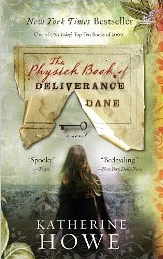
Day 249: The Physick Book of Deliverance Dane

Cover for The Physick Book of Deliverance DaneBest Book of the Week!
Connie Goodwin has just passed her orals in history at Harvard and is one thesis away from her doctorate when her advisor, Manning Chilton, challenges her to find an undiscovered primary source on which to base some subject about Colonial America. She is almost immediately side-tracked in her research by a request from her mother to sort out her grandmother’s long-abandoned house in Marblehead and sell it to pay off back taxes.

Connie finds a very old, filthy house with a gate so overgrown with vines that it’s hard to find the house. Almost immediately she has a few odd glimpses, as if she can vividly picture her grandparents and other people in the house.

While sorting through the objects and papers in the house, she finds evidence of a woman named Deliverance Dane, who was found guilty of witchcraft in the Salem trials and left behind a “recipe” book, possibly of spells. Chilton immediately begins putting pressure on Connie to find the book, as it could provide the first evidence that people were actually practicing witchcraft at that time in Massachusetts. As Connie searches for the book, she makes some astonishing discoveries about her family and herself.

Back in the 17th century, Deliverance Dane, a wise woman or healer, is called to attend a child she cannot save. When the child dies, her father accuses Deliverance of satanism.

Some small things at the beginning of the novel irritated me. In laying the foundation of some basic history, I think Howe condescends to the reader a bit too much. For example, she finds occasion to tell us what a familiar is. Although many people may assume that all familiars are cats and find out differently from this novel, I would be surprised if people didn’t know what they were, if only from remembering their grade school lessons about the Salem witch trials. But perhaps I’m wrong.

There are also a couple of instances where Connie takes awhile to figure out something that she, as a graduate history student, should already know. For example, she doesn’t immediately know that “receipt” is another word for “recipe,” and then she has to explain this term to her professor, supposedly an expert in Colonial America. I am no historian or even generally interested in this period of history, but I knew immediately what the word meant. She does the same thing with figuring out that “Deliverance Dane,” mysterious words on a piece of paper, is someone’s name, as if in all her studies of the period she never encountered such an unusual name.

It is also very easy to see where the novel is going and who will turn out to be a villain. However, I still found it interesting enough to regard it as a strong first novel, especially if you enjoy the mixture of historical fiction and the supernatural. The characters are believable, and both story lines kept my attention. The historical portion seems solidly researched.

And I won’t mention the tomatoes, because it’s just too picky.

Day 247: That Old Cape Magic

Cover for That Old Cape MagicI was so excited by discovering Empire Falls earlier this year that I went right out and bought a more recent book by Richard Russo, That Old Cape Magic. This novel observes the thoughts of Jack Griffin as his marriage implodes and again a year later as he tries to make amends.

Griffin is obsessed with not becoming his parents, a couple of academic snobs who have spent their lifetimes criticizing everything, willfully ruining other people’s possessions, and making enemies in their Midwest university departments. Yet he has given up a successful screen-writing career to teach at a New England college that his parents always aspired to, and bought an old, charming house. These decisions make him feel like he is living the lives they wanted.

As Griffin carts around his father’s ashes on the way to a wedding on Cape Cod, he behaves spitefully to his wife Joy, whom he blames for the changes in his life. In his drives around the Cape, where he and his family spent all their summers, he thinks about his past, his parents, and his marriage.

In the second part of the novel, he returns to the Cape for his daughter’s wedding with his father’s ashes still in the car, along with his mother’s. He has come with a date but his real desire is to win back his wife.

I think several things hampered me from enjoying this novel as much as I did the other. First, Griffin isn’t very likeable and his parents seem repellant, although we have some evidence that his memories may not all be accurate. One of the difficulties in Griffin’s marriage is his dislike of Joy’s family, but Joy’s family is almost stereotypically drawn as wacky, loud, and obnoxious, so it’s hard to appreciate why Joy cares for them as much as she does. Aside from being uncaring about his wife’s family and her needs, Griffin seems to be clueless about many things in his own life. Generally, since I usually need to relate to at least one character and only Griffin is fully realized, I found the novel a little unsatisfying.

Day 226: I Curse the River of Time

Cover for I Curse the River of TimeI Curse the River of Time is a sad book about Arvid Jansen, a man trying to cross a divide between himself and his dying mother. At the same time his marriage is failing and the Berlin Wall is coming down. Things are coming to an end in his life.

Jansen remembers decisions he made, particularly the one to leave university and join the Communist party. As the wall falls, he considers his loss of faith in the party. 

In contemplating his failing marriage, he also remembers his courtship of a young girl, although it is not clear whether he is thinking about his wife. He goes to his mother’s home country of Denmark, to a beach house where his family spent the summers, and recalls his childhood bond with his mother.

The novel is moody and inconclusive, and for some reason I kept expecting it to become sinister, although it did not. Even though the novel is focused around his attempts to reconcile with his mother (although that is perhaps not the correct word since there has not been a falling out–she is simply cold and unresponsive to him), it seems to me that Jansen thinks about her too much, is too obsessed with her.

The writing is excellent, spare but full of details. However, the entire feel of the novel is tenuous. There does not seem to be much to fasten onto.

Day 217: In the Time of the Butterflies

Cover for In the Time of the ButterfliesIn the last days of the Trujillo dictatorship of the Dominican Republic in the 1960’s, a jeep containing the bodies of three sisters known as “las mariposas,” or “the butterflies,” was found at the bottom of a steep cliff. The three sisters were revolutionaries who were committed to the overthrow of Trujillo, and they were murdered by the regime. In the Time of the Butterflies tells the story of the lives of the three sisters, and their surviving sister Dede.

The novel begins with the young girlhood of Patria, Minerva, Maria Terese (Mate), and Dede Mirabal, narrated by each girl in turn. As life under the regime becomes more difficult and the sisters grow older, one by one they become radicalized until they and their husbands are actively taking part in an underground movement working toward a revolution. The novel depicts their lives in prison and the final days when their husbands are moved to a new prison precisely so the sisters will be forced to drive up that fateful road to visit them.

The novel certainly is interesting and kept my attention, but it was vague in a way that is difficult to describe. I think it assumes a larger knowledge than I have of the state of affairs in the Dominican Republic at that time. Ironically, I also feel as if it downplays the acts of the regime. In my investigations after reading the novel, I learned that the Trujillo regime was responsible for the murders of many people, but the book was not effective in conveying that or the other atrocities committed by the government. Reviews of the book remark that it captures the terror of the time under the regime, but that is exactly what I feel is lacking.

Day 214: The Sense of an Ending

Cover for The Sense of an EndingBest Book of the Week!

The Sense of an Ending is a quiet novel that made me stop and consider. It is a meditation on memory–how we reinterpret past events. It is also about the lost opportunities of life.

Tony Webster begins the novel by considering his past, particularly his relationships with his pals from school. He and two other close friends chose to enlarge their circle to include a new boy, Adrian Finn, who was extremely intelligent and analytical. Adrian’s indifference to seeming cool made him very cool indeed. The four friends remained close throughout college and for awhile after, until Adrian committed suicide.

Tony also remembers his first serious relationship, with Veronica Ford, particularly an unpleasant weekend he spent with Veronica’s family. After they broke up, Adrian went on to date Veronica. He wrote Tony a letter apprising him of this as if he were asking permission to date her, and Tony’s recollection is that he ironically assented.

Tony has lead a comfortable life avoiding too much effort in his relationships. He sees himself as a “peaceable man.” He believes he understands the events from the past until he receives a legacy from Sarah Ford, Veronica’s mother–the only member of her family who seemed sympathetic during that long-ago visit. In addition to a small bequest, she has left him Adrian’s diary. This legacy confuses him. Why would a person he only met once leave him anything, and why would she possess Adrian’s diary? When Tony asks for it, he finds that Veronica has taken it.

In Tony’s attempts to gain the diary and his subsequent inquiries, he learns things that force him to re-examine and reinterpret his memories of long ago events and to reconsider the consequences of his own actions. He ends up also contemplating where his own life has gone and how he has evolved into this “peaceable man” from a boy full of curiosity and promise.

This very short novel is crammed with thoughtful observations, often wittily and wryly expressed. I found myself turning back to re-read and reconsider certain passages, which is something I seldom do. Sparely and beautifully written, the novel is an excellent illustration of the use of an unreliable narrator.

Day 207: The Child in Time

Cover for The Child in TimeThe Child in Time is one of Ian McEwan’s earlier books, written in the mid-1980’s. It is an odd book, the themes and subplots of which all have to do with childhood and the relationships between children and their parents, but I did not come away from the novel with a coherent idea of its message.

Stephen Lewis is a writer of children’s books who has come to that vocation by accident, because an adult book he wrote was accepted as one for children. He is mourning the loss of both his small daughter and his wife. His daughter was stolen away from him in a supermarket two years before, and the marriage broke up as a result of grief.

Lewis spends his time drinking and watching television in his filthy apartment. Once a week he sits in on and daydreams through a series of government committee meetings on education, occupying a seat abandoned by his friend Charles Darke, who has retired from public life.

Although the novel focuses primarily upon Stephen’s slow recovery from depression and return to a more normal life, one of the subplots concerns his friend Darke, who with his wife offered refuge to Stephen in his worst days. Darke is a successful young entrepreneur married to a much older physicist, and the Darkes have always been Stephen’s ideal of a mature, adult couple. After running several successful businesses, Darke became a politician and then abruptly retired to the country amid rumors of a breakdown. Stephen eventually finds that his friend has been suffering from obsessions related to a childhood that was cut short by a controlling father.

Another odd plot development is a strange vision Stephen has on his way to visit his wife. He sees his parents meeting in a pub as young adults and confirms with his mother that this was an actual event from before they were married.

Although the description on the book jacket says the novel is about the importance of childhood, that specific concept seems to fit only the story of Charles Darke. As well as having themes about childhood and parenthood, the novel is about mourning and its preoccupations. Particularly perplexing is a side plot about a book on parenting secretly written by the paternalistic government and potentially planned to be fraudulently released as being a result of the committee work.

Set against a bleak England of the 1980’s, occasionally featuring beggars and soup kitchens, the novel seems oddly dreamlike at times while at other times dark and disturbing.

Day 196: The Secret Keeper

Cover for The Secret KeeperI loved The Forgotten Garden so much that Kate Morton’s other books, although very good, have not been able to hold their own against it. At first I thought The Secret Keeper would also be good but not great, but a terrific surprise at the end of the book made me change my mind.

The novel begins in 1961, when sixteen-year-old Laurel Nicolson is up in the treehouse on the family farm dreaming about her boyfriend. She sees her mother Dorothy go into the house with her baby brother Gerry. It is Gerry’s birthday, and Laurel knows her mother has left the birthday picnic to fetch the family’s special birthday knife so she can cut the cake. A few minutes later, a stranger goes to the door, and Laurel sees her mother stab the man with a knife. He is assumed to be the man who has been attacking women in the area.

Fifty years later, Laurel is a famous character actor who has come home to visit her ill mother. Her mother’s memory is failing, but she has asked Laurel’s sister Rose to get some things out of a box that has always been private. Among them is a photograph of Dorothy and her friend Vivien, who died during the Blitz.

Laurel’s memory of the long-ago incident with the stranger has become muddied and even inaccurate, but she begins to remember it more clearly when she decides to look into it further. She finds that the attacker was Henry Jenkins, Vivien’s husband. Since Dorothy must have known Henry, there is obviously more to the story.

From here the story alternates between Laurel’s investigation in the present and the war years of young Dorothy (Dolly) Smitham. Dolly is madly in love with Jimmy Metcalfe, a newspaper photographer who also has sole care of his senile father. Dolly wants to marry immediately, but Jimmy thinks they can’t afford it yet, so Dolly takes a job as a companion to a wealthy old lady in London. At a war effort volunteer job, she meets Vivien, who lives across the street with her husband, a successful novelist. Dolly, who comes from a lower middle class background, gets carried away with the idea of leading a more exciting, fashionable life. After a series of misunderstandings, she hatches a plan to get money for her marriage and talks the reluctant Jimmy into helping.

At this point, my major problem with the novel was a growing dislike for Dolly, who seems narcissistic and lacking in conscience. I kept wondering how she was going to develop into the beloved mother of five children. But the novel goes on to unearth secrets. With Morton’s gift for storytelling and excellent writing, I think this novel is as good or better than The Forgotten Garden.

Day 192: Home

Cover for HomeBest Book of the Week!

The beautifully written, subtle novel Home by Marilynne Robinson makes me thoughtful. It is 1957. After a failed ten-year engagement, thirty-eight-year-old Glory Boughton has moved home to Gilead, Iowa, to care for her elderly father, a retired Presbyterian minister.

Her father has been waiting 20 years for the return of his best-loved son, Jack. Finally, they hear that Jack is coming home. Always unreliable and setting himself apart from the family, he arrives late, and Glory feels ambivalent about his return. Soon, though, she sees that he is tired and having difficulty being there, and she tries to help him.

The novel carefully explores the relationships between the three of them–Glory loving but distrustful of the pain Jack has caused and protective of her father, Jack trying to make a new life in painful and distressed conditions, and their father forgiving and unforgiving at the same time. In the background are the events of the civil rights movement, toward which Jack and his father have radically different views.

Jack is delicate and fragile. He tells Glory he lived as a vagrant, drunk, and cheat until he met a woman named Della, and now Della has gone back to her parents. He tries to find work in town and writes countless letters to Della.

This novel is apparently related to a previous one, Gilead. I do not know whether it could be considered a sequel, although I know it shares some characters.

To modern readers the manners and dress of this devout Iowa family seem very old-fashioned, and some readers may find the novel slow, but I found it engrossing. It is, of course, a retelling of the tale of the prodigal son.

This is a simple story on the surface, but it depicts complex characters and relationships. It is a novel about family relationships and love, written with a delicate touch. I find it difficult to express how fine I felt it to be.

Day 189: The Girl with No Shadow

Cover for The Girl with No ShadowI just reviewed Chocolat recently, so I thought I’d continue with a review of The Girl with No Shadow, Joanne Harris’ sequel to that novel.

The wind is blowing trouble toward Vianne Rocher, now running a small chocolatierie in Montmartre in Paris. The trouble is coming in the form of a con woman with many names, whom Vianne will know as Zozie de l’Alba.

Vianne herself has another name. She is going by Yanne Charbonneau because of some problems that developed after the birth of her second daughter, Rosette, now four. Vianne has been doing everything she can to avoid standing out. Anouk is now known as Annie. Gone are the red dresses with bells hanging from the hems. Yanne is demure and nondescript and doesn’t use her magic, even to know what a customer’s favorite chocolate is.

Annie, at eleven, is unhappy with school and with the changes in their lives. Soon more seeds of discontent are sown. As Zozie weasels her way into their lives and prises away their secrets, she decides that when she leaves, she is taking Annie with her. So, she does her best to encourage Annie’s rebellion against her mother.

Again, Harris combines the gentleness and kindness of Vianne’s temperament with a fair amount of suspense. As we learn more about Zozie’s past, we find out just how dangerous and devoid of conscience she is.

As usual the writing is beautiful, sprinkled with the scents and flavors of the chocolatierie and a dash of magic.

Another novel about Vianne and her family is just out, Peaches for Father Francis, so I guess I had better get reading!

Day 186: The Red House

Cover for The Red HouseI really enjoyed Mark Haddon’s The Curious Incident of the Dog in the Night-Time, so I was looking forward to reading The Red House. Curious Incident employs unusual narrative techniques, such as including math games, to try to re-create the thought processes of an autistic teen. The Red House also plays with narration, only not as effectively.

After being estranged for years, siblings Angela and Richard have met again at their mother’s funeral. In an impulsive attempt to restore ties with his sister, Richard rents a holiday house in Herefordshire and invites the other family to join his for a week. Richard’s family consists of his second wife Louise and her teenage daughter Melissa. Accompanying Angela are her husband Dominic and their children Benjy, Alex, and Daisy.

Each of the characters is dealing with issues. Angela had a miscarriage 18 years ago, and she has dwelled on this lost child ever since, naming her Karen and neglecting her teenage daughter Daisy as a result of this obsession. Dominic is having an affair. Daisy has become very religious and fights with Angela about it. Teenage Alex is yearning to have sex with Melissa. Richard is dreading a possible lawsuit from a patient. Louise barely knows the other family and is having problems with Richard. Melissa is awaiting the time when her parents learn that bullying by her group of friends has caused another girl to attempt suicide. Only young Benjy does not seem to have some sort of obsession.

The book jumps among the narrations of all eight characters. The voices are not always so distinct that you can immediately tell them apart. The one that is distinct is expressed as disjointed lists of things, but it is difficult to attach to anyone. For awhile I thought it might be that of the dead daughter and later I thought it may be Angela having a nervous breakdown. Most often, to figure out who the narrator was, I had to relate the narration to something that was already going on. One technique Haddon uses is to interject part of what each person is reading, which at first helps you know which person it is, but after awhile becomes tedious.

Virtually plotless, this dour novel consists of the characters struggling with their own thoughts and with each other. Generally, I disliked most of the characters and thought the novel was a frustrating reading experience.