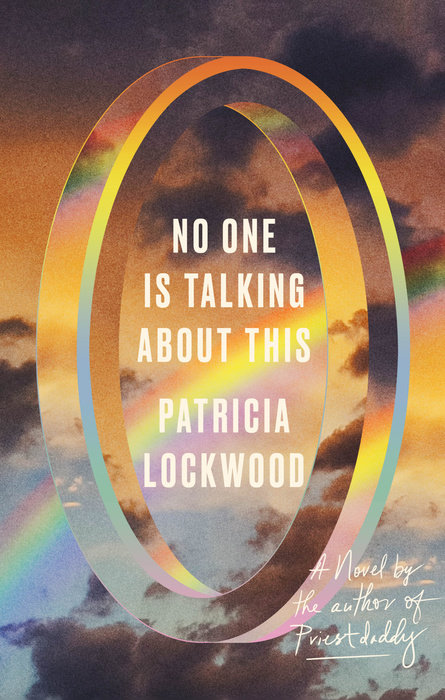
Review 2151: No One Is Talking About This

The unnamed narrator (possibly Lockwood herself) is a media influencer made famous by such utterances as “Can a dog be twins?” She seems to spend all her time online that she isn’t lecturing to her fans. She calls the Portal her information, and although she has a broad sense of irony, doesn’t seem to understand that most of it isn’t.

When I was reading this portion of the book, which is related in a sort of stream of consciousness, I realized that I was officially a geezer, because I didn’t understand a lot of what she was talking about, didn’t like her sense of humor, didn’t get her world view or sensibility. The book didn’t seem to have a plot and was mostly made up of her musings on a vast array of subjects, particularly the Internet.

Then a family crisis occurs. The second half of the book suddenly gains a plot and becomes meaningful in a way the first half wasn’t. I was deeply touched by it.

I read this novel for my Booker project.

Related Posts

Flights

Crudo

Still Alice

Review 2142: A Passage North

Readers looking for a fast-paced novel will not find one in Anuk Arudpragasam’s A Passage North. Instead, they’ll experience a novel that’s meditative and introspective.

Krishan returned several years ago to his native Sri Lanka after living away in India during his education. He returned when his relationship with Anjum ended determined to help his people in northeastern Sri Lanka after the end of the Tamil rebellion. However, after two years, he has retreated to the city of Colombo, where he lives with his mother and grandmother.

At the beginning of the novel, he learns of the death of Rani, a woman who had been caring for his grandmother and had helped her come back from a mental and physical breakdown. Rani herself had been severely depressed after the death of both her sons as a result of the war, and the work with his grandmother had begun as a help to her state of mind as well as his grandmother’s comfort. However, after Rani returned for family business to her village in the northeast, she kept delaying her return and finally died by falling into a well.

Krishan decides to attend Rani’s funeral, and this long trip into the northeast of his country gives him ample opportunity to dissect his relationship with Anjum, his own motives in returning to Sri Lanka, the possibility of Rani’s suicide, and many other issues.

Arudpragasam likes long, involved sentences with many clauses, embedded in paragraphs that sometimes continue for pages. His prose is dreamy and meandering. Krishan spends so much of his energy considering all the ramifications of everything that even though he acts, he seems oddly inert.

I found the sections about the recent history of Sri Lanka very interesting, but Arudpragasam assumes a knowledge of the situation there that I do not have.

I read this book for my Booker Prize project.

Related Posts

Burnt Sugar

The Lives of Others

The Sapphire Widow

Review 2139: French Braid

In 2010, Serena and her boyfriend James run into her cousin Nicholas in the train station. James is surprised that Serena isn’t quite sure it is him and doesn’t seem to know much about her Uncle David’s family. French Braid explores the roots of this division in the family, beginning in the 50s or 60s.

It begins with a family vacation, the only one the family every took. Robin Garrett isn’t very at home on the lake. He is interested in gadgets but finally finds a fellow vacationer to talk to. Mercy Garrett gets preoccupied with her painting, and neither she nor Robin seem to think there is anything wrong with their 15-year-old daughter Lily hanging out with a college-age boy. Silly Lily thinks her new boyfriend is going to ask her to marry him. We see most of this holiday from the point of view of Alice, the older girl, who is worried about Lily. Mercy is at least attuned to her youngest, eight-year-old David, and notices that something has happened while Robin was teaching David to swim.

As with other Tyler books, the attention isn’t always focused on Alice. The next section is about Mercy and how she gains her independence after David leaves for college. Both his sisters are now married, but Lily has decided she picked the wrong man. Mercy looks for word from David, but he begins his separation right after he leaves for college, and we don’t find out why until the end of the novel.

Tyler employs some of her tropes here—the work-obsessed husband and the ditsy wife for one—and is occupied with the same generations she usually deals with. But her characterizations are always rich and empathetic, her stories always interesting. This one is right up there as she explores the intricate connections of family life.

Related Posts

A Spool of Blue Thread

The Amateur Marriage

Breathing Lessons

Review 2137: Summerwater

Summerwater is a novel composed from brief vignettes that at first seem so disconnected as to be short stories. However, connections appear slowly.

Staying in a collection of cottages on an island in a large Scottish loch are a group of disparate people. The novel alternates point of view to tell their stories over one very wet day. In between each of these chapters is a shorter vignette about what is happening in the surrounding forest.

Justine has an obsession for running, possibly to get away from her family. But she has a secret about her running. David and Mary, an elderly couple, are navigating Mary’s growing decrepitude and memory loss. Milly and Josh are an engaged couple working on their sex life, but Millie would just like a bacon sandwich. Lola, a young girl, takes out her father’s xenophobia on a little Ukrainian girl. Alex, about fourteen, stays out in his kayak a little too long. Becky, his older sister, is so bored she wants to burn the place down. Claire is so unprepared when her husband gives her a break from the kids that she can’t figure out what to do with it. And so on.

We’re told at the beginning that there will be a death, which adds to the tension. A couple of the vignettes got old—the one about sex, even though it was funny, and the thoughts of indecisive Claire. Despite the activity, I found the work slow moving and contemplative.

Related Posts

Not the End of the World

Heads of the Colored People

The Spinning Heart

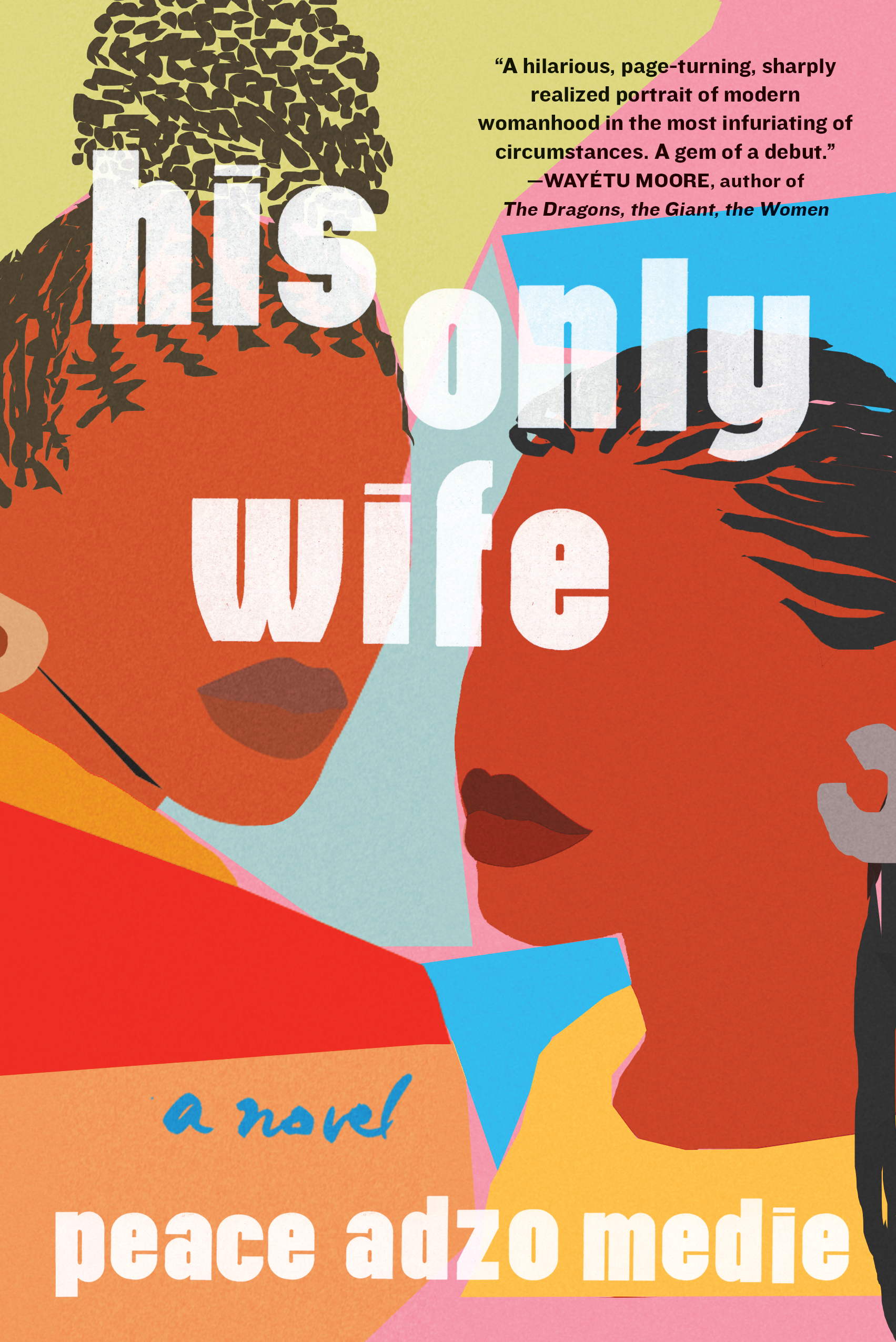
Review 2131: Literary Wives! His Only Wife

Today is another review for the Literary Wives blogging club, in which we discuss the depiction of wives in fiction. If you have read the book, please participate by leaving comments on any of our blogs.

Be sure to read the reviews and comments of the other wives!

My Review

The death of Afi’s father years ago moved her and her mother from the middle class to poverty. Her uncle refused to give them a home even though Ghanaian custom decrees that a room in his house belongs to them. If Aunty, a wealthy local businesswoman, had not taken them in, they would have been homeless.

Now Afi has agreed to marry Aunty’s son Eli, a man she doesn’t know. His family hopes that a marriage to Afi will get him away from his Liberian girlfriend, with whom he has a child. They claim she must have bewitched him.

Afi marries Eli in a traditional wedding by proxy because he is away on a business trip in Japan. His brother Richard stands in and also takes her to her new home in a modern apartment in Accra. But Eli does not appear for some weeks. Afi has nothing to do except clean the apartment (even though there are people to do that) and shop. So she, who worked as a seamstress back in her village, decides to study fashion design.

Eventually, Eli comes to the apartment, but it is clear he is living elsewhere. However, Afi begins to fall in love with him and becomes determined that he will treat her as his wife.

This novel posed difficulties for me, and it was hard for me to tell if they came from cultural differences or not. The biggest was with the treatment of Muna, the girlfriend, referred throughout the book as “that woman” or “the Liberian woman.” After all, Muna came first and has Eli’s daughter, but Afi never once acknowledges that Muna has a prior claim, presumably because Eli hasn’t married her. Afi, after all, entered the marriage knowing she exists.

Second, most of the action of the novel revolves around a weak man who tells lies to avoid conflict.

I realize the novel is about Afi learning who she is and how much she owes to her family as opposed to herself, but after all, she ends up with a business that was essentially funded by her husband. She learns to stand up for herself but at the expense of Muna and her daughter.

There are other things in the novel that are interesting, such as the tension between tradition and modern marriage. Also, the writing is lively and engaging. But if Medie intended to write a feminist book, as I might assume from her Gender Studies background, she doesn’t really succeed.

What does this book say about wives or about the experience of being a wife?

Afi, coming from a small village and a traditional marriage ceremony, arrives in Accra seeming to expect a traditional marriage, as evidenced mostly by her concern to always have food prepared for Eli even though he never tells her when he’s coming and her attempts when he is there to wait on him. She also has constant tension between what is expected of her by her family and what she feels comfortable providing. Because of the unique situation she married into and also some culture shock, she has a hard time getting her bearings in the big city, especially as Eli doesn’t talk to her about things like money, what he’s doing about his girlfriend, and so on.

Although Eli doesn’t seem to want Afi to wait on him hand and foot, like she tries to do in the beginning, he isn’t honest or open with her and (major spoiler!) we infer from the ending of the book that he was planning a polygamous marriage as soon as his mother died. How he could think this solution would be acceptable to Afi is hard to grasp.

It’s hard to understand whether the aridity of Afi’s early married life is because she is wealthy or because of the differences between living in the modern big city and the traditional countryside, but it was a relief when Afi started with her studies.

Later on, when her marriage becomes more “normal” after the birth of her son, the novel isn’t very specific about the couple’s day-to-day life, but Afi seems to spend very little time with child-rearing or house management and most of her time running her business. Her relationship with Eli is better, but he still doesn’t tell her the truth or speak with her about important things. He also at one point tries to order her to behave a specific way. Theirs may be a modern marriage in terms of Ghanaian culture, but it certainly isn’t by our standards.

Review 2124: A Train to Moscow

A Train to Moscow is Elena Gorokhova’s first novel, coming after two memoirs. Although its story is similar to that of A Mountain of Crumbs, including where it ends (which I found frustrating both times), I still found it affecting.

Sasha grows up in a small Russian village with a nose and disdain for mendacity, which, as it is the Stalin years, is dangerous for her. Her best friends are boys—Marik, who is her same age and shares her interests, and Andrei, who is two years older and disapproved of by her mother. When she is a pre-teen, she discovers her Uncle Kolya’s diary hidden away in the attic. Her uncle never returned from World War II, and the family has heard nothing from him, but his diary describes a war unlike the patriotic and courageous venture she learned about in school. Periodically, the novel includes excerpts from this diary.

When Sasha hears a play on the radio, she realizes she wants to become an actress. As she nears graduation from secondary school, she knows her family won’t approve her decision to try out for drama school in Moscow. Nor will Andrei, who is now her boyfriend and has just lost his parents and home in a fire.

This is a strong novel about family and hidden secrets, about being true to oneself, and about an abiding love.

Related Posts

A Mountain of Crumbs

Mastering the Art of Soviet Cooking

Sofia Petrovna

Review 2121: Young Mungo

Twice recently I’ve had the same unusual experience with my reading. I was looking forward to reading a second novel by an author who wrote a book that I loved, only to find the second novel seemed to be very much the same as the first, as if the writer was stuck somehow. This happened with Young Mungo.

Mungo is a caring 14-year-old Glaswegian gay boy with an alcoholic mother, a sister planning her escape, and a violent brother. Sound familiar, those of you who have read Shuggie Bain? The novel begins with Mungo being packed off on a camping trip with two men his mother barely knows from her AA meetings. He is poorly clad and equipped, the men are drunk, and a feeling of dread is the immediate effect. In between chapters that continue this story, the novel returns to scenes from Mungo’s past.

Set in the 1990’s, the novel is similar to Shuggie Bain except that Mungo is older and the novel is even more grim and violent at times. Still, it is compelling and becomes less like the other novel as it goes along. I ended up liking it but not so sure I want to visit that world a third time.

Related Posts

Shuggie Bain

A Little Life

Edinburgh

Review 2114: Lost Hearts in Italy

I absolutely loved Andrea Lee’s Red Island House—in fact, it was on my Best of the Year list this last year—but I think I would have liked Lost Hearts in Italy better if I hadn’t read the other book first. I make this comment because Lee seems to be rehashing the same story except the Red Island House also dealt with other themes.

In Red Island House, a young, beautiful American mixed race academic is married to an older, uneducated, self-made wealthy Italian businessman, a marriage that seemed to me inexplicable. In Lost Hearts in Italy, a young, beautiful American mixed race journalist meets an older, uneducated, self-made Italian billionaire when she is on her way to join her young, beautiful nice husband who loves her in their new home in Rome. Mira doesn’t even seem attracted to Zenin (she calls him by his last name as the heroine of Red Island House calls her husband), but eventually she begins having an affair with him, one that (this is no spoiler—it’s clear from the beginning) spoils her marriage with Nick. The novel moves backward and forward in time between 1986 and 2005, examining the lasting repercussions of Mira’s actions.

The only difference I can see between Zenin and Senna of Red Island House is that Zenin is tall and Senna is short. Lee is obviously obsessed by this relationship. Although she is an excellent writer, I think Red Island House, with its themes of identity, colonialism and the responsibility of the rich to the poor, has more to offer than just a dissection of this relationship. In Lost Hearts in Italy, Mira is like a moth drawn to a flame except she knows she is doing something against her own nature. My question was, then why did she do it? Zenin is not an attractive character at all. It’s inexplicable.

Related Posts

Red Island House

Ties

Siracusa

Review 2107: Spring

Spring is the third in Ali Smith’s seasonal quartet. Like with most of Smith’s books, there is a point where I say, “What the f— is she on about?” and a point where I say, “Oh.”

Richard Lease is an older man, a filmmaker who has done good work. He is grieving after his old friend Paddy’s death. Paddy had been his screenwriter, a woman who supported and inspired him and a good friend. He is further upset because the screenwriter assigned for his next film is trying to turn a delicate work about two famous writers who never actually met each other into a story about a hot affair.

Supposed to be at a meeting about this film in London, Richard takes a train in the opposite direction and gets off in Scotland, thinking about throwing himself under the train.

About halfway through the novel, it suddenly focuses to a seemingly unrelated story. Brittany is a security guard in a detention facility for illegal immigrants. She, like many of the other guards, has started to become callous and treat the detainees as if they were criminals.

She has heard a rumor about a little girl who walked into a facility and spoke to the director. The next day the toilets were spotlessly cleaned. Then one day on her way to work, she meets the child she thinks is that girl. The child Florence wants to know how to get to the place in Scotland shown on an old postcard she has. Suddenly, Brittany finds herself going along.

The novel is obviously about how we treat immigrants, but it makes comments about other things, like social media, on the way. There were times when its digressions got on my nerves and particularly one that I skipped once I had its measure. But somehow even when I’m frustrated by her, Smith always manages to pull me into her story and impress me with her intelligence.

Related Posts

Autumn

Winter

There but for the

Review 2106: The Mere Wife

Maria Dahvan Headley called The Mere Wife her novel about monsters in suburbia. It certainly is, but it’s also loosely based on the Old English epic poem Beowulf, only about women, not men.

Dana Mills is a U. S. Marine fighting in a desert country when she is captured and appears to be publicly executed on television. She awakens in the middle of the desert six months pregnant with no memory of what happened. Since she can’t tell the conditions under which she was impregnated, the Marines put her in prison stateside. She escapes and returns to her home town, which her family has lived in for generations, only to find it demolished with a suburb built on top of it.

Dana finds her way to caves in the mountain surrounded by the suburb. Inside the mountain is a train station from when the town was thriving. Living in the cave, she has her baby, but she is traumatized by PTSD and thinks he is a monster.

Seven years go by, during which Dana has been training her son, Gren, to survive, which she believes includes staying away from other people. But Gren sneaks out and makes friends with a boy in the nearest house, Dylan, who has been both spoiled and restricted and neglected. When Dana finds out about this friendship, she has only dread. Despite her efforts to keep him away, Gren sneaks out and attends a New Years party. Willa, Dana’s mother, has been aware that something has been in her house, a wild animal, she thinks. When Dana comes to fry to fetch Gren home, a series of overreactions on her part and that of Dylan’s parents result in catastrophe. Soon the police are hunting down Dana and her son. Enter a macho policeman named Ben Wolff.

This is really a rough read. Stylistically, it’s beautiful and poetic, but it is also harsh and cynical. The question Headley forces on you is, Who is the monster? Well, there are lots of them.

The novel features a chorus of women and a strong distaste for men as well as for hypocrisy.

Related Posts

Beowulf

Everything Under

Melmoth