Review 2027: Small Things Like These

It’s 1985, and Ireland isn’t doing well financially, but Bill Furlong is just about keeping his head above water with his coal business. He is a moody man, the son of an unwed mother who was lucky enough to be kept on by her employer, Mrs. Wilson, instead of being sent away when she was pregnant. Mrs. Wilson also paid for his education and helped set him up in business. Still, he wonders who his father is and if this is all there is to life.

Shortly before Christmas, he delivers an order of coal to the convent, which runs a laundry and a school for girls. There are rumors about fallen women being forced to work there and to give up their babies. But other rumors say the nuns do the laundry.

Locked in the coal shed, he finds a dirty, barefoot girl. When he takes her to the door of the convent, the nuns send her for a bath and invite her for tea. She comes in later and says the girls were playing a game with her. Bill is later ashamed of himself for saying nothing, even though she begged him to ask about her baby.

When he tries to speak to his wife about the incident, she is clear that he should not cross the nuns. So are other people. But he reflects that it would have been his own mother in the same situation 40 years ago.

At 114 pages, this novel is short, really a novella, and moody, seriously examining the subject of people’s responsibilities to others. It is purely written, pared down to its basics. A note at the end provides statistics about the Magdalen laundries, the last of which didn’t shut down until 1996.

Related Posts

Himself

The Spinning Heart

The Good People

Review 2022: Literary Wives! Red Island House

Today is another review for the Literary Wives blogging club, in which we discuss the depiction of wives in fiction. If you have read the book, please participate by leaving comments on any of our blogs.

Be sure to read the reviews and comments of the other wives!

My Review

It seems I’ve been reading books set on islands lately—Greenland, Manhattan, and now Madagascar. Like Madagascar, Red Island House is lush and mysterious, the story of a disintegrating marriage.

Shay comes to the Red House newly married to Senna. They seem an inexplicable couple. She is an American of mixed race, educated, thoughtful, tall, and beautiful. He is much older, short, white, Italian, uneducated, and self-made wealthy, also loud and impulsive. On impulse, he has bought this oceanfront property on a small island off Madagascar. He has built an overpowering but beautiful house, which will be the Senna’s summer home.

In this novel constructed of short stories, Lee tells the story of the Sennas’ marriage in terms of their relationship to the house. Shay feels sympathy for the Malagasy people, and is torn by the feeling that her situation in this huge house waited on by many servants in one of the poorest nations in the world is not very far from colonialism. Thus, from the first, she has an ambivalent relationship with her own role as mistress of the house.

The novel begins with Shay’s understanding that the man Senna has hired to manage the house, Kristos, is her enemy. When the Sennas are in the house, her husband spends a lot of time with Kristos, off fishing and probably carousing, and after Senna has been around Kristos for a while, he snaps and shouts at Shay. Shay is conscious of disappearing goods and money, but when she tries to talk to Senna, he is rude and dismissive. On the surface polite, Kristos undercuts her.

Shay learns from the housekeeper, Bertine, that Kristos, who has contacts in bad places, is using magic against her. So, Bertine takes Shay to see the Neighbor.

As in each story Lee explores some colorful character or incident, the novel covers 30 years in the Sennas’ marriage. Shay’s relationship with the island gains ambivalence after the couple converts the Red House into a bed and breakfast, and it slowly becomes the haunt of Senna’s male friends, who shift their focus from fishing to teenage sex workers as they age.

The novel is gorgeously exotic, serious, and eloquent. It’s about race, class, hope, betrayal, and the couple’s finally divisive approaches to moral problems.

What does this book say about wives or about the experience of being a wife?

Lee uses Shay’s relationship to the Red House as a symbol for the Sennas’ marriage. In the beginning of the novel, the couple goes to see its foundation on their honeymoon, and at the end of the novel, she makes a last visit to it to say goodbye to it and her marriage, and I think to meet its inheritor, her husband’s illegitimate son by a Malagasy prostitute.

I find Shay and Senna an inexplicable couple from the beginning. They are such opposites that it’s hard to believe they would even like each other, let alone love each other, but we are informed that they do. And they remain married quite a long time, although Shay has to overlook a lot.

Lee tracks the relationship to the house in one insightful chapter at the end, where she takes it through the newness of the honeymoon period through the burgeoning of having children and farther until it becomes a fantasy playhouse for a bunch of pathetic, randy old men—Senna being one of them.

Literary Wives logo

Shay’s relationship to Senna also varies as she considers the role she has taken at the Red House. She is too informed about her family’s and race’s past heritage in slavery to feel comfortable in what she sees as a colonial role in Madagascar. Although she feels she can’t understand the country, she understands it much better than Senna, who views it as a place of fantasy. As he spends more time there, she spends less.

Shay is an independent woman, so it beats me why she doesn’t leave Senna earlier. We are told she has been coached by her Italian friends to accept his infidelities, but it isn’t until she has that burst of hurt and jealousy toward the end of the novel that we understand there is still a lot of feeling there.

Related Posts

On Beauty

Alternate Side

The Amateur Marriage

Review 2015: A Girl Called Rumi

In 1981, nine-year-old Kimia is a strong-willed girl having problems with the restrictions of post-revolution Iran. Her parents’ fight for freedom has ironically ended in an almost total lack of it. Kimia hates her chador and prefers roaming around with her cousin Reza, despite it being a crime for girls and boys to play together.

One day the two children find a trap door that leads to the home of Baba Morshed, a storyteller. As he tells an ancient Persian story about the Simorgh, a mythical creature like a bird, the children can see the figures in the tale. Kimia continues to return to hear Baba Morshed’s cryptic tales.

In 2009, Kimia lives in California and works as a life counselor. She is still traumatized by events from 1981 and sometimes cuts herself. She is also full of anger against her mother. She is horrified when her mother tells her she wants to return to Iran and Kimia and her brother Ammad must come, too. The trip to Iran reveals family secrets but also involves unexpected dangers.

I liked this novel for its glimpses into Persian culture and descriptions of its food. However, some of you will not be surprised to learn that I wasn’t as comfortable with the magical realism, especially as it isn’t completely clear whether it’s the children’s imagination, rendering the ending less believable.

Related Posts

Song of a Captive Bird

Shah of Shahs

Tales from the Queen of the Desert

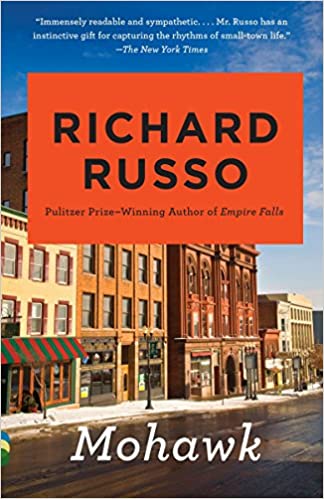
Review 2012: Mohawk

The town of Mohawk, New York, seems very similar to Empire Falls, the setting of another Russo novel. It’s another rustbelt town on the skids supported by the leather industry, which is now being found responsible for polluting the town. Of Russo’s works, it is these tales of ordinary people in rustbelt towns that I think are best.

This novel centers mostly around one extended family but with plenty of auxiliary characters. Dallas Younger is a feckless, unreliable but kind mechanic divorced from Anne, who has moved back to Mohawk from New York largely because she’s in love with Dan Wood, the wheelchair-bound husband of her cousin. Anne’s father, Mather Grouse, is known for his upright life, but he has a secret involving Wild Bill Gaffney, a mentally handicapped young man who was in love with Anne when they were in high school.

Russo’s characters are flawed but mostly likable and fully realized. This novel has a complex plot that is masterfully handled. The novel skips from 1967, when Anne’s son Randall is unhappily attending middle school in Mohawk, trying to avoid a group of bullies and purposefully scoring a bit low on his homework because it doesn’t do to be so smart, to 1971 when he is 18, has quit college, and is avoiding the draft.

For a long time, I avoided reading Russo’s novels because they sounded depressing. They are not. Instead, they demonstrate a warm understanding of and fondness for human nature. This novel sustains me in my belief that his rustbelt novels are his best.

Related Posts

Empire Falls

Everybody’s Fool

Bridge of Sighs

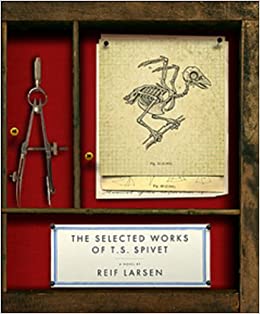
Review 2009: The Selected Works of T. S. Spivet

Tecumseh Sparrow Spivet is a 12-year-old boy who spends most of his time on a Montana ranch mapping things. Not just making geological maps but mapping the everyday activities on the ranch—his sister’s technique of shucking corn, the regularity of his father’s sip of whiskey, as well as numerous scientific subjects. In fact, his mentor, Dr. Yorn, has encouraged him to submit drawings to various journals, and he has had some published.

T. S. does not feel comfortable at home. He is mocked by most of his schoolmates. He feels he is a disappointment to his rancher father, and his scientist mother, whom he calls Dr. Claire, seems to be completely obsessed by the search for a particular beetle. Worse, his oldest brother has recently died.

One day he gets a call from the Smithsonian. It appears that Dr. York submitted one of his diagrams as an entry in a prestigious fellowship and he has won. Dr. Jibsen, unaware of his age, informs him he is expected at the Smithsonian on Thursday to give a speech.

At first T. S. hesitates about accepting the award, but then he decides to go to Washington. He packs up some things and hops a freight train east.

Liberally decorated with T. S.’s drawings and musings, this novel is inventive and sometimes funny. In a way, it is meant as a wild romp with a philosophical dint, so maybe we’re meant to overlook the truly implausible aspects of the story, such as that a recipient of an important award would have someone on the Smithsonian end immediately organizing his flight.

I was drawn along at first and ready to suspend my disbelief, but first, what can your hero do while he spends several days on a freight train getting to Chicago. Nothing, right? If you are expecting a picaresque series of adventures like I was, you’ll be disappointed. But T. S. has brought along one of his mother’s notebooks, which is how he discovers she is writing a novel about one of his father’s ancestors. Larsen inserts the entire contents of the notebook into the middle of the novel, with a few interruptions. At first, it was interesting, but after a while I sighed every time I saw the typographic clue that the novel was restarting.

This is all fairly unimportant, though, against the criticism that T. S.’s voice is never convincing as that of a 12-year-old, genius or not. Yes, he is childish at times, but then his voice is much too young for a 12-year-old. But most of his musings and concerns are those of an adult.

Is the book fun to read? Yes, mostly. But I tired of it after a while.

I read this book for my James Tait Black project.

Related Posts

The Sweetness at the Bottom of the Pie

The Invention of Hugo Cabret

The Case of the Missing Marquess

Review 1998: The Glass Hotel

A woman, Vincent, falls into the sea at the beginning of The Glass Hotel. Then the narrative returns to the past, covering about 20 years in time.

As a young woman, Vincent works as a bartender in an expensive hotel in Caiette, a small, isolated village on Vancouver Island. One day a strange message is painted on one of the lobby windows. Vincent is sure that her brother Paul, also employed by the hotel, did it because of his behavior and because she pulled a similar prank in high school. However, she doesn’t discuss it with him because shortly thereafter she meets Jonathan Alkaitis, the wealthy owner of the hotel, and leaves with him.

To get away from Caiette, Vincent has become Alkaitis’s much younger trophy wife. At least, she is pretending to be his wife. They aren’t actually married. Although there are other plot lines in this novel, most of the action centers around the discovery that Alkaitis has been running a Ponzi scheme.

There are a lot of characters in this novel, but Mandel doesn’t do much to make readers interested in them. In fact, I was struck about halfway through the novel when Alkaitis remarks that Vincent is interesting. There is very little dialogue in the novel, and frankly, Mandel hasn’t done much to show that she nor, really, anyone else is interesting.

Frankly, most of the characters in this novel are morally bankrupt. I was going to say excluding the investors, but actually they had to be either clueless or greedy, because most people would know the returns Alkaitis was paying were unlikely.

The last few pages of the book were really good, but do they make the rest worth reading? All I can say is I found the novel slow moving, and I kept putting it down. I didn’t hate it, but I didn’t much like it, either.

Related Posts

The Fall of Princes

The Big Short: Inside the Doomsday Machine

The Vanishing

Review 1888: The Fishermen

The family life of ten-year-old Ben begins to disintegrate when his father, a bank employee, is transferred to a town in a dangerous area of Western Nigeria. Ben and his three older brothers begin fishing in a forbidden river. About the time they get into trouble for that, Abulu, a madman who makes prophecies known to become true, makes one about Ikenna, Ben’s oldest brother. It is that Ikenna will be killed by a fisherman.

Ikenna becomes convinced that his brother Boja is going to kill him, even though the two have always been close. His attitude toward his family changes. He becomes angry, disrespectful toward his parents, and solitary. He locks himself into the room that he shares with Boja, only letting him in when he is out of it. Eventually, there is a shocking crisis.

I know a lot of people have liked this book, which I read for my Booker Prize project, but it didn’t do much for me. Most interesting about it was the background of Nigerian home life and customs, but these are not ours, and what, for example, might be called strictness in Nigeria is for us child abuse. Let me just say that for a novel about four brothers not set in wartime, this novel is extremely violent, graphic, and even at times amoral.

Then there is Obioma’s writing, which I found immature. A lot has been made of his unusual metaphors, but many of them don’t work very well or are just plain awkward. Occasionally, he uses the wrong word, like “haul” instead of “throw,” unless perhaps that is some kind of idiom I’m unaware of. He also loves to use polysyllabic words instead of simple ones, giving an overblown effect to his writing.

I didn’t notice some of these faults in his subsequent novel, but instead in that one I noticed lots of misogyny. I’m not proving to be an Obioma fan.

Related Posts

An Orchestra of Minorities

Americanah

Stay With Me

Review 1885: Travelers

When I first began reading Travelers, I thought I would be disappointed in it, because the bio said Habila had won several awards for his writing, but I found a misplaced modifier in the first few pages. Can’t help it—I’m a grammar nerd. However, I soon found the novel compelling.

It is structured as six novellas, which are linked by the presence or acquaintance with the unnamed narrator. He is a Nigerian student who is supposed to be finishing his dissertation in Washington when his American artist wife receives a fellowship in Berlin. Their marriage has been suffering since she had a miscarriage, and they see the move as an opportunity for a new start, but while his wife works hard, the narrator seems to be aimless, wandering around Berlin and ignoring his work. He becomes interested in a group of activists living in a squat and taking part in demonstrations. Several of them are refugees from Africa, including Mark, a transgender artist.

In this first novella, we meet Manu, who we learn about in the second novella. As Manu’s family crossed the Mediterranean in a derelict boat, the boat sank and he lost track of his wife and baby son. Every Sunday, he and his daughter search the area around Checkpoint Charlie for his wife and son.

In the third story, Portia, a Zambian studying in England, has traveled to Basel to meet Katharina, who used to be married to her brother David. She has gone there to understand her brother better, a man who always seemed to want to leave home, but also, at her mother’s behest, to find out why Katharina killed him.

In the fourth story, after meeting Portia and traveling with her to Basel, the narrator listens to the tale of a Somalian whom he meets on a train. This man and his son have suffered unimaginable hardships trying to find a place for themselves and their family. However, in a moment of confusion, the narrator loses his identity papers and finds himself incarcerated in a refugee camp.

This novel examines the state of many east and west African countries and the plight of African refugees in Europe. Habila is a master at quickly involving readers in the lives of its many often incidentally encountered characters. I read Travelers for my James Tait Black project.

Related Posts

All That Man Is

Nocturnes

In a Strange Room

Review 1878: Edinburgh

Fee is a 12-year-old mixed race boy (Korean-American) who feels out of place in his home in small-town Maine. Not only does he not look like his peers, but he likes boys. He is deeply in love with Peter, his best friend.

When Fee joins an elite boys’ choir, he thinks he recognizes in the choir director, Big Eric, a person like himself. But he soon realizes that Big Eric is a predator, who systematically abuses the soloists and keeps them from telling by threatening to cut them from the choir.

Fee conflates his homosexuality with Big Eric’s abuse and is so ashamed that he tells no one even when Peter is given a solo part. Eventually, Big Eric approaches the wrong boy, and the truth comes out. But this also has disastrous consequences for his victims, two of whom commit suicide.

Moving forward in life, Fee continues to be haunted by these events during his teen years and early adulthood. He is finally managing a happier adulthood as a swimming teacher in his home town with a loving partner when he meets a young student who reminds him of Peter and is involved in the early events in a way neither of them understand.

I had mixed feelings about this novel, which I won from Adam of Roof Beam Reader. It is beautifully written and incorporates lore from the Korean side of his character’s background. But it also feels removed from its characters, which is probably necessary as it feels at least somewhat autobiographical. There are some times when the lyrical language doesn’t seem to mean anything and is written more for its sound and images. But mostly, I am disappointed in the ending of the book.

Read no further if you want to avoid spoilers. I don’t usually include them, but I felt I had to in order to express my opinion of the book. It seemed to me that his succumbing to the boy, even though it was mutual and the boy was much older than he had been, is still a predatory act because of the teacher-student relationship. Also, I could not believe that he could teach a student without knowing his last name. There are rosters, reports to be filled out. That was just unbelievable.

Related Posts

Shuggie Bain

A Little Life

A Place Called Winter

Review 1872: The Bass Rock

Told in three compelling narratives that take place over centuries, The Bass Rock is a novel about the history of violence toward women. The novel is located on the banks of the Firth of Forth, an area of Scotland dominated by the Bass Rock.

Early in the 18th century, the local priest comes upon some young men raping a very young girl, Sarah. The priest rescues her, but the young men claim she must be a witch because she enchanted them and forced them to do it. Soon, the men have burned down the priest’s house, and the entire household must flee toward the beach.

Post-World War II, Ruth and her husband Peter have recently moved into the big house in North Berwick. Ruth doesn’t quite understand the reason for the move, since Peter works in London. He says it is for the benefit of his sons by his previous marriage, Christopher and Michael, but they are being sent off to school. Soon, newly wed Ruth finds herself left very much on her own with only the housekeeper Betty for company. She begins to discover some secrets in the family.

After Ruth’s death as an old lady, Michael’s daughter Viv is hired by the family to sort through the things left in the house so it can be sold. She has recently had some mental issues and feels like she is the family failure. Almost despite herself, she befriends Maggie, a homeless occasional sex worker who has an interesting take on things. Maggie tells her there is a ghost in the house.

This is a powerful novel. Although its theme is grim, its main characters are relatable and sometimes likable. I loved All the Birds, Singing, and this is another winner from Wyld.

Related Posts

All the Birds, Singing

The House Between Tides

The Vanishing Act of Esme Lennox