Review 2058: Crudo

If I had ever heard of Kathy Acker, I might have appreciated Crudo, which I read for my James Tait Black project, more. The novel incorporates her writing and depicts a woman named Kathy who has had a double mastectomy and otherwise seems to echo Acker’s life except that it is set in 2017, some years after her death.

The novel is primarily a character study. Its events, with some reminiscences, are days leading up to her wedding and the month afterwards. She is extremely neurotic and sometimes seems almost paralyzed by world events. She is commitment phobic and yet is getting married, so she obsesses about that. She thinks in very graphic terms and expresses herself crudely at times. She decides to do something and changes her mind. She has screaming fits because the deck was painted brown.

Altogether, she is a difficult and infuriating woman. I didn’t like her at all, which interfered with my enjoyment of the novel.

Laing’s writing is clean and vivid. She appropriates the words of others as did Acker, but her appropriations are noted at the end of the novel.

Related Posts

Suzanne

Song of a Captive Bird

Miss Emily

Review 2056: Bewilderment

Theo Byrne is an astrobiologist whose job is to search for life on other worlds. He is also a bereft widower and the father of Robin, a troubled nine-year-old boy. Robin is kind and super-intelligent, very concerned about animals, but he is also hyper-anxious and prone to horrible fits of rage. He has received conflicting diagnoses, and Theo doesn’t want to subject his growing brain to psychotropic drugs.

After a few incidents at school, Theo is aware that he soon may be butting heads with social services. So, when Stryker, a scientist at the university where Theo works, offers Robin a place in his experimental but noninvasive treatment studies, Theo accepts. The treatments seem to work magically well, but at the same time Theo fears that Robin is becoming a different person.

Theo and his environmental activist wife have brought Robin up to appreciate the abundance and beauty of natural life, so some of the most beautiful moments in this novel come during their camp-outs. Theo also entertains Robin with bedtime stories about the kinds of life that may be on other planets.

Powers has created an absolutely convincing story about the inner life of a fragile boy and his father, who is trying very hard but who himself is unusual and slightly off-kilter. He has set it in a slightly dystopian time with a Trump-like president and a background of social and environmental disintegration. The references in the beginning to the novel Flowers for Algernon set the tone for where the novel is going and despite a few smiles, there is no doubt that it is going there. Here is another troubling novel from Powers, very sad and powerful.

Related Posts

Orfeo

The Overstory

The New Wilderness

Review 2045: A Town Called Solace

I enjoyed Mary Lawson’s Crow Lake a great deal, but I can say for A Town Called Solace that at some point, I became so interested in it that I had a hard time putting it down to get other things done. This novel is set in 1972 and in memories of 30 years earlier.

Eight-year-old Clara is nearly stunned with anxiety. Her 15-year-old sister Rose ran away from home several weeks ago. Clara’s mother is prostrate from grief, and Clara stays looking out the window, because Rose told her she’d send her a message and she doesn’t want to miss it. She takes comfort in going next door to feed Mrs. Orchard’s cat, as she asked her to do when she went into the hospital. The only thing is, a strange man has appeared in Mrs. Orchard’s house.

That man is Liam. Clara’s parents haven’t told her that Mrs. Orchard died and left everything to Liam, a neighbor from her previous home she took care of when he was four. Liam has recently split from his wife and on hearing of his inheritance, quit his job and traveled all the way to far northern Ontario to Solace. His plan is to fix up the house and sell it, but he slowly becomes involved with people in the community.

Liam, who has always had trouble forming relationships, understands that Clara believes her parents are liars because they didn’t tell her about Mrs. Orchard, so he extends her the peace of his home when he is out so that she can feed and play with the cat, and the courtesy of not lying to her. Periodically, the novel returns a few months in time to Mrs. Orchard’s last few days and her memories of that time when Liam was four years old.

I absolutely loved this book. It is about loneliness and the difference that love and understanding can make in a life. It is empathetic without being mawkish or manipulative. It’s also about ordinary people trying to make their way through life. It’s lovely.

Related Posts

Crow Lake

The Northern Lights

The Haunting of L.

Review 2043: The True Deceiver

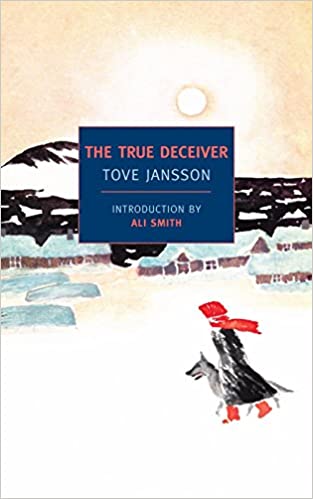
Katri and Mats Kling are village outcasts. Katri has strange yellow eyes, and although she is very intelligent, she is brusque and has no people skills. Mats, her younger brother, is more accepted but seems lacking intellectually and is treated like the village idiot.

Katri wants two things—to find a stable home for Mats and get enough money to build the boat he wants. To do so, she has her eye on Anna Aemelin, an elderly illustrator of children’s books who is known for her drawings of fluffy bunnies.

By offering to deliver Anna’s mail and supplies, Katri begins to strike up a relationship with Anna and is soon working in her house as a servant. Katri sees herself as scrupulously honest, and when she begins managing Anna’s finances, she sees that Anna is being cheated by almost everyone. But Anna doesn’t want to see some things.

This is an odd little book about deception and self-deception but also about an unusual kind of friendship. Katri is accompanied everywhere with a wolf-like dog, while Anna is compared to the fluffy bunnies covered in flowers that she draws all over her meticulous forest floorscapes. But by the end of the novel, the dog has run away, and Anna has stopped painting bunnies.

Related Posts

Lolly Willowes

Miss Plum and Miss Penny

Your Presence Is Requested in Suvanto

Review 2034: The Year of the Runaways

The Year of the Runaways is another book I read for my Booker Prize project. It follows the fortunes of a group of young Indian men who are living illegally in England looking for work.

Tochi is a young man from a low-caste family who in India had been finally getting his head above water since he had bargained for an auto so that he could work as a taxi driver. But after an election where one party rabbled-roused on the slogan of “racial purity,” his entire family was murdered. He travels illegally to England to start again.

Alvar’s father’s shawl business isn’t doing well and his younger brother will soon have school fees to pay. He also wants to marry Lakhpreet, his friend Randeep’s sister. He is able to get a student visa for England with no intention of studying, because he has had to borrow money from a moneylender for his fare.

Randeep comes from a wealthier family, but his father, a government official, loses his job after a mental breakdown. Randeep is kicked out of college in India and attacked for sexually assaulting a girl because he is constantly misreading people’s reactions. To get to London, he enters into a visa marriage with Narinder, a devout Sikh.

All of these young men travel to England with completely unrealistic ideas of how much money they can make or how easy it will be to even find work. They end up living together in a house packed with illegal immigrants working for low wages at menial work, most often employed by their own countrymen. Those with families receive constant demands from them for more money. And things get worse.

This novel is a throw-back to the 19th century social realism genre. The story is compellingly told and illuminates the dilemma of the illegal immigrant. I didn’t feel particularly attached to any of the characters, but I felt sorry for all of them.

Related Posts

The Lives of Others

Nectar in a Sieve

The Lowland

Review 2033: Astonish Me

I enjoyed Maggie Shipstead’s Great Circle, although maybe I thought it was a little overhyped. However, I liked it well enough to look for something else by her and found Astonish Me.

When ballet dancer Joan sees Arslan Rusakov dance, she falls madly in love with him. A brief encounter leads to a correspondence, and a few years later, in 1975, Joan helps him defect from the USSR. Arslan is not faithful to her, however, and once he finds that she is not a good enough dancer to dance with him, he seems to lose interest.

Joan finds she is pregnant and decides to leave the dance life. She seduces her lifelong friend, Jacob, and marries him. They settle in to a suburban life in California.

Their son Harry develops the same kind of friendship with his neighbor Chloe that Jacob had with Joan—he worships her while she seems often embarrassed by him, yet appreciates his friendship. But as they reach their teens with both turning to ballet, it becomes obvious that Harry will be a great dancer while the jury is still out on Chloe.

At first, I was turned off by Joan’s decision to deceive Jacob. I felt it was particularly unlikely for that time. However, as the novel digs deeper into the fascinating world of dance, I found it more and more compelling. I liked, too, that Shipstead’s characters have their faults. They’re human, not perfect. If anything, I liked this novel better than Great Circle.

Related Posts

Great Circle

Pippa Passes

Ballet Shoes

Review 2031: Attrib. and Other Stories

I found Attrib. and Other Stories, which I read for my James Tait Black prize project, a little intimidating, as I find reading poetry. That’s because, although I enjoy language, I use and understand it more straightforwardly.

Williams, on the other hand, clearly loves to play with language while also understanding the moments when it fails you. Two of the stories demonstrate this: “Alphabet,” in which a sufferer from aphasia is forgetting her words along with her lover, and “Spins,” where the narrator contemplates her inability to find the right word as her lover stomps out the door.

“Smote,” subtitled “(or when I find I cannot Kiss You in Front of a Print by Bridget Riley)” was a bit much for me in the verbal gymnastics department, but then its ending was so simple. The most straightforward story and the one that affected me most was “Spines,” about a family on vacation that can’t be bothered to remove a drowning hedgehog from the swimming pool.

Williams is playful and imaginative in her writing. Most of the stories (all except “Spines”) are written in the first person and feel very personal.

Related Posts

Not the End of the World

Thunderstruck and Other Stories

Sudden Traveler

Review 2027: Small Things Like These

It’s 1985, and Ireland isn’t doing well financially, but Bill Furlong is just about keeping his head above water with his coal business. He is a moody man, the son of an unwed mother who was lucky enough to be kept on by her employer, Mrs. Wilson, instead of being sent away when she was pregnant. Mrs. Wilson also paid for his education and helped set him up in business. Still, he wonders who his father is and if this is all there is to life.

Shortly before Christmas, he delivers an order of coal to the convent, which runs a laundry and a school for girls. There are rumors about fallen women being forced to work there and to give up their babies. But other rumors say the nuns do the laundry.

Locked in the coal shed, he finds a dirty, barefoot girl. When he takes her to the door of the convent, the nuns send her for a bath and invite her for tea. She comes in later and says the girls were playing a game with her. Bill is later ashamed of himself for saying nothing, even though she begged him to ask about her baby.

When he tries to speak to his wife about the incident, she is clear that he should not cross the nuns. So are other people. But he reflects that it would have been his own mother in the same situation 40 years ago.

At 114 pages, this novel is short, really a novella, and moody, seriously examining the subject of people’s responsibilities to others. It is purely written, pared down to its basics. A note at the end provides statistics about the Magdalen laundries, the last of which didn’t shut down until 1996.

Related Posts

Himself

The Spinning Heart

The Good People

Review 2022: Literary Wives! Red Island House

Today is another review for the Literary Wives blogging club, in which we discuss the depiction of wives in fiction. If you have read the book, please participate by leaving comments on any of our blogs.

Be sure to read the reviews and comments of the other wives!

My Review

It seems I’ve been reading books set on islands lately—Greenland, Manhattan, and now Madagascar. Like Madagascar, Red Island House is lush and mysterious, the story of a disintegrating marriage.

Shay comes to the Red House newly married to Senna. They seem an inexplicable couple. She is an American of mixed race, educated, thoughtful, tall, and beautiful. He is much older, short, white, Italian, uneducated, and self-made wealthy, also loud and impulsive. On impulse, he has bought this oceanfront property on a small island off Madagascar. He has built an overpowering but beautiful house, which will be the Senna’s summer home.

In this novel constructed of short stories, Lee tells the story of the Sennas’ marriage in terms of their relationship to the house. Shay feels sympathy for the Malagasy people, and is torn by the feeling that her situation in this huge house waited on by many servants in one of the poorest nations in the world is not very far from colonialism. Thus, from the first, she has an ambivalent relationship with her own role as mistress of the house.

The novel begins with Shay’s understanding that the man Senna has hired to manage the house, Kristos, is her enemy. When the Sennas are in the house, her husband spends a lot of time with Kristos, off fishing and probably carousing, and after Senna has been around Kristos for a while, he snaps and shouts at Shay. Shay is conscious of disappearing goods and money, but when she tries to talk to Senna, he is rude and dismissive. On the surface polite, Kristos undercuts her.

Shay learns from the housekeeper, Bertine, that Kristos, who has contacts in bad places, is using magic against her. So, Bertine takes Shay to see the Neighbor.

As in each story Lee explores some colorful character or incident, the novel covers 30 years in the Sennas’ marriage. Shay’s relationship with the island gains ambivalence after the couple converts the Red House into a bed and breakfast, and it slowly becomes the haunt of Senna’s male friends, who shift their focus from fishing to teenage sex workers as they age.

The novel is gorgeously exotic, serious, and eloquent. It’s about race, class, hope, betrayal, and the couple’s finally divisive approaches to moral problems.

What does this book say about wives or about the experience of being a wife?

Lee uses Shay’s relationship to the Red House as a symbol for the Sennas’ marriage. In the beginning of the novel, the couple goes to see its foundation on their honeymoon, and at the end of the novel, she makes a last visit to it to say goodbye to it and her marriage, and I think to meet its inheritor, her husband’s illegitimate son by a Malagasy prostitute.

I find Shay and Senna an inexplicable couple from the beginning. They are such opposites that it’s hard to believe they would even like each other, let alone love each other, but we are informed that they do. And they remain married quite a long time, although Shay has to overlook a lot.

Lee tracks the relationship to the house in one insightful chapter at the end, where she takes it through the newness of the honeymoon period through the burgeoning of having children and farther until it becomes a fantasy playhouse for a bunch of pathetic, randy old men—Senna being one of them.

Literary Wives logo

Shay’s relationship to Senna also varies as she considers the role she has taken at the Red House. She is too informed about her family’s and race’s past heritage in slavery to feel comfortable in what she sees as a colonial role in Madagascar. Although she feels she can’t understand the country, she understands it much better than Senna, who views it as a place of fantasy. As he spends more time there, she spends less.

Shay is an independent woman, so it beats me why she doesn’t leave Senna earlier. We are told she has been coached by her Italian friends to accept his infidelities, but it isn’t until she has that burst of hurt and jealousy toward the end of the novel that we understand there is still a lot of feeling there.

Related Posts

On Beauty

Alternate Side

The Amateur Marriage

Review 2015: A Girl Called Rumi

In 1981, nine-year-old Kimia is a strong-willed girl having problems with the restrictions of post-revolution Iran. Her parents’ fight for freedom has ironically ended in an almost total lack of it. Kimia hates her chador and prefers roaming around with her cousin Reza, despite it being a crime for girls and boys to play together.

One day the two children find a trap door that leads to the home of Baba Morshed, a storyteller. As he tells an ancient Persian story about the Simorgh, a mythical creature like a bird, the children can see the figures in the tale. Kimia continues to return to hear Baba Morshed’s cryptic tales.

In 2009, Kimia lives in California and works as a life counselor. She is still traumatized by events from 1981 and sometimes cuts herself. She is also full of anger against her mother. She is horrified when her mother tells her she wants to return to Iran and Kimia and her brother Ammad must come, too. The trip to Iran reveals family secrets but also involves unexpected dangers.

I liked this novel for its glimpses into Persian culture and descriptions of its food. However, some of you will not be surprised to learn that I wasn’t as comfortable with the magical realism, especially as it isn’t completely clear whether it’s the children’s imagination, rendering the ending less believable.

Related Posts

Song of a Captive Bird

Shah of Shahs

Tales from the Queen of the Desert