Day 211: Affinity

Cover for AffinitySarah Waters is great at constructing compelling plots and characters who fascinate even if you dislike them. In Affinity, Margaret Prior begins visiting the woman’s ward of Millbank Prison as a volunteer in an effort to become more active after a year of depression. As with many Victorian charities, the point of this volunteer work is to set the inmates the example of a proper upper-class woman and to make sure they have religious training. Margaret is despondent because her father treated her like an equal and employed her as his assistant, but with her father’s death, she is left with a mother who apparently despises her and with no work or purpose.

Margaret becomes fascinated with a prisoner named Selina Dawes, a spiritualist found guilty of complicity in her sponsor’s death as well as fraud and assault. Although initially skeptical of Selina’s abilities, Margaret begins to experience strange, unexplainable events. Not only does she become convinced of Selina’s powers, but she believes she is innocent.

As Margaret’s obsession grows, she devises a daring escape plan for Selina.

Waters’ depiction of London in Victorian times is convincing, and the atmosphere of the novel is grim and foreboding. Although I was not at all sympathetic to Margaret, I was engrossed by the story and particularly interested in the explanation, if there was any, for the apparently psychic phenomena in the novel.

Day 208: The Quiet Twin

Cover for The Quiet TwinThe Quiet Twin by Dan Vyleta seems to start out as a standard mystery, but it turns out to be something else entirely. I was attracted to it because in reviews it was compared to Rear Window, one of my favorite movies.

In a 1939 Viennese neighborhood, there is a rumor of a serial killer. A man was murdered not far away, and someone has killed Professor Speckstein’s old dog in a similar manner.

The courtyard behind Dr. Beer’s more respectable apartment building is shared by some tenements occupied by poverty-stricken tenants. The view that some apartments have into others sets up the situation reminiscent of Rear Window.

Dr. Beer is called to treat Professor Speckstein’s niece Zuzka, a college student who suffers from periodic paralysis. Speckstein is a disgraced former college professor who was once accused of child molestation but has hung onto his social position by becoming a Nazi party informant. Dr. Beer, a student of Freud, diagnoses Zuzka with hysteria.

Zuzka is bored and sleepless, so she watches the courtyard from the window in the middle of the night. She has seen a man across the way washing off makeup and what appears to be blood, so she decides to investigate whether he is the killer.

Also living in the courtyard is a drunken man and his little girl Lieschen, whose body is badly deformed from an accident. Zuzka befriends Lieschen while Dr. Beer worries what may happen to her under the Nazis, having heard about some of their ideas.

A brutish police detective named Teuben appears to investigate the murders, but his actual plan is to pin them on some hapless person.

Although Vyleta has tried to depict the atmosphere among the common people of Vienna under the Nazis, I am not so sure he succeeds. Dr. Beer seems to be one of the few characters who is aware of any threat. An aura of dread persists, but it seems more dependent upon my knowledge of coming events than on any feeling from the novel, although the novel is certainly bleak. Perhaps because I read In the Garden of the Beasts only a few weeks before, I expected an atmosphere that was much more fraught with peril.

Day 206: Special Assignments: The Further Adventures of Erast Fandorin

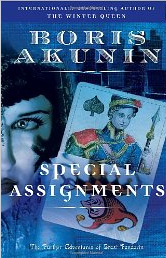
Cover for Special AssignmentsI have been following Boris Akunin’s Erast Fandorin series for several years. At first I liked Akunin’s shy, skinny, intellectual young hero. But then Fandorin transformed himself into a muscle-bound Putinesque superhero wannabe, so I lost most of my affection for him.

Set in Tsarist Russia, Special Assignments is actually two novelettes about Fandorin cases. The first, “Jack of Spades,” is a silly case where Fandorin is pursuing a clever con artist. It is supposed to be funny, I think, but I mostly missed the humor and found it ridiculously overcomplicated.

The second story I did not finish once I grasped where it was going. Called “The Decorator,” it is about Jack the Ripper moving his operations to Moscow. However, it becomes quickly obvious that Jack is supposed to be not only a woman but one who is murdering prostitutes because they are defiling their bodies. The whole idea was so abhorrent to me that I refused to read any more of it.

Day 205: The Journal of Mrs. Pepys

Cover for The Journal of Mrs. PepysI began reading Samuel Pepys’ famous diaries years ago, but found it difficult to understand many of the oblique references to events of the time and found many of the entries very trivial. There was also a whole lot of drinking going on. However, I thought I’d give the fictional journal of his wife a try by reading The Journal of Mrs. Pepys: Portrait of a Marriage by Sara George.

The journal follows the course of the Pepys’ marriage and their rise in prosperity. George was careful to follow closely the events related in Samuel Pepys’ diary, which somewhat hampers the plot. The novel looks at these events from the point of view of Elizabeth Pepys, particularly how she reacts to her husband’s frequent absences and philandering.

The novel provides an interesting insight into the events leading up to and during the Restoration–particularly the eagerness with which the populous welcomes Charles II to the throne and the rapidity with which they tire of the court’s profligacy and debauchery.

Also of interest are some of the customs observed. I was intrigued by how freely the Pepyses behaved with their servants, treating them as if they were friends and then getting into spats with them for taking liberties. Also of interest were some of the social behaviors, like the celebration of Valentines Day, where women picked their valentines, who then had to buy them expensive gifts. And then there were the freedoms of male friends to walk up into ladies’ bedrooms or of both sexes to share bedrooms on a trip away from home without any indication of scandal.

Written mostly in modern English, the novel manages a fine balancing act between understandability and the correct use of outdated terms or terms that have changed their meanings with time.

Although I found the novel interesting enough, by nature of the concept, it could not follow the traditional plot structure of a series of building climaxes. There is a climax at the end, but generally the novel stays fairly level.

Day 202: The Lantern Bearers

Cover for The Lantern BearersIf you are historical fiction lover and are not familiar with Rosemary Sutcliff, I recommend that you try one of her books. She is best known for her novels about the Roman occupation of Britain and the interaction between the Romans and the various British peoples. Although many of her books are classified as children’s literature, the ones I have read are just as suitable for adults. My review today is of a Sutcliff book I read most recently, which unfortunately is the third book of her acclaimed Eagle of the Ninth trilogy, The Lantern Bearers. Although she wrote a series of eight books about the Aquila family, three are usually grouped together and sometimes can be purchased as one book. The other two are The Eagle of the Ninth and The Silver Branch.

The Lantern Bearers is about the desertion of Britain by the Romans and its subsequent inundation by marauding Saxons. Aquila is a soldier with the last battalion on Britain. He is recalled to his regiment to withdraw from Britain and leave his father and sister behind in the home they have occupied for generations.

Aquila finds that his heart is with Britain, so he deserts his regiment and returns home. However, the day after he arrives, his home is attacked by the Saxons, his father is killed, and he and his sister are enslaved.

Without giving too much away, I will say that the story eventually focuses on the rise of the British ruler Ambrosius and his adopted son Artos, from whom we get the stories of King Arthur.

I think these books are fascinating, although of the three in the trilogy, my favorite is The Eagle of the Ninth (which, by the way, was recently made into a very good movie that no one apparently went to see; I recommend it). If I had any criticism of this book, which is carefully researched, well written, and full of action, I would say that sometimes it seems as if Sutcliff thinks the Roman occupation of Britain was completely positive. I doubt if the Britains felt that way when they were conquered. However, even though her heroes are often Romans, her ideas are more nuanced than that.

If you decide to read this trilogy, I suggest you start with The Eagle of the Ninth, although the books are far enough separated in time to be read as stand-alones.

Day 201: The School of Night

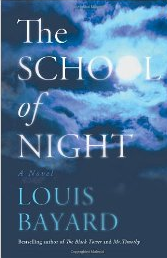
The School of NightCoincidentally, this summer I read and reviewed Shadow of Night, and The School of Night by Louis Bayard is another novel that deals with the School of Night, a group of Elizabethan scholars who pursued forbidden knowledge. Its members were Sir Walter Raleigh, Thomas Harriot, and Kit Marlowe, among others. The School of Night follows events in two time periods, the present and 1603.

Ten years ago Henry Cavendish was an Elizabethan scholar with a promising future, but he was disgraced when he accepted as legitimate a forged letter supposedly by Sir Walter Raleigh and presented it at a conference. Since then, he has barely eked out a living, teaching part-time, doing editing work, and taking whatever jobs he can get. His only true friend is the eccentric Alonzo Wax, a collector and purveyor of rare books.

But Alonzo is dead, having drowned himself after trying to contact Henry, and Henry finds himself the estate executor. Shortly after the funeral, Henry is contacted by another collector, Bernard Styles, who shows him the second page of a letter by Raleigh that he alleges Alonzo stole from him. This letter makes a rare reference to the School of Night. Styles offers Henry a lot of money to find the letter in Alonzo’s papers and give it to him.

Henry also meets Clarissa Dale, who claims to have made Alonzo’s acquaintance after a lecture about the School of Night. Although she is not an academic, she has been having visions of Thomas Harriot and an assistant named Margaret and wants to find out why.

Henry has barely begun to work with Alonzo’s papers when Alonzo’s secretary, Lily Pentzler, is murdered and all of Alonzo’s books are stolen. This incident makes Henry and Clarissa wonder if Alonzo was murdered, too. Soon, Henry and Clarissa find themselves investigating the secrets of the letter.

Alternating with the present-time story is that of Thomas Harriot, the leader of the School of Night, as he explores Virginia and later works on his forbidden experiments while hidden away on the estate of the Earl of Percy. Finding that his maid servant Margaret can read, he begins to train her to assist him in his experiments.

Although I guessed one important secret early on, I found this novel deeply satisfying. It is full of twists and betrayals and has interesting characters. It treats the historical plot intelligently, and although this comment is not meant as a criticism of Shadow of Night, it deals more seriously with the School of Night than does Shadow of Night (which of course has a completely different focus).

I had not read Bayard before, but he is known for writing historical mysteries that feature such characters as a grown-up Tiny Tim (Mr. Timothy) and Edgar Allan Poe (The Pale Blue Eye). I am interested in reading more.

Day 196: The Secret Keeper

Cover for The Secret KeeperI loved The Forgotten Garden so much that Kate Morton’s other books, although very good, have not been able to hold their own against it. At first I thought The Secret Keeper would also be good but not great, but a terrific surprise at the end of the book made me change my mind.

The novel begins in 1961, when sixteen-year-old Laurel Nicolson is up in the treehouse on the family farm dreaming about her boyfriend. She sees her mother Dorothy go into the house with her baby brother Gerry. It is Gerry’s birthday, and Laurel knows her mother has left the birthday picnic to fetch the family’s special birthday knife so she can cut the cake. A few minutes later, a stranger goes to the door, and Laurel sees her mother stab the man with a knife. He is assumed to be the man who has been attacking women in the area.

Fifty years later, Laurel is a famous character actor who has come home to visit her ill mother. Her mother’s memory is failing, but she has asked Laurel’s sister Rose to get some things out of a box that has always been private. Among them is a photograph of Dorothy and her friend Vivien, who died during the Blitz.

Laurel’s memory of the long-ago incident with the stranger has become muddied and even inaccurate, but she begins to remember it more clearly when she decides to look into it further. She finds that the attacker was Henry Jenkins, Vivien’s husband. Since Dorothy must have known Henry, there is obviously more to the story.

From here the story alternates between Laurel’s investigation in the present and the war years of young Dorothy (Dolly) Smitham. Dolly is madly in love with Jimmy Metcalfe, a newspaper photographer who also has sole care of his senile father. Dolly wants to marry immediately, but Jimmy thinks they can’t afford it yet, so Dolly takes a job as a companion to a wealthy old lady in London. At a war effort volunteer job, she meets Vivien, who lives across the street with her husband, a successful novelist. Dolly, who comes from a lower middle class background, gets carried away with the idea of leading a more exciting, fashionable life. After a series of misunderstandings, she hatches a plan to get money for her marriage and talks the reluctant Jimmy into helping.

At this point, my major problem with the novel was a growing dislike for Dolly, who seems narcissistic and lacking in conscience. I kept wondering how she was going to develop into the beloved mother of five children. But the novel goes on to unearth secrets. With Morton’s gift for storytelling and excellent writing, I think this novel is as good or better than The Forgotten Garden.

Day 194: Burning Bright

Cover for Burning BrightI’m afraid I cannot read any book by Tracy Chevalier without thinking of the purity of the character she created in Girl with a Pearl Earring. Unfortunately, I haven’t read a book by her that was as good, but I keep hoping for one.

In Burning Bright, set in 18th century London, Jem Kellaway, a young lad from the country, moves with his family into Lambeth. They settle into a row house owned by Kellaway’s new employer, next door to the poet and artist William Blake and his wife.

Jem befriends a London street urchin named Maggie Butterfield, and they spend some time with the Blakes. These two children are meant to represent Blake’s ideas of innocence and experience.

Jem’s father has taken a carpentry job with Astley’s Circus. Unfortunately, Jem’s sister Maisie soon attracts the eye of John Astley, the rapscallion son of the circus owner.

Most of the action of the novel centers around the unease generated in England by the French Revolution. Blake’s unusual publications have made him appear to be seditious, and he and his family are threatened as the hysteria rises.

Unfortunately, the characters and story are not very interesting, and William Blake is almost incidental to the novel. The novel does nothing to make the mysterious Blake more understandable to us.

Day 188: The Nature of Monsters

Cover for The Nature of MonstersClare Clark seems to be fascinated with shit. Her first book, The Great Stink, featured a mystery during the digging of the London sewer system, and it seemed to revel in descriptions of filth. The Nature of Monsters also spends a great deal of time describing the sanitary conditions of 18th century London.

The novel begins with a description of the 1666 Great Fire of London and the subsequent birth of a disfigured child. This opening is perplexing, and it takes you awhile to figure out the connection to the rest of the novel.

It is 1718, and Eliza Tally has essentially been sold by her mother to a wealthy man’s son, although they first perform a semi-legal marriage ceremony. When Eliza gets pregnant, her mother goes to the man’s father to negotiate a settlement. The results are not what she expects, as Eliza is sold into servitude in London as a maid for an apothecary, whom she thinks is supposed to rid her of her child. But he has other plans.

Eliza is trapped in a bizarre household. She is never allowed to see the apothecary. His wife, Mrs. Black, is intimidating and maintains an iron control over the household. The apothecary has a slimy assistant, and the only other servant is Mary, a mentally handicapped girl. The atmosphere of the house is dark and creepy.

Convinced that he is a scientist and that he is making scientific experiments, the apothecary believes that what a pregnant woman experiences determines the formation of her child. Since he has a handy pregnant woman in his house, he decides to use her for his experiments. Clark has written another disturbing but well-written and suspenseful novel.

Day 184: Caleb’s Crossing

Cover for Caleb's CrossingBest Book of the Week!

Caleb’s Crossing by Geraldine Brooks is a wonderful novel about life in 17th century Martha’s Vineyard and Cambridge. The novel is focused around Caleb Cheeshahteaumauk, the first American Indian to take a degree at Harvard. It is narrated from the point of view of Bethia Mayfield, a girl whose thirst for knowledge is only slaked with great difficulty in Puritan New England.

Bethia meets Caleb when they are both twelve. She is wandering around the beaches of her home island, Noepe, later to be called Martha’s Vineyard, in a small act of rebellion because she is not supposed to be alone. She has already been halted in her education by her father, a minister and missionary to the Indians, who sees how her superior abilities humiliate her brother Makepeace.

Caleb is not one of the “praying Indians” who have adopted Christianity and moved closer to town. By all rights Bethia should avoid him. But she loves nature and is happy for Caleb to teach her about the island’s wildlife and learn his language while she teaches him English, reading, and writing. Although their relationship is perfectly innocent, it remains a secret and is naturally broken off as they grow older.

In learning more about English ways, and particularly about writing, Caleb decides he can best help his people by becoming more educated. His path continues together with Bethia’s, as a series of tragedies result in Bethia’s agreement to sacrifice herself for Makepeace’s tuition by working as an indentured servant for the teacher who is preparing Caleb, his friend Joel, and Makepeace to enter Harvard. As Caleb struggles with his adoption of the English culture, Bethia struggles with her own desires for an intellectual life in a culture that only recognizes one path for her–marriage and motherhood.

Although a few historical figures appear in the novel, little is known of Caleb and Joel–both historical figures–so the account is completely fictionalized. For example, Bethia’s father Thomas Mayfield is based on Thomas Mayhew, Jr., who did not have a daughter.

This is an enthralling novel, an evocative picture of the place and times, and Bethia and Caleb are memorable characters.