Day 435: Literary Wives: The Wife, the Maid, and the Mistress

Cover for The Wife, the Maid, and the MistressToday is another Literary Wives posting, where along with several other bloggers, I post reviews of the same book with the theme of “wives.” For more information, see my Literary Wives page.

The famous disappearance of Judge Crater, who like Jimmy Hoffa was never heard from again, certainly has potential for a noirish whodunnit. I just wasn’t that satisfied with Ariel Lawhon’s version of the story.

For one thing, although the plot has all the elements of a noir mystery, the writing style doesn’t reflect the cold crispness and snappy dialogue I expect from noir. It is merely pedestrian.

At the beginning of the novel, Judge Crater’s wife Stella meets Jude Simon, the detective who was on the case, years later in 1969 to give him a confession. Then we return in time to 1930. The bulk of the novels flits restlessly between different days and times around and before this period, returning occasionally to 1969 to Stella and Jude’s meeting.

This time shifting was one of my problems with the novel. I do not remember dates readily, and it was difficult for me to keep my place in time. Possibly a fault that will be cleared up in the published book (I was reading an advanced reading copy) is the problem of the dates at the beginning of sections, which sometimes are there to signal a change in time and sometimes are not. The first time the time changed with no indication, I thought it was a mistake, but then it happened several more times.

In addition, a few scenes that return to an earlier time have no apparent purpose. Perhaps they are intended to establish something about the Craters’ relationship, but I find them unnecessary to the story. The example that comes to mind is a dinner scene where the judge tells Stella where he wants her to shop from then on.

For the plot, the judge disappears at the beginning of the book. His mistress Ritzi is hiding in the room when he is taken, so it is no surprise to find out who took him. His wife Stella and their maid Maria also have some guilty knowledge. Maria sees her husband Jude plant some money in the house after the judge’s disappearance, and Stella removes money from the house and all their assets from the bank before reporting the judge as missing.

Overall, I found the novel mildly entertaining. It does manage a surprise at the end, which I didn’t expect because the novel seemed otherwise predictable. I also think more could have been done to make the time period and the setting more evocative.

Now to our questions for Literary Wives.

What does this book say about wives or the experience of being a wife?

There are two prominent wives in the novel–Stella and Maria. The judge sees his wife’s role as being an ornament and an asset on his way to the top, and Stella seems to have agreed to take this role, although she obviously has lost her respect for him over time. There are some references to happier times, but we frankly can’t see that he has any redeeming qualities. Stella’s only other concern seems to be to make sure she has money after the judge’s disappearance.

Maria’s relationship is more loving. She seems to see her role as to protect and support her husband and to try to become a mother. However, we don’t really see very much of Jude and Maria together, and Jude seems to be preoccupied with his difficulties at work.

In what way does this woman define “wife” or is defined by “wife”?

Except for one central act, which I don’t want to give away, both women are essentially defined by their roles as wives, which are fairly stereotypical for the time. Stella is the society wife. Maria is the religious little woman. This defining act tells us there is more to both of them, but we don’t really understand these women very well as people, and this act is only revealed at the end of the novel, giving us no opportunity to view them in another way. I think Ritzi is the most fully developed character, and although she is actually a wife as well, that part of her character isn’t really explored.

Be sure to view the posts of the other “wives,” as follows. An interview with Ariel Lawhon is posted on Audra’s blog, Unabridged Chick.

Ariel of One Little Library
Audra of Unabridged Chick
Carolyn of Rosemary and Reading Glasses
Cecilia of Only You
Emily of The Bookshelf of Emily J.
Lynn of Smoke and Mirrors

Day 426: A Fatal Likeness

Cover for A Fatal LikenessIn A Fatal Likeness, Lynn Shepherd has created her own gothic horror around the mysteries in the real lives of two fans of the gothic, the poet Percy Bysshe Shelley and his wife, the writer Mary Shelley. It is not only a dark story, but some of it is relatively plausible, given the research Shepherd has done into their lives. Ever since I read Shepherd’s astounding reworking of Bleak House, The Solitary House, I have been a fan of her narrative skills, her writing skills, and her imagination.

Shepherd’s detective, Charles Maddox, is summoned to the home of Percy Shelley, the son of the deceased poet. Shelley and his wife have established a shrine to the poet’s memory and say they are worried about some papers someone is offering to sell them. Mrs. Shelley in particular has been responsible for destroying any papers that would tarnish Shelley’s legacy. They hire Charles to find out what is contained in these papers.

Charles has his own reasons for taking the job, for his beloved great-uncle, also Charles Maddox, the master detective who trained him and is his only family, suffered a stroke upon receiving a calling card bearing the name of his client. Charles learns from his assistant Abel that his great-uncle was employed on a case years before for William Godwin, the brilliant philosopher and Mary Shelley’s father. When the file on this case is located, though, some of the pages have been torn out.

Charles takes a room in the home of the person purveying the papers, whom Charles has been told is an Italian man, and it is not long before he realizes his landlady is Clair Clairmont. Clair, the step-sister of Mary Shelley, infamously ran off with Shelley and Mary when both the girls were only sixteen and Shelley was still married to his first wife, Harriet.

Charles is soon to realize that everyone involved in this case has ulterior motives, those of the Shelleys to find out whether a record of the earlier case still exists, as it certainly contains damaging information. With his great-uncle only slowly recovering, it is up to Charles to discover what mysteries lurk in the Shelleys’ past. As he investigates the earlier case, he finds records of an even earlier encounter with his great-uncle.

The Shelleys’ past is a rat’s nest, with two young suicided women, Shelley’s first wife and Mary’s other step-sister, with several dead infants, with Shelley’s own history of delusions, hallucinations, fits, and obsessions. Each person’s story of the fraught years of the Shelleys’ relationship is different, and it is difficult to know what or whom to believe. It is not long before Charles is to think Percy Shelley was something of a monster.

Doubles are a theme throughout the novel. Shelley is always involved with two women at once, two young women commit suicide, Shelley is obsessed with the idea of a doppelganger and thinks he has encountered a monster with his own face. Charles’ great-uncle was partially deceived long ago by the likeness he perceived between the young Mary Godwin and a lost love.

Shepherd’s writing style is distinctive. She writes in limited third person but overlays this voice occasionally with observations from a more knowing narrator of a later time, perhaps the present. The effect is slightly facetious and ironic in tone.

Her research into this time period and into the lives of the Shelleys is clearly extensive. She impressed me with The Solitary House and here she continues to do so with a fascinating, disturbing tale about some turbulent personalities.

Day 425: The Gods of Gotham

Cover for The Gods of GothamBest Book of the Week!

New York in 1845 is a turbulent city. The political campaign between the Democrats and the Whigs is crooked and violent, and the recent influx of Irish poor is causing some Protestant leaders to preach against Papists. The recent establishment of a police force has been fought against by those claiming it impinges on their civil liberties.

Timothy Wilde is a bartender who has managed to save up $500 and intends to ask the woman he loves, Mercy Underhill, for her hand. A huge fire that ranges more than twenty blocks changes his plans, for his home is burned down with all his money in it and so is his place of work. His face is badly scarred as well, so Timothy believes his future is ruined.

His older brother Valentine, with whom he has a rocky relationship, has plans for him. Val has just been made a captain in the new police force and believes the copper stars–for that is what they are soon called because of their badges–is the place for his brother. Timothy is distrustful of Val’s intentions. His brother is a popular and charismatic leader of the firemen and the Democratic party, but Timothy also knows him as an opium addict and a wild man who hangs out with thugs. Timothy soon finds that the job suits him, however.

He is not long on the job before a child runs into him late one night, hysterical and covered with blood, saying “He’s going to tear him to pieces.” Wilde sees that she is a kinchin mab, or a child prostitute. He brings her home to the Dutch widow who is his new landlady instead of taking her in for questioning. When the girl recovers herself, she identifies herself as Bird and tells him a pack of lies. He soon finds out what she was talking about, however, when the body of a young male child prostitute is found in a trash receptacle.

Timothy’s investigation results in the discovery of a field full of bodies on the edge of the city–a total of 19 dead children with a cross carved into their torsos. Although the authorities try to keep this a secret, the word soon gets out. Then someone begins writing letters blaming the deaths on the Irish. Soon the city is a powder keg.

This novel is even better than Faye’s acclaimed first, Dust and Shadow. It depicts New York in all its grit and dissension and feels historically grounded. It introduces an honest, kind, and clever hero whom I hope we’ll see more of. The plot is full of twists, and although I managed to spot a perpetrator well in advance, the story was much more tangled than I expected. I thoroughly enjoyed this novel.

Day 419: The Bones of Paris

Cover for The Bones of ParisHappy Halloween! I tried to select a book that was appropriate for the occasion, although I didn’t have a ghost story lined up.

Laurie R. King’s series about Mary Russell and Sherlock Holmes is very popular, but I prefer her Kate Martinelli series or, even better, some of her dark psychological stand-alone novels. Folly is my favorite. With The Bones of Paris, she brings some of that darker sensibility to what looks like the beginning of a new mystery series.

Harris Stuyvesant is an ex-FBI agent who has been scraping a living in Europe by taking private investigation work. Among the hordes of American expatriates in 1929 Paris, he is searching for a young woman, Pip Crosby, whose relatives have not heard from her in months. A cause for possible embarrassment or worse is that Harris met Pip in Nice the year before and had a brief fling with her. Ever since a disastrous incident that ended his career and cost him his fiancée, he has been living an aimless and bohemian existence.

Two of Harris’ first stops in his search for Pip are Pip’s flatmate, Nancy Berger, and the Paris Missing Persons Bureau. Nancy seems to have a hangover but is actually suffering the effects of travel. She just returned from an archaeological dig in Greece and has not seen Pip for months. Harris finds the police officer, Doucet, concerned about what may be a series of killings.

Harris’ attentions soon narrow on three men connected with the art world whose names keep surfacing in connection with Pip and who all have a fascination with the macabre. The artist Man Ray‘s photographs of Pip focus on a gruesome scar from an accident in her youth. Count Dominic de Charmentier is a wealthy patron of the arts who owns a theatre that alternates grotesque and frightening scenes with comic ones. He also hosts parties that feature macabre decorations and terrifying staged events. Didi Moreau is a creepy, disturbing artist who makes displays of found objects, including human bones. Pip has a few of these displays in her room, as well as some of Man Ray’s photographs. When Harris begins investigating these men more closely, he finds to his alarm that his ex-fiancée, Sarah Grey, is working as de Charmentier’s assistant.

King evokes the time and place with mastery, introducing us to a dissolute café culture populated with famous figures such as Cole Porter and Josephine Baker. She also cleverly raises the creep factor by interjecting short chapters about the bones that underlie parts of Paris, foreboding snippets of conversation, and other indications that something monstrous is going on behind the scenes of glittering nightlife.

Day 412: Stone’s Fall

Cover for Stone's FallBest Book of the Week!
Ever since Iain Pears wrote the stunning An Instance of the Fingerpost, I have been waiting for him to come out with something that could match it for complexity and interest. He has finally achieved this with Stone’s Fall.

Did he fall or was he pushed? might be the question journalist Matthew Braddock is asked to answer when Elizabeth Stone hires him after her husband falls to his death from his office window. Instead, she asks him to find the child John Stone mentioned in his will. Stone’s estate is tied up during the search for this unknown heir, but Elizabeth says she has no ulterior motives except a sincere wish to follow her husband’s wishes. As Stone was an extremely wealthy but private arms manufacturer and the only person who could understand the complex structure of his inter-related companies, many are concerned in his affairs, even the British government.

Completely infatuated with the older woman and feeling wholly unqualified to find the child, Braddock instead concentrates on investigating the last days of Stone’s life and the state of his corporations. In doing so, he finds evidence that Stone’s net worth was not nearly as large as everyone thinks. He also has questions about the involvement of Henry Cort, a mysterious figure believed to work for the Foreign Office. Braddock relates the tale of what he discovered quite some time after his 1909 investigation, in 1953 after Elizabeth Stone’s funeral.

Braddock’s story does not answer many questions even though he believes he has found some facts, but after his narrative, he includes a manuscript sent to him by Henry Cort. Cort takes his own story back further, to events in Paris of 1890, when he befriends Elizabeth after having known her years before.

The final section of the novel takes us to Venice in 1867, when as a young man John Stone meets Cort’s parents and the man who invented the torpedo that began Stone’s empire. It is in this final section of the novel that we begin to understand the answers to the mysteries of John Stone’s life and death.

This series of narratives is like a set of nested gift boxes–as we unwrap each one, we learn more and go deeper into the story, finally beginning to understand the mysterious Stone. The novel is impeccably plotted and beautifully written–a great reading experience for those who appreciate a mystery that is not formulaic.

Day 405: The Child’s Child

Cover for the Child's ChildEven though The Child’s Child is a relatively short novel, it seems to take a long time to get to the payoff. Although Barbara Vine’s novels are more character studies than thrillers, they always involve a certain amount of suspense.

This book uses a novel-within-a-novel structure, with the exterior novel taking place in 2011 while the interior one begins in 1929. The themes of unwed motherhood and homosexuality and the extent to which both are stigmatized are the same in both stories.

Grace Easton is a graduate student working on a thesis about the portrayal of unwed mothers in literature. She and her brother Andrew have inherited a house and impulsively decide to share it instead of selling it. However, they have not discussed issues such as how to deal with prospective mates, and soon enough Andrew, who is gay, has brought home James, a writer. Grace and James do not get on, and she begins to feel uncomfortable in her own home.

One evening Andrew and James witness a brutal crime against a gay friend, about which they will be called upon to testify. James is extremely upset by this event, and his reaction leads to unforeseen complications.

Grace has promised to read the manuscript (the interior novel) written by an acquaintance’s father with a view to telling the acquaintance whether it is publishable. She has been avoiding reading it while she works on her thesis but finally begins. We are led to understand that, while presented as a novel, it is actually a true story of the writer’s relative.

In the interior novel, Maud Goodwin becomes pregnant at fifteen and is immediately rebuffed by her family, with the exception of her brother John. John has recently taken a new job in a different county, and his solution to his sister’s problem is to set up housekeeping with her, the two of them posing as husband and wife to avoid her shame. John is homosexual, which of course was illegal in those days, and has vowed to remain celibate, so he knows he will never marry.

The interior novel takes up the bulk of the book, which I found unfortunate. I thought John was in some ways foolish, and Maud becomes a bitter, ungrateful woman. My immediate thought, even as John was deciding what to do, was that Maud’s situation could just as effectively and more sensibly have been taken care of by her posing as a widow and sharing a house with her brother.

Sadly, John lacks judgment in where he bestows his affections, and when he chooses a partner he basically seals his fate. I had some sympathy for John, but he exits the novel fairly early on, and I grew to dislike Maud more and more.

It isn’t until the narrative returns to the present time that I feel the novel regains its focus and finally provides some payoff, and the long-anticipated suspense. In addition, sadly, the themes of the novel seem labored and obvious, to the point where the author has characters voicing them instead of letting the reader figure them out. If you want to try Barbara Vine, the name Ruth Rendell uses for her psychological suspense novels, I suggest instead A Dark-Adapted Eye, which is one of my favorites.

Day 402: Dust and Shadow

Cover for Dust and ShadowIn Dust and Shadow: An Account of the Ripper Killings by Dr. John H. Watson, Lyndsay Faye combines a great deal of research into the Jack the Ripper killings in 1888 with a vast knowledge of Sherlock Holmes literature to offer an entertaining solution to the crimes. The novel begins nearly 50 years after the events, when Dr. Watson places his narrative of the murders into a safety deposit box on the eve of war.

Inspector Lestrade comes to consult Holmes after the second murder, when police begin to realize the two deaths may be linked. Holmes immediately begins pursuing his usual means of detection–inspecting the body and the scenes of the crimes, trying to find out where the victims were last sighted, questioning the victims’ friends–and he very quickly figures out that another murder is related. He even hires an alert young prostitute, Mary Ann Monk, to make her own enquiries and observations after she identifies the body of her friend, Mrs. Nichols. However, he is soon frustrated by his lack of progress. The only lead Holmes has come across is the story of an elusive sailor, being sought by a friend who thinks he may have been involved in the first murder, that of Mrs. Nichols.

Soon Holmes and Watson have something else to worry about, for a member of the press is printing details of the crimes unknown to but a few. He has been alleging that Holmes himself may be the murderer.

Faye’s novel is atmospheric and absorbing. Its greatest accomplishment, though, is in successfully capturing the narrative style of Doctor Watson, making us believe that this could be a Holmes story. Although I was about 100 pages ahead of Holmes in solving the murder (which would never happen in a real Holmes story), I still found the solution ingenious as well as the reason why the crimes are recorded in history as unsolved (when, of course, Holmes solved them). This novel is a very good first effort. I have Faye’s next book awaiting me in my pile.

Day 398: The Strange Fate of Kitty Easton

Cover for The Strange Fate of Kitty EastonIf you prefer a book to leap immediately into action, this is probably not the mystery for you. The second in a series, it starts slowly, with Speller taking the time to develop the setting and characters.

Laurence Bartram is a young man damaged by World War I, during which his wife and child died and he was injured. Laurence is an expert on church architecture, and he is happy to be summoned to the estate of Easton Deadall by his friend, William Bolitho. William wants him to look over  a small but unusual church, for which William is designing and installing a window.

Laurence is soon pulled into the affairs of the Eastons, a family that is haunted by the war, but moreso by the disappearance in 1911 of the young daughter of Digby Easton, the oldest of the three Easton brothers. Digby died during the war, but Kitty still obsesses her mother Lydia, an invalid who sometimes speaks of her as if she is alive.

The middle Easton son, Julian, has been doing his best with the estate, which Laurence finds beautiful but slightly crumbling, while Lydia’s sister Frances takes care of her. Laurence finds the subject of Kitty lurking behind every conversation and wonders if they will discover her body in the course of their renovations. Soon, the third Easton brother, Patrick, returns to Easton Deadall after an absence of years, first at Oxford and then on an archaeological dig in Greece. It becomes obvious that there is tension between him and Julian.

The family decides to make up a party to visit the Empire Exhibition. William, who was left wheelchair bound by the war, does not feel he can handle it, and Lydia is too ill, but the rest of the family goes. The expedition includes Eleanor, William’s wife, and Laurence. They also bring along David, the estate’s man of all work, and the teenage maid Maggie to help care for William and Eleanor’s young son Nicholas. At the exhibition, Maggie and Nicholas go missing, and although the others find Nicholas, Maggie is nowhere to be seen.

Distressed by Maggie’s disappearance, which can’t but echo the earlier one of Kitty, the family begins falling apart and secrets emerge, especially about the charismatic Digby and his relationships to his family and to his troops during the war. A few days after the disastrous outing, Laurence and David are clearing an area in the church to prepare for the installation of William’s window when they discover a trap door in the floor under the altar. When they open it, they find the body of a woman. The police are able to quickly ascertain that the body is of a woman too old to be Maggie, but then, who can it be? Could it even be Kitty, grown up and returned from wherever she has been?

Laurence does not exactly detect so much as look into a few things the others haven’t thought of, and he eventually unearths a tangle of secrets. Although the novel takes awhile to get going, I soon found myself unable to put it down. It slowly and skillfully builds to suspense. I found it well worth my patience.

Day 374: A Plague of Lies

Cover for A Plague of LiesA Plague of Lies is the third in the mystery series set in 17th century France and featuring Charles du Luc, a master of rhetoric at the Louis le Grand school in Paris.

Charles is dismayed when he is summoned to escort Père Jouvancy to the court at Versailles to present Madame de Maintenon with the gift of a holy relic. Madame is angry with the Jesuits because the King’s confessor, Père la Chaise, convinced the King not to give her the title of Queen, so the gift is an attempt to regain favor. Although Charles disapproves of what he sees as the Sun King’s constant self-glorification, he must escort Père Jouvancy, an old man who is just recovering from an illness that is raging through Paris.

On their way to Versailles, Charles and Jouvancy encounter Lieutenant-Général de la Reynie, head of the Paris police, whom Charles has assisted on occasion. La Reynie asks Charles to keep an eye on the Prince of Conti while he is there and to listen to what is said about him.

Once at court, though, Père Jouvancy has a relapse, and Charles comes close to witnessing the death of a much-disliked man, the Comte de Fleury. Apparently, he too was ill and running for the latrine when he slipped on the wet floor and fell down the stairs. The rumor is that he was writing a scandalous memoir, and poison is immediately mentioned. When the other members of Charles’ party fall ill, there are more rumors of poison, but all the men seem to just have food poisoning.

De Fleury does appear to have been poisoned, however, and Charles observes several people going in and out of his room, including the Duc du Maine, son of the King. Charles finds himself getting embroiled in the problems of the Duc’s sister, Mademoiselle de Rouen, who is soon to be engaged to the son of the King of Poland and is not happy about it. Charles also observes Conti behaving suspiciously. Next, a gardener is found drowned.

The novel presents us with a convoluted plot but also with a fascinating portrait of the court at Versailles. Rock’s knowledge of the period, even of how the places she describes would have appeared at that time, seems convincingly complete. Her novels are always absorbing.

Day 366: The Pale Blue Eye

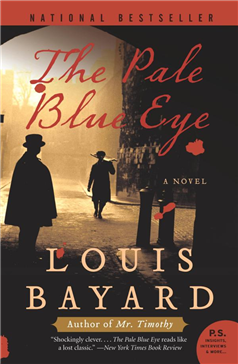
Cover for The Pale Blue EyeGus Landor, a retired New York police detective, is dying, and he writes the account of his last case in The Pale Blue Eye. Gus is a lonely widower who earlier moved up to the mountains near the Hudson Valley with his wife and daughter to help improve his lungs. But his wife died within a year, and his daughter left him soon after. So, Gus lives as a veritable hermit.

On an October morning in 1830, an officer from West Point fetches him. The body of a cadet named Fry was found hanged the night before, presumably a suicide, but during the night his body was stolen and later he was found with his heart removed. Superintendent Thayer and Commander Hitchcock wish to hire Landor to find who stole the heart. Landor is quick to figure out that Fry did not commit suicide but was murdered. A mysterious message clutched in his hand seems to indicate an assignation.

Landor soon realizes that his investigations on the reservation will be sorely hampered without the assistance of an inside man. So, he asks for the help of an unusual cadet he has met who is not in good favor with the academy–Cadet Edgar Allan Poe.

This is a clever novel with a macabre mystery that would have been completely to Poe’s taste. Just when we think everything is figured out, Bayard presents us with a twist. His portrait of the young Poe, bombastic, ridiculously romantic, and fearfully intelligent, is a great pleasure.

I would only fault the novel for a slow-paced middle section, and only because Landor doesn’t seem to be doing anything. Most of the plot is driven forward by Poe’s reports, which begin to dwell on his infatuation with a lovely young woman, Lea, the daughter of the post doctor, who unfortunately suffers from the “falling sickness,” or epilepsy.

Of course, Landor is doing something–he’s deciphering Fry’s diary–but since he doesn’t relate its revelations, his investigation seems to flag, and he barely seems to look into a second death, with a second missing heart. Otherwise, the novel is well written, with well-developed and interesting characters and a surprising ending.