Day 271: The Abyssinian Proof

Cover for The Abyssinian ProofIn 19th century Istanbul, the magistrate Kamil Pasha  is assigned to find out who is stealing valuable relics throughout the city and selling them to London. He is instructed to find the relics and bring them back to where they belong. One of the relics is contained in a reliquary that has been guarded since the last days of the Byzantine Empire by a sect of Abyssinian descent called the Melisites. The relic is called the Proof of God.

Kamil is an upright and dedicated civil servant. While he is investigating, he learns about the history and beliefs of an odd group of people, the descendents of Abyssinian slaves who live in an abandoned cistern and are part of the city’s underworld.

In pursuit of the relic thieves and in investigation of some apparently related murders, we follow Kamil through the subterranean passages under Istanbul.

Kamil is also attracted to Elia, a refugee artist who lives in his sister’s house. Elia has suffered terribly, though, and is not really prepared to pursue more than friendship.

As with Barbara Nadel’s more modern Turkish mysteries, I find novels set in this exotic locale interesting, and the history presented in The Abyssinian Proof is fascinating. Sometimes, I wish that Kamil Pasha wasn’t quite such a serious man, however.

Day 264: The Ballad of Tom Dooley

Cover for The Ballad of Tom DooleySharyn McCrumb has written several series of light mysteries, some better than others. I have usually enjoyed her “ballad” series–atmospheric, sometimes ghostly mysteries set in Appalachia and each named after a traditional folk ballad. The Ballad of Tom Dooley, despite a background of historical research (because this folk ballad is based on a true case), is not her best, however.

According to McCrumb’s notes at the end of the novel, she got interested in the story after researching it for an article and decided that the prevailing theories of the crime are not satisfying. So, she reconstructed her theory of the crime in this book. As such, it is not so much a mystery as an explication.

Most people vaguely know the story, that Tom Dooley (actually Dula) met Laura Foster “on the mountain/stabbed her with [his] knife.” Another defendant, Ann Melton, was let go. But McCrumb says most people in Wilkes County, where the crime occurred, will tell you Ann did it. To McCrumb, knowing that Ann was Tom’s long-time married lover, Tom being guilty didn’t make sense.

The novel is narrated by two characters who were actually involved in the incident: Pauline Foster, who was Ann Melton’s cousin and servant girl; and Zebulon Vance, the ex-governor and senator of pre-Civil War North Carolina who defended Tom. Pauline is an interesting character–McCrumb depicts her as a sociopath who manipulates the others and wants revenge for Ann’s slights.

The biggest fault in the novel is the narration of Zebulon Vance. At first, I thought McCrumb’s intent was to depict him as a maundering old bore, possibly even senile, as his section is so repetitive and adds so little to the narrative. It is mostly about himself and has little to do with the story. But then I read that Vance’s career was one reason McCrumb wanted to do the story. Instead of adding to it, it detracts from and drags against the impetus of the plot.

The fact is that none of the characters are likable people, and the crime isn’t particularly interesting. From the author of some haunting stories, this novel is a disappointment. If McCrumb wanted to write about Vance, she may have done better to write a biography.

Day 249: The Physick Book of Deliverance Dane

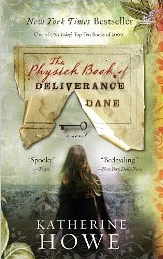
Cover for The Physick Book of Deliverance DaneBest Book of the Week!
Connie Goodwin has just passed her orals in history at Harvard and is one thesis away from her doctorate when her advisor, Manning Chilton, challenges her to find an undiscovered primary source on which to base some subject about Colonial America. She is almost immediately side-tracked in her research by a request from her mother to sort out her grandmother’s long-abandoned house in Marblehead and sell it to pay off back taxes.

Connie finds a very old, filthy house with a gate so overgrown with vines that it’s hard to find the house. Almost immediately she has a few odd glimpses, as if she can vividly picture her grandparents and other people in the house.

While sorting through the objects and papers in the house, she finds evidence of a woman named Deliverance Dane, who was found guilty of witchcraft in the Salem trials and left behind a “recipe” book, possibly of spells. Chilton immediately begins putting pressure on Connie to find the book, as it could provide the first evidence that people were actually practicing witchcraft at that time in Massachusetts. As Connie searches for the book, she makes some astonishing discoveries about her family and herself.

Back in the 17th century, Deliverance Dane, a wise woman or healer, is called to attend a child she cannot save. When the child dies, her father accuses Deliverance of satanism.

Some small things at the beginning of the novel irritated me. In laying the foundation of some basic history, I think Howe condescends to the reader a bit too much. For example, she finds occasion to tell us what a familiar is. Although many people may assume that all familiars are cats and find out differently from this novel, I would be surprised if people didn’t know what they were, if only from remembering their grade school lessons about the Salem witch trials. But perhaps I’m wrong.

There are also a couple of instances where Connie takes awhile to figure out something that she, as a graduate history student, should already know. For example, she doesn’t immediately know that “receipt” is another word for “recipe,” and then she has to explain this term to her professor, supposedly an expert in Colonial America. I am no historian or even generally interested in this period of history, but I knew immediately what the word meant. She does the same thing with figuring out that “Deliverance Dane,” mysterious words on a piece of paper, is someone’s name, as if in all her studies of the period she never encountered such an unusual name.

It is also very easy to see where the novel is going and who will turn out to be a villain. However, I still found it interesting enough to regard it as a strong first novel, especially if you enjoy the mixture of historical fiction and the supernatural. The characters are believable, and both story lines kept my attention. The historical portion seems solidly researched.

And I won’t mention the tomatoes, because it’s just too picky.

Day 240: A Murderous Procession

Cover for A Murderous ProcessionWhen I first started reading Ariana Franklin’s “Mistress of the Art of Death” series, I had mixed feelings about the premise, which is that a 12th century Jewish woman doctor is trapped in England because of her usefulness to Henry II and is in love with a bishop. However, these books are well written and show a great deal of knowledge of the time and place. Ultimately, I find the books interesting and the characters compelling.

Adelia Aguilar is a medieval forensic pathologist trained in Italy who is forced in England to pretend that her Moorish servant Mansur is the doctor and she is his interpreter, since no one would believe a woman could be a trained doctor. In A Murderous Procession, Adelia is living a retired life in the countryside with her daughter when she is ordered to accompany Henry II’s daughter Joanna to her marriage with the King of Sicily. Adelia must leave her own daughter with Queen Eleanor until she returns.

However, Adelia herself is being followed, by a vengeful madman whose bandit lover she killed in a previous book. Unfortunately, I read and reviewed these books out of order. The previous book is Grave Goods, I believe.

Adelia’s lover Rawley is also a member of the party, but he is required to leave periodically on missions of diplomacy. In his absence, the madman incites the entire party, particularly the church men, against Adelia and Mansur, blaming them for the procession’s many mishaps.

Franklin was only able to write a few books in this series before she died. A Murderous Procession is the last. She also wrote the excellent pre-World War II book set in Berlin, City of Shadows, which I reviewed a few months ago. Her death is a sad loss to the fans of good historical fiction.

Day 235: The Eloquence of Blood

Cover for The Eloquence of BloodIn the second of Judith Rock’s series, the Louis le Grand school run by the Jesuits is under financial hardship in this cold winter of 1686. On a visit to Monsieur Callot to ask for a contribution to the alms budget, rhetorician Charles du Luc meets a lovely young woman, Martine Mynette.

Martine’s mother Anne has recently died, and Martine is very concerned, because Henri Brion, a notary and Monsieur Callot’s nephew, has been unable to find a copy of Martine’s donation entre vifs. Because Martine is adopted, according to French law of the time she cannot inherit, so the only way her mother could leave her an inheritance is through this document. The copy usually hidden in the house is gone, and M. Brion is looking for his own copy.

When Charles relates this story to the school’s rector, Pére le Picart, the rector is dismayed because the Jesuit order was expecting the money through a bequest by Anne Mynette’s father. If a donation entre vifs exists, the school will not be entitled to the bequest. Another concern is that M. Brion is the same person who has supposedly been following up on the order’s claim. The rector sends Charles to the Brion’s house to find out what is going on.

Charles finds the area in disorder. Martine–a neighbor of the Brion’s, and Isabelle Brion’s best friend–has been murdered. No one has seen M. Brion. Isabelle is concerned because her father was trying to force her brother Gilles to marry Martine, which gives Gilles a motive for murder.

In addition to finding out about the bequest, Charles is assigned to follow the investigation into Martine’s murder. There are rumors on the street that the Jesuits murdered Martine for the money, and Paris seems to be entering one of its periodic convulsions against the Jesuit order.

As usual for the two books in this series, the historical details seem convincing and interesting. The novel is well written and keeps you involved. One very small caveat that I did not notice in the first book–Rock explains even the simplest French, which is annoying.

Day 231: I Am Half-Sick of Shadows

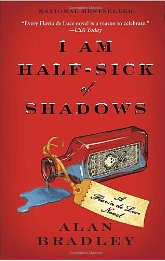
Cover for I Am Half-Sick of ShadowsAnother comic mystery starring the eleven-year-old sleuth Flavia de Luce, I Am Half-Sick of Shadows is the usual fun, even though the clues don’t add up until after the murderer is revealed.

Flavia’s father has rented out the house for Christmas to a film company in an effort to save the estate, since the family is so badly in debt. On Christmas Eve, the lead actors, Phyllis Wyvern and Desmond Duncan, perform a small benefit concert for the village of Bishop’s Lacey, after which everyone is snowed in by a blizzard. During the night, Wyvern is murdered, strangled to death with a length of film. This situation leaves the entire film crew and population of the village as potential suspects.

Although Flavia doesn’t know who the killer is, she becomes trapped on the roof where she has gone to shoot off fireworks and perform a scientific experiment. She has devised a super-sticky bird lime and has spread it all over the roof in an effort to capture Father Christmas, if he exists. Unfortunately, the murderer finds some reason to suspect that Flavia might be on his or her trail.

Day 208: The Quiet Twin

Cover for The Quiet TwinThe Quiet Twin by Dan Vyleta seems to start out as a standard mystery, but it turns out to be something else entirely. I was attracted to it because in reviews it was compared to Rear Window, one of my favorite movies.

In a 1939 Viennese neighborhood, there is a rumor of a serial killer. A man was murdered not far away, and someone has killed Professor Speckstein’s old dog in a similar manner.

The courtyard behind Dr. Beer’s more respectable apartment building is shared by some tenements occupied by poverty-stricken tenants. The view that some apartments have into others sets up the situation reminiscent of Rear Window.

Dr. Beer is called to treat Professor Speckstein’s niece Zuzka, a college student who suffers from periodic paralysis. Speckstein is a disgraced former college professor who was once accused of child molestation but has hung onto his social position by becoming a Nazi party informant. Dr. Beer, a student of Freud, diagnoses Zuzka with hysteria.

Zuzka is bored and sleepless, so she watches the courtyard from the window in the middle of the night. She has seen a man across the way washing off makeup and what appears to be blood, so she decides to investigate whether he is the killer.

Also living in the courtyard is a drunken man and his little girl Lieschen, whose body is badly deformed from an accident. Zuzka befriends Lieschen while Dr. Beer worries what may happen to her under the Nazis, having heard about some of their ideas.

A brutish police detective named Teuben appears to investigate the murders, but his actual plan is to pin them on some hapless person.

Although Vyleta has tried to depict the atmosphere among the common people of Vienna under the Nazis, I am not so sure he succeeds. Dr. Beer seems to be one of the few characters who is aware of any threat. An aura of dread persists, but it seems more dependent upon my knowledge of coming events than on any feeling from the novel, although the novel is certainly bleak. Perhaps because I read In the Garden of the Beasts only a few weeks before, I expected an atmosphere that was much more fraught with peril.

Day 206: Special Assignments: The Further Adventures of Erast Fandorin

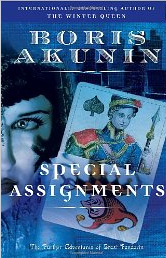
Cover for Special AssignmentsI have been following Boris Akunin’s Erast Fandorin series for several years. At first I liked Akunin’s shy, skinny, intellectual young hero. But then Fandorin transformed himself into a muscle-bound Putinesque superhero wannabe, so I lost most of my affection for him.

Set in Tsarist Russia, Special Assignments is actually two novelettes about Fandorin cases. The first, “Jack of Spades,” is a silly case where Fandorin is pursuing a clever con artist. It is supposed to be funny, I think, but I mostly missed the humor and found it ridiculously overcomplicated.

The second story I did not finish once I grasped where it was going. Called “The Decorator,” it is about Jack the Ripper moving his operations to Moscow. However, it becomes quickly obvious that Jack is supposed to be not only a woman but one who is murdering prostitutes because they are defiling their bodies. The whole idea was so abhorrent to me that I refused to read any more of it.

Day 171: Eye of the Red Tsar

Cover for Eye of the Red TsarI had a strange reaction to Eye of the Red Tsar by Sam Eastland. I felt as if the author had researched the time and place without actually grasping anything about it. The novel is placed in post-revolutionary USSR with flashbacks to pre-revolutionary Russia. Tsar Nicholas II and Stalin are both characters in the book, in their different time periods, but you do not get any feeling that the author understands what kind of people they were or anything about the politics involved. Given my fascination with Russia, this novel would seem to be a great fit for me, but I have nothing but objections to it.

Pekkala, a Finnish soldier, is a prisoner in a labor camp in Siberia at the beginning of the novel. He was Nicholas II’s private investigator before the revolution, when he became known as The Emerald Eye. He remained completely faithful to the Romanovs, so when the family was captured by the Bolsheviks, he was exiled to Siberia. But at the beginning of the novel, he is released because Stalin wants him to find out exactly what happened the night the Tsar and his family were executed. Of course, this question has remained a mystery to the western world until recently, but I did not buy at all that Stalin and his predecessors would not have already known perfectly well what happened to the Romanovs.

My first objection is about how Stalin is characterized. The book takes place partly in 1929, when Stalin is only a few years away from his reign of terror. Yet he is depicted as quiet and thoughtful, not exactly true to the historical consensus. As a kind of extension of that thought, even though the book is about a time and place when everything is politicized, the novel provides no political context for the reader.

Another problem I have is with the narrative style. As Pekkala conducts his investigation, he remembers his past, in order. When I compare Eastland’s technique with that used in The Darkest Room, where characters have fleeting thoughts or disjointed memories that eventually add up to something, this novel seems incomparably clumsy in execution.

Finally (somewhat of a spoiler), I found it completely unbelievable, given the loyalty of the main character to the Romanovs, that he would willingly agree to work for Stalin at the end of the book. I forgive myself for revealing this turn of events, as it is easy to see it coming. Readers are told at the beginning of the book that Stalin is known as the Red Tsar. Obviously, since Pekkala was the Emerald Eye under the Nicholas, he will become the Eye of the Red Tsar under Stalin.

Day 167: City of Shadows

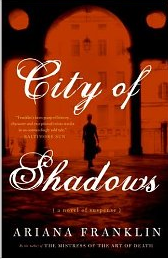
Cover for City of ShadowsAlthough I have read and liked books from Ariana Franklin’s “Mistress of the Art of Death” mystery series, I think that City of Shadows, a stand-alone thriller about a different period, is particularly good. On a side note, I am sorry to hear that Ariana Franklin has died, so we will never learn what her plans were for the characters in her series.

Esther Solomonova is a mysterious scarred woman who works for the phony Russian prince and nightclub owner Nick Potrovskov in 1920’s Berlin. However, the book begins a step before we get to Esther, when a woman is being chased through the streets of Berlin and dives into a canal to get away. Nick hears that this woman, Anna Anderson, is claiming to be Grand Duchess Anastasia of the murdered Romanov family, so he decides to take her under his wing in the hopes of getting a share of the Tsar’s fortune that has been left in England.

Anna is in an asylum, and the inmates claim that every six weeks a man lurks outside, trying to get a chance to murder her. After Nick removes her from the asylum, people begin dying. Only Detective Schmidt pays attention to Esther’s theory that someone is trying to kill Anna, since the only evidence is the testimony of insane people.

Franklin does a convincing job of mixing the true story of Anna Anderson with the completely fictional murder plot. She evokes a real sense of the chaotic, anarchic, starving Berlin in the time in which Hitler is coming to power.