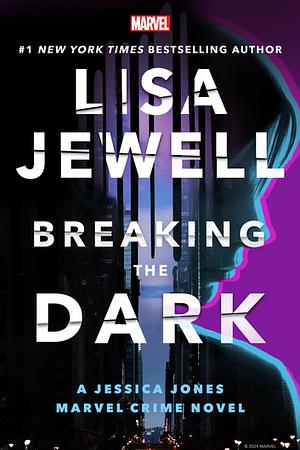
Review 2731: Breaking the Dark

I read a couple of Lisa Jewell’s earlier books and noted that she was moving into thriller territory (the first one was domestic drama), so I made a note to myself to try one. I got this one because it showed up in my Amazon suggestions without bothering to read about it. My bad.

When I picked it up to read it, the first thing I noticed was the word “Marvel.” Now, my husband and I went to some of the superhero movies way back when, but at some point, we just decided we were done. And now I live in a movie desert in which the only theater for miles carries almost exclusively what my family calls “movies for 14-year-old boys” or animated movies, which my husband doesn’t like. So, I don’t go to the movies very often.

I scanned a New York Times review of the book, but I didn’t see hints of anything, so I started reading it. However, there are hints in the book, and at about page 70, it was clear that the main character is some sort of retired superhero. I said, nope, not doing this.

So, if you’re still interested, this appears to be the first in a series about Jessica Jones, a private detective. Amber Randall, middle-aged and wealthy, tells her that her two children went to visit their father in England and came back acting like different people. Jessica is reluctant to take the case, but Amber gets her to follow them, and Jessica has to admit that there’s something strange about them. So, the plan is for Jessica to go to Engand and try to figure out what happened.

For a thriller, it’s a fairly slow starter, since this is pretty much all that happens in the first 70 pages except for appearances of a mysterious little girl.

Oh, and this may sound picky, but the first thing Jessica does is go feed a neighbor’s cat, a cat she doesn’t know, and she leaves the door open so it gets out. Now, who would do that? with any animal except a fish, I mean? or something in a cage. It provides an excuse for the first hint that Jessica is not what she seems.

The novel is well written, and I suspect it’s fine for anyone who wants to read about superheroes, but I don’t.

Related Posts

The House We Grew Up In

The Family Upstairs

Practical Magic

Review 1743: The Family Upstairs

Here’s another book that qualifies for RIP XVI!

Libby Jones knows that she is adopted and that on her 25th birthday she’ll receive some sort of inheritance. However, she is floored to find she has inherited a house in Chelsea that is worth millions.

The house has a dark history, though. Twenty-four years ago, Libby was found in a cradle in the house with four dead people, an apparent cult suicide. Her teenage brother and sister were missing.

Alternating with Libby’s discoveries is the narrative of Henry Lamb, her brother, who was 10 years old when first Justin and Birdie and more fatefully, David Thomsen and his family moved into the Lambs’ house. Slowly, David begins bringing Henry’s infatuated mother and weak father under his thumb.

We also hear from Lucy, another former inhabitant of the house, who is barely surviving, homeless on Italian streets with her two children and her dog. She needs to get to England and to do so, must beg for help from her abusive ex-husband.

This novel feels like it is building to a suspenseful ending, but its ending is surprising and ambiguous. I wouldn’t exactly class it as a thriller, but it is dark and interesting.

Related Posts

The Girls

The Widow’s House

Dark Places

Day 594: The House We Grew Up In

Cover for The House We Grew Up InIn some ways The House We Grew Up In hit home for me, but ultimately I felt it both was a bit unlikely and found too easy a solution for large problems. It is about a family trying to cope with a terrible event and with their mother’s mental illness.

We meet the Bird family at various stages of their lives, beginning when the oldest daughter Meg is about ten. As Easter is mother Lorelei’s favorite holiday, many of the events in the novel are set at that time.

In her mid-thirties, Lorelei Bird is a vibrant, beautiful woman, but there are already signs of what will become her obsession. Her kitchen is cheerfully cluttered and serves as the gathering spot for friends and neighbors. Lorelei’s husband Colin is a gentle, loving man, but when the wading pool gets punctured and Lorelei argues for keeping it anyway, he remarks mildly that they already have several punctured pools in storage. The kitchen wall is gay with children’s drawings, but when any of the children draw something new, Colin hastily claims it to put in his files.

When Lorelei’s youngest children are sixteen, tragedy strikes. From a seemingly happy family, the Birds disintegrate into unhappy adults. Meg, apparently the most well-adjusted and practical, is rigid and judgmental and  fanatical about neatness. Bethany, slightly younger, is afraid to leave home and carries on an inappropriate affair for years. Rory simply leaves, seldom to be seen again.

Lorelei dumps Colin for a relationship with Vicky, the next-door neighbor. By the time of her death, twenty years later, she has accumulated so much junk in the house that only narrow pathways are open and she lives in one soft chair. All her loved ones have left her because they can’t live in the environment she has created.

With her death, the scattered family reassembles to try to clean out the house. As they exchange information, they slowly begin to understand some family secrets.

In some ways, the novel affected me because I have a family member who is a hoarder, although not yet on the scale of Lorelei. Still, we have an unusable room and some junk piled up even in the public rooms. It is very difficult to deal with.

http://www.netgalley.comYet, I felt that the novel was too easy. First, it gives every member of the immediate family severe emotional problems, which I actually found unlikely. Then it clears them up magically at the end after a few conversations. Not happening. The ending moves the novel in my mind from a thoughtful examination of the problems caused by unresolved tragedies and mental illness to something more closely resembling a sitcom ending.