Day 723: Greenbanks

Cover for GreenbanksBest Book of the Week!
This novel begins with a large family Christmas dinner at Greenbanks, the home of Robert and Louise Ashton. It is around 1910. Louise is in her late middle age, a quiet, kind woman who delights in her housekeeping skills and her garden. Her husband, a serial philanderer, has proved a source of pain and humiliation, but she has tried to live it down.

Although the Ashtons are grandparents, three of their grown children live at home. Jim works at the family business, allowing his father to devote little time to it. Charles also purportedly works there, but he prefers to spend time fiddling with inventions, tinkling the piano, and entertaining his adoring mother. Laura is just about to engage herself to Cecil Bradfield. Rachel, the five-year-old daughter of Letty and Ambrose, is Louise’s favorite grandchild.

Robert soon dies in embarrassing circumstances. But even though the novel follows the fortunes of the family over roughly 15 years, it concentrates on the relationship between Louise and Rachel. Rachel, with a self-absorbed mother and an officious father, loves spending as much time as possible at Greenbanks with her grandmother.

The novel has overtones that are feminist for the time, as Rachel finds she has a gift for scholarship. Her father’s rigid and old-fashioned ideas about the place of an education in the lives of young women cost her a scholarship at Oxford, but she manages to continue her education despite him.

Inside cover
The cover at the top is really plain, but for some reason Amazon shows this picture, which is actually the inside of the cover!

One source of disagreement in the family is Louise’s choice of companion. Louise always felt sorry for Kate Barlow when she was a child and tried to include her in family activities. When Kate was a young woman, it was rumored she became pregnant by a married man and had his child, then was thrown off by her parents. Louise meets her in town one day and begins a correspondence with the reluctant woman. After Charles leaves for South Africa and her other two children marry, she invites Kate to become her companion. But Kate never really accepts Louise’s kindness.

The story of the Ashtons is told in spare, matter-of-fact prose that makes no attempt to influence the reader. Many of the characters are flawed and some are unlikable, but there are no heroes and villains here, just a set of ordinary middle-class people. It’s difficult, then, to explain why I so much enjoyed reading this novel. Whipple is a master of style and shows us her characters in the fullness of their lives.

Related Posts

Someone at a Distance

A View of the Harbour

Mrs. Palfrey at the Claremont

Day 722: The Narrow Road to the Deep North

Cover for The Narrow Road to the Deep NorthDon’t expect good cheer and humor from The Narrow Road to the Deep North. It is the often harrowing novel based on the experiences of Richard Flanagan’s father as a POW during World War II, one of the hundreds of thousands of Australian soldiers forced to build a railroad through Burma with not much more than their bare hands. A much-sanitized version of this story was the basis for The Bridge on the River Kwai.

Dorrigo Evans is the main character of the novel, a surgeon who ends up being in charge of the prisoners simply by virtue of not having died. We meet him first as an older man, one of Australia’s greatest war heroes, feeling no self-worth, unhappily married, and unfaithful to his wife. The novel moves back and forth in time between the days when he is waiting to be shipped overseas at the beginning of the war until his death years later. In the summer before he went to war, we learn, he fell madly in love and had an affair with his uncle’s young wife Amy.

I think it is interesting that the New York Times reviewer thought this affair was a huge flaw in the novel while the Washington Post reviewer thought it was beautiful. I agree with neither of them (although I lean more toward the Times reviewer’s opinion) but think the Times reviewer was off base in blaming the affair for keeping Dorrigo from pulling his life together after the war. It wasn’t the affair at all but the memory of the decisions Evans was forced to make during the war. At one point, he must decide whether to try to save Darky Gardiner an undeserved beating or try to save another man’s leg. Both die, and the later revelation of Darky’s true identity makes this more painful. At another point Dorrigo is made to decide which of his starving, disease-ridden men must march 100 miles north of the camp. He picks the men with boots, reasoning they might have a chance of making it alive.

Occasionally, we see the thoughts of the men’s captors, the Japanese officers or Korean guards. In all his life after, only for a moment does the Japanese Major Nakamura have the slightest doubt of his behavior during the war. To him, the Australian soldiers had shamed themselves by surrendering and were being given a chance to redeem themselves by serving the Emperor. We occasionally also get glimpses of the brutality of mind that characterizes the Japanese military.

Whether you like this book or not, it is not one you will soon forget. This novel won the Booker Prize last year. Although I preferred several of the other short- and long-listed books for the prize, I still found it compelling reading.

Related Posts

Unbroken: A World War II Story of Survival, Resilience, and Redemption

Life After Life

A God in Ruins

Day 713: Salem Chapel

Cover for Salem ChapelBest Book of the Week!
Because of the order the books were listed in on Wikipedia, I thought that Salem Chapel was the first of Margaret Oliphant’s Chronicles of Carlingford. However, the introduction to the book says it is the second. When I started to read it, I thought it was going to be, like Miss Marjoribanks, a light satire on society, only a different level of society. But it is much more dramatic than that.

Arthur Vincent proudly takes up his first clergy position as the Dissenting vicar of Salem Chapel at Carlingford. He is an educated gentleman of some ability, and he is certain he will soon be an accepted member of the best Carlingford society. But he receives a shock when he meets his congregation of buttermen, poulterers, and greengrocers and their wives. He soon finds, too, that he is expected to bend to their wishes, as they pay his salary.

Arthur is a proud young man of good family, and this doesn’t sit well with him. Still, he makes an impression with his first sermon and dutifully goes about his business until he is struck by the sight of the beautiful, young Dowager Lady Western. Although a mutual acquaintance tries to warn him not to make anything of her warm manner to him, as she is like that with everyone, he doesn’t pay attention. Soon, he is informed that his parishioners are displeased. He has been seen paying a call in Grange Lane, the home of the upper-class residents of Carlingford (and setting of Miss Marjoribanks), who all attend St. Roque’s.

Arthur has also made the acquaintance of a less prosperous woman, Mrs. Hilyard, an impoverished gentlewoman who takes in sewing. Mrs. Hilyard is an odd and unfortunate woman, and it is a favor she asks of Arthur and his family that drives the larger actions of the plot.

Up until the major events are set in motion, I found the book amusing, as when Arthur, moonstruck by the sight of Lady Western, spends an entire week daydreaming about her. His congregation interprets this lack of activity as a scholarly application to his sermon and is impressed.

This novel contains wonderful characters who can be a bit Dickensian, like the well-meaning butterman Deacon Tozer or the disturbing Mrs. Hilyard, who reminds me a bit of Rose Dartle in David Copperfield. From humor, the novel soon takes a more serious turn.

The introduction to this novel says that once Mrs. Oliphant was one of the most well-regarded of the Victorian novelists, but she is now nearly forgotten. I have found the two of her novels I’ve read to be very entertaining. I think she reminds me, with a delicate touch, more of Jane Austen than any other writer I’ve encountered, and some of the events of Salem Chapel are remindful of Pride and Prejudice. I can only hope that more people will decide to read the works of Margaret Oliphant.

Related Posts

Miss Marjoribanks

Persuasion

David Copperfield

Day 709: Family Furnishings

Cover for Family FurnishingsBest Book of the Week!
I felt it was about time I read something by Alice Munro, having only ever encountered a story or two in a magazine. Now, I only wish I’d read her earlier. A note in Family Furnishings explains that the stories were selected to cover the entire time of Munro’s writing career, although it also refers to two volumes. So, I assume this volume is from the latter half.

I am usually more a long fiction person, because I like to get thoroughly involved in what I’m reading, and short fiction doesn’t usually accomplish that. But in this case, I found myself completely absorbed in story after story.

Early on in the volume, I thought I detected a pattern of Munro telling how the different characters formed their families, sometimes in unusual ways. Later, I thought I might have imagined this pattern, or it may not fit all the stories. In any case, the stories are spell-binding, often toward the end revealing something that happened earlier than the timeframe of the story and illuminating some truth. Some of the stories appear to be autobiographical and some may be about Munro’s ancestors.

“The Love of a Good Woman” at first seems to be two unconnected stories, one about three boys discovering a car in the river with a body in it, the other about a nurse discovering tender feelings for a man she knew in high school while she is nursing his dying wife. Yet, it turns suddenly into a murder mystery. But Munro somehow makes this a banal and everyday event.

In “Hateship, Friendship, Courtship, Loveship, Marriage,” we seem to be reading about a swindle. An old man’s servant suddenly runs off with his dead daughter’s furniture to live with his ex-son-in-law. But halfway through the story, we meet two adolescent girls, Edith and Sabitha, who are actually controlling this situation through a prank.

“The Bear Came Over the Mountain” is the touching but even more complex source of the wonderful movie Away from Her, about a man helplessly observing his wife’s growing loss of memory from Alzheimer’s. In “The Children Stay,” a young woman walks away from her family during a vacation on Vancouver Island to leave with her lover.

Several of the stories are about Munro’s own childhood—how her father began raising animals for fur too late to make a success of it and had to go work in a foundry, how her mother suffered for years from Parkinson’s, how the truth of a story long told about a crazy neighbor’s behavior when Munro was a baby suddenly was revealed years later when she saw a poem in a newspaper.

All of these stories show us the complexities and depths of human interactions. They are minutely observed and beautifully written. I’ll soon be looking for more to read by Alice Munro.

Related Posts

The Empty Family

Unaccustomed Earth

Stone Mattress

Day 707: Don Quijote

Cover for Don QuijoteI know. This is not the spelling of “Quixote” most people are accustomed to seeing, but it is the one used in my Norton Critical Edition, translated by Burton Raffel. And a sprightly translation it is.

Don Quijote is the story of an old man who has studied the popular chivalric romances so much that they have addled his brain. He declares himself a knight errant and takes to the road seeking adventure. Accompanying him is a neighboring farmer, Sancho Panza, who he has convinced to come with him as his squire in exchange for a share in certain rewards. In particular, Sancho has his heart set on the governorship of an island.

Don Quijote doesn’t just look for adventure. In the first book, he hurls himself at every passer by, convincing himself that windmills are giants, a barber is a knight, an inn is a castle. Above all else, he worships his lady, the beautiful Dulcinea, whom he has never met but whom Sancho remembers as a muscular peasant girl.

Don Quijote is both a parody of the chivalric romances and a satire against the Spanish conquistadores. Its most important distinction is that it is considered the first modern novel. I found volume one to be amusing in a sort of slapstick style, as Don Quijote’s adventures always go wrong and end up with him and Sancho Panza being beaten up.

Volume two was a little too much of the same, though. In a bit of metafiction, Cervantes lists some of the things readers criticized from the first volume and then attempts to avoid them. So, for example, the two adventurers are not beaten up as often. However, both volumes contain long disquisitions on such topics as marriage, poetry, chivalry that don’t all translate well into modern times.

Finally, after Don Quijote had himself lowered into Montesino’s Cave to see its wonders and then fell asleep and dreamt a bunch of nonsense and never even saw the cave, I had to stop. Quijote was in the midst of recounting his ridiculous dream, which he took for reality, and it seemed to go on and on. I leafed ahead, looking for the end of it, never found the end, and finally lost patience. I fully believe, since apparently someone else published a book about our hero after the first volume came out, that Cervantes only brought Quijote back out on the road so that he could kill him off at the end.

Related Posts

People of the Book

The Black Tulip

Othello

Day 705: The Spinning Heart

Cover for The Spinning HeartDonal Ryan achieves a remarkable feat in The Spinning Heart. In this very short novel, he manages to depict the effects of the recent Irish financial collapse from the viewpoints of 21 different small town residents. (My caveat: I didn’t actually count them. I am relying for the number on an article about the novel.)

First we hear from Bobby Mahon, who is absorbed in his contempt for his father Frank and his betrayal by his employer. Frank drank away his own inheritance, his father’s farm, and as soon as it was gone, stopped drinking. This all because Bobby’s grandfather said that at least Frank, at that time a teetotaler, wouldn’t drink away the farm. Frank himself was so verbally abusive that Bobby and his beloved mother stopped talking to each other to avert his wrath. That pretense eventually grew into an actual estrangement.

Bobby was the foreman of a crew for a successful construction company until the downturn, when the company folded and the boss, Pokey, disappeared. Now, Bobby and the other men have found out that Pokey did not pay in for their government benefits, instead pocketing the money, so none of them will get unemployment or their pensions.

Josie, Pokey’s father, laments his decision to turn his company over to Pokey and feels sorry for the men left without an income. He blames himself for loving Pokey’s other brother more than Pokey.

Vasya, a contract construction worker from the Caucasus, has even fewer options than Bobby and his men. He relates how Pokey gave him a ride and lied to him about work the last time he saw him, on Pokey’s way out of town.

And so the novel goes, written in many different voices in Irish slang. As the novel moves forward, tensions rise, finally ending in violence. A well-regarded young man is accused of murder. A small child is kidnapped.

Using an unusual technique, this novel conveys the perspective of an entire small community and the impact the economic calamity has had on all their lives. Surprisingly, considering the subject matter, the book is rough and funny, as well as poignant.

Related Posts

Broken Harbor

We, the Drowned

The Gathering

Day 698: The Namesake

Cover for The NamesakeIn 1968, Ashima Ganguli gives birth to her first child. She has travelled from Calcutta to Cambridge, Massachusetts, to live with her husband, whom she barely knows, and is missing her family in India. When she has a boy, she and her husband Ashoke run into difficulty because they are waiting for a name to arrive from her grandmother. But the American hospital needs to put a name on the birth certificate. Finally, Ashoke picks Gogol, after Nikolai Gogol, a favorite author whom he credits with saving his life after a horrendous train accident when he was a young man.

Gogol grows up embarrassed by his name and rejecting the traditions of his Bengali parents. He is bored through the endless Saturdays spent with his parents’ Bengali friends and the biennial trips to India where they do almost nothing but visit family. His mother, on the other hand, has never stopped missing India. His parents want him to observe the customs of his homeland, while he just wants to be American.

This novel insightfully explores the stresses for Indian immigrants adjusting to American ways and the tensions between the traditional and the present for their first-generation American children. Lahiri’s prose is full of minutely observed details as well as empathy for both generations.

Related Posts

The Lowland

Unaccustomed Earth

Under the Lemon Trees


Day 695: The Assassination of Margaret Thatcher

Cover for The Assassination of Margaret ThatcherThe Assassination of Margaret Thatcher is a collection of short stories that reveal an unusual sensibility. Some of the stories echo other of Hilary Mantel’s writings.

For example, the first story, “Sorry to Disturb,” seems as if it could be a chapter from Mantel’s Eight Months on Ghazzah Street. It is about an English woman living in Saudi Arabia who has troubles with a Pakistani man she befriends. Several other stories refer to physical ailments that she talks about in her memoir Giving Up the Ghost. Another story, “Terminus,” is about seeing the ghost of her father on the subway. But of course, many writers’ fiction has an element of the autobiographical.

The title story has more than a hint of the absurd. In the story, an apartment owner is held hostage by a sniper who is waiting for Margaret Thatcher to emerge from the hospital below her window. The hostage, who doesn’t like Thatcher either, begins helping with the planned attack and escape.

All of these stories are impeccably written, some are haunting, and all reflect the workings of an unusual mind.

Related Posts

Giving Up the Ghost

Beyond Black

The Stone Mattress

Day 687: Someone At a Distance

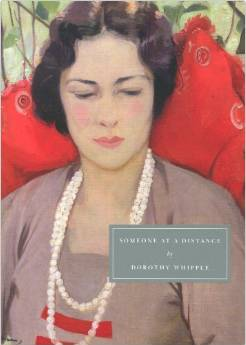
Cover for Someone at a DistanceBest Book of the Week!
I would normally not give away something important that happens well into a novel, but the book blurb openly presents it as the novel’s central conflict. The Norths are an affectionate and happy family with little to discontent them in post-World War I England. Avery enjoys his work as a partner in a publishing firm and is a loving husband and father. He dotes on his daughter Anne especially. Ellen loves her family and her garden. Although she perhaps does too much for her family, she enjoys it. Hugh is serving his term in the army but can’t wait to get out and work at his father’s firm. Fifteen-year-old Anne loves her family and especially her horse.

The only small annoyance in the family’s life is Avery’s mother, who is critical and discontented, wanting more attention than the busy family can provide. But she soon solves her own problem by hiring a companion, a French girl named Louise Lanier.

Louise is a selfish and discontented young woman who is fleeing the end of an affair in which she was felt to be socially inferior to her lover and unworthy of marrying him. Eventually, she sets her sights on Avery, heedless of any destruction she may wreak with her harmful intentions and toxic personality.

I spent the first half of this novel entranced by this perceptive and layered novel and the last third in tears. The characters are wonderfully realized. Perhaps Louise’s character lacks a little nuance, but we have all met people who are able to justify their own bad behavior to themselves. This is a great book that should have had more attention since it was written in the 1930’s.

Related Posts

The Watch Tower

A View of the Harbour

The Travelling Hornplayer

Day 685: A Thousand Acres

Cover of A Thousand AcresBest Book of the Week!
A Thousand Acres is a powerful novel set mostly in 1979 rural Iowa. It evokes a completely realized world that is complex and secret.

Ginny Smith has lived on the family farm all her life. Her husband Ty farms alongside her father, Larry Cook, and she and Ty live on what used to be their neighbor’s property, which Larry has bought to make his thousand acres of land. Ginny’s sister Rose also lives on the farm, and her husband Pete works with Larry as well, a bit less comfortably. The women’s youngest sister Caroline is a lawyer in Des Moines.

Ginny is proud of her family’s accomplishment in creating a fine, well-run farm out of the swampland her great-grandparents bought sight unseen. It soon becomes clear that the farm and the relationship to the land is the most important thing to her family—to all of the families in the area.

At a local barbecue, Larry makes an unexpected announcement. He will create a corporation of the farm and hand it over to his three daughters. Ginny, who is mild-mannered, is taken aback and has doubts, but she does not say anything. Rose seems to be enthusiastic. Caroline simply says “I don’t know,” at which point, Larry petulantly cuts her out. When she tries to approach him later, he slams the door in her face.

Harold Clark, another older farmer, has his prodigal son Jess return after an absence of many years. Almost immediately, he begins to favor Jess over his more loyal and hard-working son Loren.

If this all is beginning to sound familiar, it should, for A Thousand Acres is a modern re-imagining of King Lear. This novel, however, turns the original on its head, for we see it from the point of view of the two “greedy” sisters. In fact, Smiley accomplishes a rather clever trick, because while the neighbors and townspeople see events occur that, from their points of view, seem parallel to those of the play, the readers of the novel are conscious of a whole new layer of information, about how two old men lie and exaggerate when they don’t get their way, and how family secrets fuel Ginny’s timidity and Rose’s rage.

This novel presents complicated, flawed characters in a fully realized setting. It is really excellent and thought-provoking.

Related Posts

The All-True Travels and Adventures of Lidie Newton

King Lear

Home