Day 675: Amsterdam

Cover for AmsterdamThe Booker Prize people liked Amsterdam a bit more than I did. Although the shattering last page of McEwan’s Atonement absolutely upended that novel, the same technique did not work as well for this one. Perhaps the problem lies with my having seen McEwan do this several times already.

The novel begins with the death of Molly Lane. Two old friends, both former lovers of Molly, meet at the funeral. Clive Linley is a world-famous composer, and Vernon Halliday is an editor trying to save a floundering newspaper. At the funeral is another of Molly’s former lovers, foreign secretary Julian Garmony, a right-wing bigot whom both men dislike. They all pay stiff respects to Molly’s possessive husband George.

The brush with mortality makes both Clive and Vernon a tad hypochondriac, and they end up exchanging a pledge. But various stresses will soon interfere with their friendship. Clive is struggling to complete what he thinks will be his masterpiece in time for a performance in Amsterdam. And George has offered to sell Vernon some compromising photos of Julian that he found in Molly’s papers. Vernon has to decide whether publication of these photos will result in increased sales or backlash.

This novel is darkly humorous. None of these men is a sterling individual. In fact, they are all morally bankrupt. Clive seems the least at fault for quite some time, but then he does something unforgivable and justifies it as being for his art.

It’s difficult to explain my main criticism without revealing the ending. I can only say that the implications of the final page do not make sense, that there is no way that the character could have known how things would work out. So, I do not think the surprise ending works as well in this case as in other McEwan novels.

Related Posts

Sweet Tooth

The Sense of an Ending

The Child in Time

Day 671: Lila

Cover for LilaBest Book of the Week!
In Lila, wonderful writer Marilynne Robinson returns to the small Iowa town of Gilead, the setting of her previous novels Gilead and Home. In these novels Lila Ames is not much of a presence. She is referred to as the surprising choice of a wife for the elderly, gentle, and educated pastor John Ames—much younger, rough, and uneducated.

Lila has lived almost her entire life on the tramp, ever since Doll stole her away, a neglected, starving, feverish little mite who lived mostly under the table or was locked out of the house. Doll and Lila joined up with a group of travelers lead by Doane, wandering from job to job, and life was just fine until the long, dark days of the Depression and the Dust Bowl. Years later, Lila has stopped outside Gilead and is living in a shack, walking to nearby farms and houses and asking for work.

Lila knows nothing about religion, but on occasion she has been curious about it and was warned away by Doane, who claims all preachers are charlatans. So, one day she ventures into the church. There she sees and is drawn to John Ames, and he to her. Eventually, they marry.

The action of this novel is mostly interior. Lila is tormented by some of the memories of her previous life and feels unworthy of Ames. She is afraid that he may ask her to leave at any minute. All the same, she occasionally wants to return to the freedom of her old life.

Ames, on the other hand, is happy to have Lila’s company, for he has lived alone ever since the death of his wife in childbirth, years ago. He is afraid she will decide to leave him one day.

As with Gilead and Home, this is a quiet novel, characterized by religious discussions as Lila tries to read and understand the Bible. She has no prior relationship to religion, but she has vowed that John Ames’s son will be brought up praying, as his father does. The discussions in Gilead between the two pastors were way over my head, but these are more fundamental.

I am not particularly interested in religion, but what I like about Robinson’s books is that they are about good people trying to be good. That is a refreshing theme these days. And the writing is superb, the subject matter approached with delicacy. I can’t recommend any book by Marilynne Robinson strongly enough.

Related Posts

Gilead

Home

Housekeeping


Day 668: The Sea

Cover for The SeaIn this contemplative novel, recently widowed Max Morden returns to the small Irish seaside resort where his family used to live when he was a boy. It was there he met and became fascinated by the Grace family, much above his own in social strata.

Max’s memories are assisted by his residence as a boarder at The Cedars, the house where the Graces stayed that summer. The Cedars has become a boarding house that is now managed by Miss Vavasour.

The young Max became the companion of the Grace’s oddly feral twins, Chloe and Myles. They are two very unpleasant children who torment their teenage nanny Rose. At first infatuated with the voluptuous Mrs. Grace, Max eventually turns his attentions to the spiky Chloe.

Through his memories of the extraordinary events of that summer and his feelings about his wife’s death, Max eventually gains some self-knowledge. Looking back, he also gains some understanding of the dynamics between people that he did not grasp as a child.

The Sea is stylistically exquisite, with its sussurating and rhythmic prose a striking meditation on death, grief, and memory. Although I guessed one of its revelations much earlier than intended, that did not take away from the power of the prose.

Related Posts

The Sense of an Ending

Bridge of Sighs

Nora Webster


Day 664: Miss Marjoribanks

Cover for Miss MarjoribanksBest Book of the Week!
It’s not often that I discover a delightful novel by a classic author whose works I am unfamiliar with. But that’s the case with Miss Marjoribanks. It is a wonderfully ironic comic novel about middle class mores with an exasperating and ultimately lovable heroine.

We first meet Lucilla Marjoribanks at the age of 15. Her long-ailing mother has died, and Lucilla rushes home vowing to be a comfort to her father. Dr. Marjoribanks, who has been looking forward to a comfortable bachelor existence, wastes no time in sending her back to school.

Four years pass, and Miss Marjoribanks returns from her tour on the continent determined to devote herself to her father for the next ten years, suggesting that by then she may have “gone off” a little and will start looking for a husband. Lucilla is a young woman of energy and complete self-confidence who is determined to be a force in Carlingford society. But first she must deal with a proposal from her cousin, Tom Marjoribanks. She loses no time in dispatching him to India.

Dr. Marjoribanks watches in amusement as Lucilla calmly removes the reins of his household from his redoubtable cook Nancy and begins to take control of Carlingford society. Her first project is to begin a series of “evenings” every Thursday.

As Lucilla deftly and with dauntless good humor manages the affairs of her friends, somehow none of a series of eligible men ever come up to scratch with a marriage proposal when her friends expect them to. But Lucilla insists she will dedicate herself to her father’s happiness at least until she is 29.

Although Lucilla, with her managing ways, could easily be a figure of satire, I grew to admire her and like her friends and neighbors, who are fully realized even though  this book is the fifth in a series and I have not read the others. We even feel sympathy for Barbara Lake, the contralto whose voice goes so well with Lucilla’s that Lucilla invites her to her evenings. Barbara, from a lower strata of society, sees Lucilla’s actions as condescension and rewards Lucilla’s impulse with spite.

I was hugely entertained by Lucilla’s career and have already started looking for more books by Oliphant. Margaret Oliphant, I find, was once one of the most popular authors of the mid-19th century, and she deserves to be remembered.

Related Posts

Anderby Wold

Good Behaviour

Mrs. Dalloway


Day 663: Pastoral

Cover for PastoralAndré Alexis states that his intention for this novel was to write a modern pastoral. If you’re not familiar with this term, it’s not surprising, for pastoral literature hasn’t been popular for hundreds of years. A pastoral is a work about life in the country, sometimes comparing it to life in the city, showing the pleasures of a simpler existence.

Alexis tells us explicitly, though, that his protagonist, Father Christopher Pennant, expects the rural town of Barrow, Ontario, to be simple but finds it is not. Indeed, events force him through a crisis of faith.

Father Pennant is a little disappointed by his posting to his first parish of Barrow but is determined to do a good job. There he meets a young woman, Liz Denny, who has just discovered her fiancé is sleeping with another woman. Another parishioner with a problem is Father Pennant’s caretaker, Lowther Williams, 62 and certain he will die at 63. He has set Father Pennant a test to determine if he is the proper person to attend to his affairs after his death.

This is an unusual novel and I’m not quite sure what I think of it. Although I enjoyed Father Pennant’s journey, his conclusions about faith are not definitive and we’re not sure where he will end up. I was also interested in whether Liz would decide to marry Rob after all.

The novel takes place in an indefinite time period that could be any time from the 50’s on. If it is in the present, the town seems old-fashioned. A detail that struck me as odd is that at least three characters keep prayer books with them, and these characters are not religious. Now, things could be different in rural Canada, but as far as I know, I have never even seen a prayer book outside church and don’t know anyone who has one. So, I had to wonder whether something was meant by it.

The descriptions of nature are truly gorgeous. Father Pennant spends more and more of his time exploring it and wonders during his struggles if the study of nature may not be enough for anyone. The novel is written with a gentle humor and sense of irony, and the language is truly lyrical at times.

By the way, my copy is an expensively produced paperback, very nicely printed on thick, high-quality paper. Unfortunately, the last 8 or 10 pages are out of order, which was momentarily confusing.

Related Posts

The Hour I First Believed

Gilead

Religion and the Decline of Magic

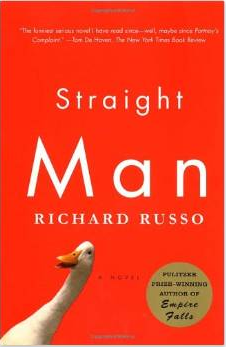
Day 660: Straight Man

Cover for Straight ManSo far, I have enjoyed Empire Falls the most of Richard Russo’s novels, and Straight Man is at least also set in the rust belt, which he depicts so well. However, rather than being a depiction of small-town life, it is a rich spoof of academia. My husband, formerly the spouse of an academic, tells a joke, probably an old one, that the reason politics in academia is so vicious is that the stakes are so low. That these battles are being fought not on the campus of a great university but of an obscure college in a small Pennsylvania industrial town makes it more ironic.

William Henry Devereux, Jr., (Hank) sees himself as a bit of a rebel, although his rebelliousness mostly confines itself to snarky comments in faculty meetings and satiric opinion pieces on academic life in the local paper. He was once the author of a decently reviewed novel, but now he finds himself the interim head of the English department at a small Pennsylvania college.

Hank has been ignoring rumors that the college is to undergo stringent cuts on the grounds that the same rumors make the rounds every April. The faculty members in his department are constantly embattled, most recently over the job search for a new department head. Hank is better at enraging them than smoothing things over, and at the beginning of the novel suffers a wound to his nose when a professor hits him with her spiral notebook.

Maybe Hank wouldn’t have gotten himself into quite so much trouble, but his wife Lily is out of town on a job interview, and he is preoccupied by a possible kidney stone when he begins taking the rumors seriously. One of the reasons he has discounted them is that the college is breaking ground on an expensive new technology center and he can hardly believe they could claim financial problems requiring layoffs at the same time.

Such is the case, he finds, and with his department members all worried about their jobs, he chooses the groundbreaking ceremony to stage a protest, claiming he will kill a duck (which is in reality a goose) from the campus pond for every day he doesn’t get his budget. Soon he finds himself a minor media celebrity and a suspect of campus security when someone actually does kill a goose. In the meantime, his daughter’s marriage is imploding, he keeps imagining his wife is having an affair with the dean, his scholar father who years before deserted him and his mother for a graduate student is returning, and an attractive daughter of a colleague might be trying to seduce him. The events of this week force him to examine his relationship to his own life.

I found this novel both a bit over the top and amusing, as well as true. If I have a criticism, it is to wonder about some modern male authors’ fascination with bodily functions, and why they seem to think they’re funny. But I guess I can’t constrain this complaint to just novelists, because I’ve been staying away from comic movies for years for the same reason.

Related Posts

That Old Cape Cod Magic

Lucky Jim

The Bridge of Sighs

Day 657: The Fish Can Sing

Cover for The Fish Can SingÁlfgrímur is an orphan boy who has always known life in a simple turf cottage with his foster parents, Björn of Brekkukot, whom he calls Grandfather, and Grandmother. His grandfather lives a life of integrity, with no interest in ambition. Words are so important in their household, Álfgrímur explains, that they are only spoken to hide things.

Álfgrímur grows up with his only ambition to live in his grandparents’ cottage and fish for lumpfish with his grandfather. But his grandmother has other ideas, so when he is old enough, he goes reluctantly off to school.

Most of this novel is an account of everyday life at Brekkukot, peopled by the peculiar residents of the grandparents’ loft, some permanently there and others passing through. These people are all good but eccentric. For example, there is the Superintendent, whom Álfgrímur as a boy thinks is the superintendent of the entire city of Reykjavic but turns out to be in charge of the public toilets at the harbor.

Hanging on the wall of their neighbor Kristín’s cottage is the picture of a young man. When Álfgrímur asks about him, his grandparents answer “He was a nice little boy, that Georg,” Kristín’s son. But Georg is now Garðar Holm, a famous Icelandic opera singer. Garðar Holm seldom comes home. When he does and his patron schedules a concert, he never appears, but he does take an interest in Álfgrímur. Álfgrímur can sing and he wants to learn to sing “one true note.”

In this novel, Laxness is interested in exploring the tension between fame and obscurity, but he is also interested in the importance of morality and honest dealing. Serious as its intent is and primitive as are the characters’ surroundings, this is not at all a grim novel. It is told with a wry and ironic sense of humor and is full of colorful characters. With Laxness, you can be sure that there is plenty going on beneath the surface of things.

Related Posts

Independent People

Cod: A Biography of the Fish That Changed the World

The Beautiful Mystery

Day 652: Amy and Isabelle

Cover for Amy and IsabelleIn 60’s small-town New England, Isabelle Goodrow and her 16-year-old daughter Amy are having a tough summer. They are together all the time because Amy has a job in the mill office where Isabelle has worked for years, but they are presently resentful of each other and barely speak.

Although Amy has been harboring typical teenage feelings toward her mother, their problems go back a lot farther. Some of them have roots in how Isabelle has represented herself in town since she moved there. She has some social ambitions and thinks she is more refined than the other women who work in the office. Quietly in love with her married boss for years, she is concerned about how she and her daughter are perceived. She also has secrets.

But their immediate problems begin earlier that school year, when insecure Amy thinks she is in love.

This is my third Strout novel, and I like how observant she is of life in these small, conservative New England towns. She presents us with situations that are dramatic but common and has us examine the lives of ordinary people. Amy and Isabelle are hard on each other, as mothers and daughters can be, but they are also able to learn from their mistakes, even if the lessons are painful.

Related Posts

Olive Kitteridge

Giving Up the Ghost

Empire Falls

Day 639: The Children’s Crusade

Cover for The Children's CrusadeIt took me awhile to figure out the focus of The Children’s Crusade, which for some time just seems to wander backward and forward in time telling the story of a family. This is not really a criticism, though, as I was interested in the story.

It begins when Bill Blair discovers a piece of land outside San Francisco after his time serving in the Korean War. He envisions children playing there, so he buys the property, and eventually he marries and builds a house. He is a pediatrician, and he and his wife Penny have four children: Robert, Rebecca, Ryan, and James.

By the time the older children are nearing their teens, all of the children begin planning a Children’s Crusade. The purpose of the crusade is to try to think of activities that their mother will want to do with them. Although their father is warm and nurturing, their mother is distant and passive-aggressive, wanting, for example, her family to explicitly invite her on outings even though she knows they want her to come and will be disappointed if she doesn’t. When they don’t think to ask her, she stays home. She begins spending more and more time in a shed on the property working on art projects.

It is a usually unacknowledged fact within the family that the addition of James, large, obstreperous, and destructive, proved overwhelming for their mother. He feels this deeply, and it makes him more unruly. Affectionate and caring Ryan, closest to him in age, tries to make up for their mother’s neglect, but he is only three years older than James. Robert and Rebecca spend a lot of time keeping James out of their mother’s hair.

http://www.netgalley.comAs adults after their father’s death, the four siblings are forced to consider selling the house. No one originally wanted to sell, so they have it rented out, but then James forces the issue when he needs the money to make a home for his married girlfriend and her children. Even though Bill and Penny Blair were separated for years before Bill died, Penny must agree to the sale of the house. This arrangement forces James to talk to his mother for the first time in years after one of her art projects proved difficult to forgive.

The novel moves between the points of view of each of the siblings, only briefly touching on that of the parents. It is absorbing and well written and struck some chords with me. Its examination of the complexities of human relationships is thought-provoking.

Day 636: Their Eyes Were Watching God

their-eyes-were-watching-godTheir Eyes Were Watching God was my selection for Classics Spin #8 for the Classics Club! Here is my review.

I had a complex reaction to this novel. On the one hand, I liked its protagonist, Janie Crawford, and was interested in her struggle to define her own identity. On the other hand, I didn’t much like any other characters in the novel. On the one hand, Janie’s struggles to define herself make the novel a landmark feminist book; on the other hand, Janie defines herself through her choice of husbands and her relationships to them. On the one hand, I don’t usually like tales in the vernacular; on the other hand, both the educated omniscient narrator and Janie’s vernacular third/first-person narration have moments of entrancing imagery. And speaking of that imagery, for a book written in 1937, the novel is occasionally startling in its sexuality.

A woman in her 40’s, Janie has recently returned home without Tea Cake, the man she left with. Having departed in some scandal, a well-off widow with a much younger, penniless man, she is figuring in a lot of talk. So, when her friend Pheoby comes to see her, Janie decides to tell her the story of her life.

Janie was raised by her grandmother in West Florida after her mother had her as a result of rape and then disappeared. Janie is a light-skinned black woman with long beautiful hair, and her appearance features in much of her story. When she is still an extremely innocent 16-year-old, her grandmother marries her off to a much older man, trying to give her stability. Janie thinks that marrying will make them love each other, but she is soon disillusioned and finds he is inclined to treat her like a work horse.

Then she meets Joe Stark, a flashy well-dressed man who seems to be going somewhere, and is. She leaves with him and they settle in an all-black town in “the new part of Florida,” where Joe soon becomes the mayor and store owner. But he defines his marriage by what he gives her and expects her to maintain a certain decorum as his wife, not allowing her to participate in many of the small town amusements. Also, he treats her with disrespect, publicly ridiculing her.

After Joe dies, under circumstances that have already started talk, Janie meets Tea Cake and eventually leaves with him to work in the Everglades. Although Tea Cake is in some ways an improvement over her other two husbands, there are some events that disturbed me. First, he steals her $200 and comes back with $12, but she is only upset when she thinks he has left her. Next, he earns it back but makes her put it in the bank and promise to live off what he can provide, a classic play for dominance that ignores the fact that she soon has to go to work next to him, manually in the fields. Finally, he beats her up once, not because of anything she does but because he wants to show everyone that she belongs to him.

Hurston was a trained ethnographer, and her fiction details a way of life in small-town Florida of her time. I found many of the details interesting. A fascination with skin color and Caucasian features is one theme that comes up several times. In fact, when Tea Cake beats Janie, instead of provoking a discussion of the fairness of the beating, the people are more fascinated by Janie’s skin being fair enough that they can see the bruises, which makes the other men envious.

Janie is often viewed harshly and unfairly by others. But it is part of her growing self-awareness that she doesn’t care. Although to me she sometimes seems too passive in her relationship to men—her gentle response to Tea Cake’s beating is seen as a good thing—she is otherwise a strong and resourceful heroine.