Day 1004: Half-Blood Blues

Cover for Half-Blood BluesIn 1939 Paris after the German occupation, Sid Griffiths and the members of the Hot Time Swinger’s American Band have just finished cutting a record when Hiero Falk, German but black, is picked up by the Gestapo and never seen again. In 1992, Falk, now considered a jazz legend on the basis of that one recording of the “Half-Blood Blues,” is being honored with the opening of a documentary in Berlin. Sid quit playing years ago, but Chip Jones, another member of the band, talks him into attending.

Chip has been Sid’s frenemy since childhood. He’s a great musician, but he’s also a liar. When he and Sid get up at the opening to talk about Hiero, Chip blindsides Sid with terrible lies about him and Hiero to the audience. The problem is, Sid did do something shameful to Hiero, just not what Chip accuses him of.

After the presentation, Chip talks the reluctant Sid into traveling to Poland. He has found out Hiero is alive and has even corresponded with him. As the two travel by bus into Poland, Sid thinks back to the events of 1939.

This novel is written in African-American vernacular that sounds fairly modern, even for the part from World War II. It takes a little getting used to, although I am not sure if it is accurate for the time. Certainly, the novel effective re-creates the feeling of the time and place, and the precarious existence of these young musicians.

This novel was on both my Walter Scott Prize and Man Booker Prize lists. It was another book that I may not have chosen on my own but that I enjoyed reading.

Related Posts

Suite Française

In the Garden of the Beasts

The Good Lord Bird


Day 995: The Promise

Cover for The PromiseSeveral years ago, I read Erik Larson’s Isaac’s Storm, a nonfiction account of the terrible Galveston hurricane and flood of 1900. So, when one of the books on my Walter Scott Prize list turned out to be set in that time and place, I really wanted to read it. It did not disappoint.

Catherine Wainwright has behaved badly, and the result is a scandal that has resulted in her ostracism from her home town of Dayton, Ohio, and cost her livelihood as a performing pianist. In desperation, she writes to an old friend, Oscar Williams, who is a dairy farmer on Galveston Island. Although she has always considered herself his social superior, years ago he proposed to her. She did not accept him, but he is now a widower with a young son. He proposes again and she accepts. She has barely enough money to get to Galveston.

Nan Ogden is a much less sophisticated woman. She was the best friend of Bernadette, Oscar’s wife, and promised her she would take care of Andre, Oscar and Bernadette’s son. Truth be told, she has her own feelings for Oscar. Until Catherine appears, she has hopes that some day she might be Oscar’s wife. Instead, she finds herself a housekeeper for a woman who can barely boil an egg.

We don’t like Catherine at first, but she quickly grows on us as she develops more empathy for other people. As Catherine, Oscar, Andre, and Nan try to sort out their various feelings and relationships, the tension in the novel builds toward the storm. Then the novel becomes truly riveting.

The Promise is especially strong in its sense of place. I’ve been to Galveston when it was so hot I wondered how anyone could live there before air conditioning, let alone wearing corsets and tight clothes. Weisgarber really makes you feel the heat and stickiness.

Related Posts

The Tilted World

The Son

The Johnstown Flood

Day 958: Merivel: A Man of His Time

Cover for MerivelIt wasn’t until I started reading Merivel for my Walter Scott prize project that I realized it was a sequel to Rose Tremain’s better-known novel Restoration. I hadn’t read Restoration in 20 years, but I decided not to reread it first. I only remembered that it was about a doctor who got caught up in the debaucheries of the court of Charles II.

Merivel is a picaresque novel, like its predecessor. In its bawdy exuberance, it reminds me a bit of Tom Jones or Tristam Shandy. It begins in 1683, when Robert Merivel is living alone on his estate, an older man suffering from melancholy. His young daughter Margaret spends much of her time with the neighbors, who have four daughters. He is lonely and feels his life has had little purpose. He discovers his original manuscript (presumably the text of Restoration), which he refers to as the Wedge, but he doesn’t have the energy to read it.

On a whim, he decides that since Margaret is going on a trip with her friends to Cornwall, he will journey to the court of Louis XIV in Versailles and offer his services as a physician. To do this, he gets a letter of introduction from Charles II.

It is difficult to describe the plot of this novel. It doesn’t have a central concern except the feeling of its hero of having accomplished nothing. Merivel has many adventures, including falling in love with a woman he meets at Versailles and dueling with her husband, but they are all related in a semi-comic, mocking manner. Merivel, who seems ready to fall into every folly, is a sort of hapless anti-hero who hasn’t grown up much from the first novel.

Behind the scenes, we see that England is faltering. The poor are getting poorer as the court indulges itself. Merivel, who remains aware of the plight of others, can’t help observing that Charles II seems to feel no responsibility for this. Although this novel is not one of my favorites on the Walter Scott Prize short list, it certainly seems to reflect the time period in which it is set.

Related Posts

Viper Wine

The Sun King

The Nature of Monsters

Day 953: The Glass Room

Cover for The Glass RoomThe Glass Room is one of the books I’m reading for my Walter Scott Prize project. The novel is inspired by a real house in the Czech Republic designed by Mies van der Rohe. Most of the reviews of the novel, as well as the novel itself, have spent some time describing this house, and although architectural elevations appear before each section of the book, it helps to look at the pictures online when you’re trying to visualize the house.

Liesel and Viktor Landauer are recently married and have decided to build a modern home on a piece of property given to them by Liesel’s parents in the newly formed country of Czechoslovakia. Viktor wants a house that is open and will have no secrets, one of the ironies of a plot with many that I started to think of as mirrors. Viktor is excited at the beginning of what he sees as modern, changing times in the formation of the new country. But of course Czechoslovakia will not be in charge of itself for long, and in fact now no longer exists. Then we have the irony of the house itself, built for no secrets, that harbors many.

Viktor and Liesel’s marriage and day-to-day life are hardly at all the focus of this novel. We see Viktor getting a little annoyed at the depth of Liesel’s involvement with building and decorating the house, but otherwise Mawer actually spends very little time on them together. Instead, he focuses on their relationships with other people, Viktor’s with his mistress Kata and Liesel with her friend Hana. But World War II looms ever closer and eventually the family must leave the country, as Viktor is Jewish.

The book is divided almost exactly in half, the first half devoted to the building of the house and its existence as a family home. The second half explores its use by the different political entities that take it over, when it is never a family home, another mirror. First, it is a Nazi laboratory for attempting to identify physical characteristics of Jews and Slavs. During this time, Hana gets involved in a dangerous affair with one of the scientists. Next, it is a horse stable for Russian cavalry, then a physiotherapy lab for polio victims, and finally a museum.

The huge windowed glass room that makes up the living room, dining area, sitting area, and music room has at its heart a stone wall made of onyx. In the evening sunshine this wall glows and colors the room bright red. I think this is a metaphor—the clean, modern, uncluttered structure, one that may seem cold, is taken over by the unanticipated heart of the house, this red, for passion. I’m saying this clumsily, but one of Mawer’s focuses is the eroticism that is repeatedly evoked in these surroundings, not between Viktor and Liesel, but between other couples. At first, I was confused by why we know almost nothing about Viktor and Liesel together but dwell repeatedly on Viktor’s sexual relationship with Kata. But sex is one of the focuses of this novel, one of its mirrors. For example, in the icy surroundings of the lab designed for the most evil of purposes, Hana makes passionate love with Stahl, who later coldly discards her and even betrays her. Also, there is a tension between the openness of the house and a sense of voyeurism.

This novel was definitely not my favorite of the books I’ve read so far for this project. It is called a novel of ideas, but really it is so detached as to be almost cerebral. Yet, we are repeatedly entertained by descriptions of pubic hair or of how Hana’s labia just show beneath it. I found it unsettling and could understand a bit why the original owners of the house refer to the book as “probably pornography.” It is not pornography, of course, but the family is not buying Mawer’s stance that it’s a fictional story about a real house. They think it’s about them. Or perhaps they are afraid people will think it’s about them.

Despite this detachment from the characters, I still found some scenes toward the end of the novel touching. As for the rest, perhaps Mawer wanted to make readers feel like they were voyeurs. (See? Another mirror—the openness of the house versus voyeurism.) I am not sure, but I could have forgone some of the intense sexuality of this novel. There is another book by Mawer on my list, and I can’t say I’m looking forward to it. (Oh, dear, it just won the Man Booker prize.)

Related Posts

A God in Ruins

Snow Country

Death in Venice

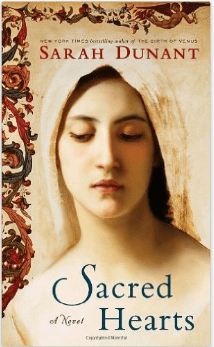
Day 948: Sacred Hearts

Cover for Sacred HeartsBest Book of the Week!
Sacred Hearts is another book I read for my Walter Scott Prize project. Although Sarah Dunant is an author I’ve read in the past with moderate enjoyment, I very much enjoyed her novel about the Borgias, Blood & Beauty.

This novel is also set in Renaissance Italy, in 1570 Ferrara. Dunant begins the book by telling us that in the second half of the 16th century, dowries had become so expensive that roughly half the daughters of noble families were consigned to convents, whether willingly or unwillingly.

Suora Zuana is one of that number. When her professor father died years before, she had nowhere to go and her dowry was small. Yes, dowries had to be paid to convents as well, but they were much smaller than those paid with brides.

Her small dowry has not earned Zuana very many comforts in the convent of Santa Caterina, but she has created a valuable role for herself as a healer and dispenser of remedies. She has managed to bring along many of her father’s books, although some of the most valuable were stolen at his death by his students and peers, and she has greatly expanded the convent’s herb garden. Aside from caring for the convent’s ill, she makes medicines for the bishop and others.

At the opening of the novel, she is on her way to drug Serafina, a novice who has been screaming for days, ever since she was forcibly ensconced in the convent by her family. She is a girl from Milan, so no one in the convent is familiar with her family. Suora Zuana is able to calm her, and later they find she has an angelic voice, which delights the convent choir director.

For the sake of everyone’s peace, the abbess, Madonna Chiara, asks Suora Zuana to take Serafina under her wing rather than handing her over to the novice mistress, Suora Umiliana. So, Zuana begins teach Serafina how to prepare medications. None of the sisters know that Serafina has hatched a plot to escape from the convent with her lover, the musician Jacopo.

What Serafina doesn’t understand, although she probably wouldn’t care, is that this is a politically delicate time for Santa Caterina and for all convents in general. Reforms on the heels of the Counter-Reformation have resulted in a cracking down on convents in some cities. Madonna Chiara fears that the convent’s few liberties will be lost, especially if they have a scandal. Their means of making a living will be removed, their orchestras disbanded and performances disallowed, their books will be confiscated, and they will no longer be allowed outside in the garden. Visitors will only be able to see them behind a grating. This is what has been happening throughout Italy.

On the local front, some of the sisters, led by Suora Umiliana, would like the convent to become stricter in its observances, even though it is already strict. Suora Umiliana is a religious zealot who is fascinated by Suora Magdalena, the convent’s “living saint.” Although Suora Magdalena has long been close to death, when she was younger she had fits of ecstasy and suffered from stigmata. Shortly after Serafina arrives at the convent, Magdalena has the first of her fits in years and speaks to Serafina. Later, when Serafina becomes ill, Umiliana thinks she can use her condition to take over control of the convent from Chiara.

Although I was interested in this novel, it took me some time to become really involved in it. I am revealing more about the plot than I usually would, because the description of the book from the blurb about how Suora Zuana comes to care for Serafina does little to convey the depths and power of this novel. For quite a while I had no idea where it was going and wondered how interested I was, but the novel turned out to be very much worth reading. This is one that really sneaks up on you.

Related Posts

Blood & Beauty

The Malice of Fortune

The Chalice


Day 918: Ghost Light

Cover for Ghost LightBest Book of the Week!
The Irish playwright John Millington Synge was engaged to marry an actress, Molly Allgood, when he died in 1909. Their relationship was of several years’ standing, but it was considered scandalous because of the difference in their ages and stations. Synge was nearly twice as old as Molly, and Molly was from a poor and uncultured family.

Ghost Light is a fictionalized account of this relationship, and O’Connor freely admits to taking liberties with it. The novel begins in 1952, when Molly is an old lady, nearly destitute and living in a cheap rooming house in London. The story follows her for one night and day of her life, during which she remembers the events in her love affair with Synge.

This novel is beautifully and atmospherically written, poetic at times, and partially in different flavors of Irish vernacular. It eloquently tells a story of frustrated love and loss. This is a compelling characterization of Molly and her view of the character of Synge. Ghost Light has been another interesting experience from my Walter Scott Prize list.

Day 911: A Place Called Winter

Cover for A Place Called WinterI read A Place Called Winter for my Walter Scott Prize project, the second book I’ve read for the 2016 list. Like one of the other books I read recently for that project, Arctic Summer, it has as a major theme the main character’s homosexuality. However, I found myself feeling much closer to the characters and more interested in the plot of this novel than I did for Arctic Summer.

At the beginning of the novel, Harry Cane is being treated, or rather mistreated, in an asylum in Canada. Shortly thereafter, he is transferred to an experimental center that treats the patients much more humanely. We understand that Harry has committed a crime, but we don’t know what it is. Between short chapters about his life at the center, we learn what brought him there.

The story of Harry’s life begins when his wealthy father dies. His brother Jack is still in school, and Harry undertakes his education and expenses. Harry is a man of no occupation who feels that he would like one, but he doesn’t know what to do about it. He feels vaguely that he would like to work an estate or a farm but thinks he has to be born to it. A shy man with an occasional stammer, he likes reading and horses. Eventually, he marries a shy woman, Winnie, who informs him on their wedding night that she loves someone else. Nevertheless, he cares for his wife and loves his daughter.

An investment recommendation by his brother-in-law takes a large part of Harry’s inheritance, and Harry and his family are forced to move in with his in-laws. He is an innocent-minded person, so it is not until he meets an actor named Browning that he realizes he is homosexual. He begins an affair with Browning, but then disaster strikes. His affair is exposed to his in-laws by a blackmailer and Harry is forced out of the family. Even his brother Jack, whom he loves, is pressured by his wife not to correspond with him.

Now totally alone, Harry emigrates to Canada and ends up in Saskatchewan, which is just being opened to settlement by the arrival of the Grand Trunk Railway. On shipboard, he meets Troels Munck, who finds him a position where he can learn farming and then helps him purchase a homestead. Munck, though, is a bully, and from the moment Harry meets him, we know that relationship will not end well.

link to NetgalleyHarry finds that a farmer’s life suits him. He settles in, works hard, and makes friends. But we know where he is at the beginning of the book, so the tension builds as we find out how he got there.

Although the time spent to get him to Canada, where the book really captured me, seems a little long, by the time he gets there, we know Harry very well. He is a kind and polite person, but he earns our respect when he finds his niche. Eventually, I became deeply involved in his story. It was also interesting in its details of early homesteading and treatment of mental illness.

Related Posts

Arctic Summer

This Godforsaken Place

Giants in the Earth


Day 887: Fair Helen

Cover for Fair HelenBest Book of the Week!
I was completely entranced by Fair Helen from the first moments of reading it. It’s based on a 16th century ballad, “Fair Helen of Kirkconnel Lea.” Since one of my interests (although sadly not pursued for years) is early ballads of Great Britain, Ireland, and Appalachia, this is a good fit for me.

Harry Langdon is a city man, a scrivener from Edinburgh, the son of a craftsman, so the Borderlands seem wild to him when he answers the summons of his good friend Adam Fleming. Adam feels he needs his friend’s support. He fears his stepfather, his father’s brother, might be trying to kill him. And Harry is surprised to find Adam’s stepfather in the role of Heidsman instead of Adam after the recent death of Adam’s father. (If this sounds familiar, it’s supposed to.)

But Adam is more concerned about the disposition of his love affair. He has fallen madly in love with Helen Irvine, a beautiful and vivacious girl. But the Irvines and the Flemings have been feuding for years. (If this sounds familiar in a different way, it’s supposed to.) Helen’s parents want her to marry Robert Bell, a man with more prospects than a member of an unmade family.

We know from the beginning of the novel that none of this will end well, for we have the text of the ballad before us. And Harry in his old age is telling this story of the most important event in his life and the two people he loved most. For Helen is his cousin, and the two of them were very close as children.

The situation is complicated by the politics of the Borderlands. Harry finds himself summoned by Walter Scott of Buccleuch, a lord who frankly terrifies him (a very different Wat Scott of Buccleuch than the one depicted by Dorothy Dunnet), and is forced to spy on his friends. It becomes clear to him that there have been attempts at murder, if not of Adam, but who is behind them and why?

The novel is written in a mix of Scots and English, with a glossary provided. It is a strong style that goes well with its subject matter. At first, I was thrown off by the footnotes, which are all in the wrong places. I didn’t realize what was going on and thought they were simply non sequiturs. When I figured it out, I spent a lot of time flipping pages, trying to match them up. I honestly wasn’t sure if it was a printing error until I ran across the following passage:

I had aimed to set down plainly only what I witnessed concerning the events at Kirkconnel, to correct the folk haivers and bring some understanding. Yet already I find footnotes, asides and addenda have begun to run wild down the margins and among the lines. I like to think of them as bright wildflowers that border and run through the acres of turnip and kale by which we feed ourselves.

So, Greig is having some fun with us and in more ways than one, although this is in general not a light-hearted novel. It is lovely, though, full of yearning and regret, with a backbone of history for those who are interested.

In my recurring theme of quality printing, I have to say that this is the first modern book with properly bound signatures that I’ve seen in a long while, as opposed to the signatures being hacked off and glued. That’s great, and it means my book will stay together longer. However, the end papers were pasted down carelessly. They have creases, and some of the pages of the book stick out beyond the cover. So, Quercus Books, one big step forward and a few small ones back.

Related Posts

The Candlemass Road

The Disorderly Knights

Turn of the Tide

Day 872: Elizabeth Is Missing

Cover for Elizabeth Is MIssingBefore I begin my review, here is a little bit of news about the Walter Scott Prize for Historical Fiction. Some of you may know that, along with Helen of She Reads Novels, I am attempting to read all the short-listed novels. Today the short list for 2016 was released. To see the list, check out my Walter Scott project page. I have only read one of the novels, but was disappointed, along with other readers, to see that A God in Ruins, which was on the long list, didn’t make the short list.

* * *

Elizabeth Is Missing is—I won’t disguise it—the third book about Alzheimers I’ve read in the last six months. When the book blurb says Maud is forgetful, that’s putting it mildly. After only a few pages of this novel, I wondered why Maud was living alone.

Maud is an old lady who is having trouble keeping track of just about everything. She writes herself reminder notes but loses them. She makes endless cups of tea and forgets them. Her caregiver comes in every morning and makes her lunch and she has eaten it by 9:30. She remembers occasionally that her friend Elizabeth is missing. Elizabeth doesn’t answer her phone and she isn’t home. But no one pays attention to a dotty old lady.

Of course, we realize fairly quickly that Elizabeth isn’t missing, but Maud has a more important mystery in her life. When she was a young girl just after World War II, her older sister Sukey disappeared, never to be seen again. Although Maud’s short-term memory is inconsistent, there’s nothing wrong with her long-term memory, at least not at first, so the more coherent narrative is the time around Sukey’s disappearance. Maud finds the boundaries between the past and present blurring.

I found this novel extremely painful to read at times, even more so than Still Alice. However, it is certainly compelling although not perhaps as realistic as Still Alice is.

One thing that bothered me, although only a bit, is that Maud clearly has all the information she needs to solve her sister’s disappearance, if only she can make sense of it. But she tried to investigate when she was young, and she had the same information then. That she would finally solve it in her current condition is a bit hard to buy. We’re to understand that she found something before the action of the novel, though. At least, that’s what I think happened, since sometimes the narration from the point of view of a confused old woman is a little opaque.

Related Posts

Still Alice

This Is Your Life, Harriet Chance!

Family Furnishings

Day 865: Arctic Summer

Cover for Arctic SummerFrom its description, I thought that Arctic Summer might be one of the most interesting books I’m reading from the Walter Scott Prize list. It is described as a fictional biography of E. M. Forster, particularly leading up to his publication of A Passage to India.

That is certainly the time period the novel covers, and A Passage to India is one of its preoccupations. But the novel spends most of its time on Forster’s obsession with his homosexuality and his desire for sexual experience. As I’m not all that interested in reading about anyone’s obsession with sexuality, this novel was not the best fit for me.

The novel begins in 1912 on Forster’s first trip to India. While he is there, he will visit a good friend, Masood, and he has hopes that his life will open up, particularly in regard to sex. At the age of 33, he is still a virgin, his fear of disgrace holding him back from expressing his sexuality at home. Perhaps in India he will have an experience, maybe with Masood, whom he loves.

Unfortunately, Forster, who goes by Morgan, has a tendency to fall in love with heterosexual men and prefers men from a lower class, so nothing quite works out the way he wishes. Even when he finally has some encounters, years later, what he is actually looking for is love, which he never finds. The novel follows him during the long gestation of his novel about India, back to England, to Alexandria during World War I, and back to India again. During this time, his most significant relationships are with two friends who do not return his feelings.

The novel is extremely well written, and Galgut deeply characterizes Morgan, if not the other characters. It did make me wonder if any person could be so relentlessly focused on sex, although of course he is also lonely. It also made me wonder how, if he really felt this unrelenting focus, he ever got anything written. Certainly this novel makes you feel for Forster—he was a sad man.

Related Posts

The Master

Under the Wide and Starry Sky

Studio Saint-Ex